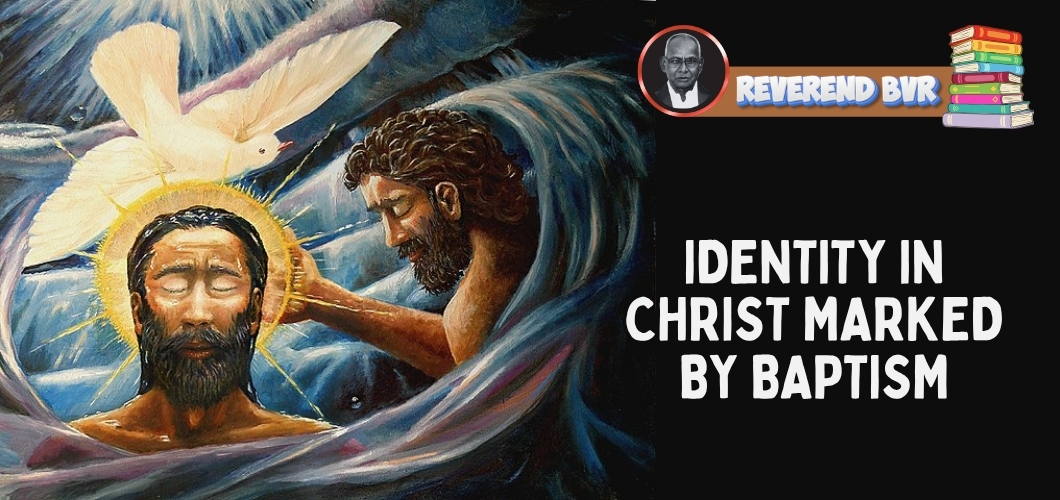
Sermon Title: Identity in Christ Marked by Baptism.
Occasion: 10th Week after Pentecost | Sunday, 9 August 2026. | Baptism Sunday
Scripture Readings: Genesis 11:7–24 | Psalm 32 | Epistle: 1 Peter 3:18–22 | Gospel: John 3:1–8 (Optional: Exodus 14:15–31; 1 Corinthians 12:12–20).
Original Language Reflections (For deeper study, refer to the Table of Hebrew and Greek Terms in Section IX. of the sermon).
Website: www.reverendbvr.com
Theological Thesis
Christian identity is not something we construct but something God graciously bestows. Through the saving work of Jesus Christ, signified and sealed in baptism, believers are brought out of bondage into new creation, united to Christ and one another, and empowered by the Holy Spirit to live as citizens of God’s Kingdom.
Introduction
One of the deepest questions every human being asks is, Who am I? What’s my Identity ?
We answer that question in many ways. We identify ourselves by family, nationality, profession, education, achievements, failures, political views, language, culture, or social status. Yet every one of these identities is fragile. Careers change. Relationships break. Health declines. Wealth disappears. Reputation fades.
The Bible tells us that our truest identity does not begin with ourselves but with God.
We are created in His image, yet our identity has been fractured by sin. Left to ourselves, we seek meaning through self-definition, but Scripture repeatedly shows that genuine identity is received rather than invented.
This Sunday the Church reflects upon one of God’s greatest gifts: Baptism, the visible sign through which God marks His people as belonging to Christ. Baptism is far more than a religious ceremony or family tradition. It proclaims God’s saving initiative, our union with Christ, our incorporation into His Church, and our calling to live as a new humanity.
Today’s readings move from humanity’s confusion at Babel to Israel’s deliverance through the Red Sea, from David’s joy in forgiven sin to Nicodemus’ new birth, from Noah’s flood to Peter’s vision of baptism, and finally to Paul’s picture of the Church as one body. Together they proclaim one magnificent truth: our identity is found in Christ alone.
God Scatters, Yet God Preserves (Genesis 11:7-24):
The passage begins with God’s judgment upon the Tower of Babel. Humanity sought to “make a name for ourselves” (Genesis 11:4). Their ambition was not merely architectural; it was theological. They desired security, glory, and identity apart from God.
The Hebrew word שֵׁם (shem), meaning “name,” represents reputation, identity, and lasting significance. Ironically, those who sought to establish their own name lost the very unity they desired. Their language was confused, and they were scattered across the earth.
Yet the genealogy beginning with Shem immediately after Babel reveals something remarkable. God’s purposes continue despite human rebellion. Divine judgment never has the final word. God preserves the covenant line that will eventually lead to Abraham and ultimately to Jesus Christ.
Babel therefore reveals humanity’s attempt to create identity by human achievement, while the genealogy reminds us that identity comes through God’s covenant faithfulness.
Every generation/age builds its own towers i.e., success, wealth, technology, nationalism, social influence, but none of these can provide lasting identity. Only God gives a name that endures.
The Joy of Forgiven Identity (Psalm 32) :
If Babel exposes human pride, Psalm 32 reveals God’s gracious answer.
David begins: “Blessed is the one whose transgression is forgiven.”
The Hebrew word אַשְׁרֵי (ashrei) means deep flourishing, true happiness, or covenantal blessedness.
Notice that David does not rejoice in his accomplishments but in God’s forgiveness.
Sin distorts identity because it alienates us from God. David vividly describes the physical and spiritual burden of concealed guilt: “My bones wasted away through my groaning all day long.”
But everything changes with confession: “I acknowledged my sin to you…and you forgave.”
Forgiveness restores fellowship, joy, and identity.
This psalm beautifully prepares us for baptism. Before baptism signifies new life, it first proclaims God’s gracious removal of sin. We do not enter God’s family because we are morally impressive; we enter because Christ has forgiven us.
Born from Above (John 3:1-8) :
The Gospel reading introduces Nicodemus, a respected Pharisee and teacher of Israel. He possesses knowledge, influence, and religious credentials. Yet Jesus tells him that none of these can bring entrance into God’s Kingdom.
“Unless one is born again, he cannot see the kingdom of God.”
The Greek phrase γεννηθῇ ἄνωθεν (gennēthē anōthen) carries a beautiful double meaning. It can mean “born again” and “born from above.”
Jesus intentionally allows both meanings to stand.
Christian identity begins not with self-improvement but with divine rebirth.
Nicodemus thinks biologically, Jesus speaks spiritually.
He continues: “Unless one is born of water and Spirit.”
Throughout Scripture, water symbolizes cleansing while the Spirit signifies God’s creative power. Jesus echoes the promise of Ezekiel 36 where God declares that He will sprinkle clean water upon His people and place His Spirit within them.
Baptism therefore points beyond the water itself to God’s transforming action through the Holy Spirit.
Just as no one gives physical birth to themselves, no one creates spiritual life by effort or religious performance. Salvation is God’s gracious work.
Baptism and Union with Christ (1 Peter 3:18-22) :
Peter presents one of the New Testament’s richest baptismal texts.
He first proclaims the Gospel: “Christ suffered once for sins, the righteous for the unrighteous.”
Everything about baptism depends upon Christ’s completed work.
Peter then recalls Noah and the Flood. Just as eight people were brought safely through the waters, believers now experience God’s saving work through baptism.
Peter immediately guards against misunderstanding: “Not as a removal of dirt from the body, but as an appeal to God for a good conscience.”
The outward washing is not magical. Rather, baptism is God’s covenant sign that points to Christ’s death and resurrection.
The Greek word συνείδησις (syneidēsis), “conscience,” reminds us that baptism involves an inward transformation made possible through Christ’s resurrection.
Because Jesus now reigns at God’s right hand with all powers subject to Him, the baptized believer possesses a new identity under the victorious Lord.
Passing Through the Waters (Exodus 14:15-31):
Israel stands trapped between Pharaoh’s army and the Red Sea. From a human perspective, there is no escape. Yet God commands Moses: “Go forward.”
The waters divide; Israel passes safely through. Egypt’s oppressive power is destroyed.
Throughout Christian history, this event has been understood as a profound picture of baptism.
The old life of slavery is left behind and A new covenant journey begins.
Israel does not rescue itself; God alone delivers. Likewise, baptism proclaims that salvation is entirely God’s gracious initiative.
Our identity is no longer determined by the slavery of sin but by God’s redeeming love.
Baptized into One Body (1 Corinthians 12:12-20) :
Paul now shifts from personal identity to communal identity.
He writes: “For in one Spirit we were all baptized into one body.”
Baptism never creates isolated Christians. It creates a family. The Church is not merely an organization but the living Body of Christ.
Paul uses the image of the human body. Feet, hands, eyes, and ears all differ. Yet every member belongs.
Our culture often encourages individualism. The Gospel creates communion. Our uniqueness is not erased but redeemed. Every baptized believer receives a place, a purpose, and a calling within Christ’s body.
Identity in Christ is therefore both personal and corporate. We belong to Christ. We belong to one another.
The Unified Biblical Message:
Taken together, today’s readings tell one continuous story.
- At Babel, humanity attempted to create identity apart from God and found only confusion.
- At the Red Sea, God created a redeemed people through deliverance.
- David celebrated the joy of forgiven identity.
- Jesus declared that entry into God’s Kingdom requires new birth from above.
- Peter proclaimed that baptism points to Christ’s saving death and victorious resurrection.
- Paul reminded believers that baptism incorporates us into one living body.
This movement follows the whole drama of Scripture:
- Creation.
- Fall.
- Redemption.
- New Creation.
Baptism stands within that story as God’s covenant sign that we belong to Jesus Christ.
It does not replace faith; it proclaims God’s gracious promise that salvation is found in Christ alone.
Our baptism continually reminds us that our past no longer defines us, our failures no longer enslave us, and our future is secured in the risen Lord.
The Collect in Conversation with Scripture
The Collect beautifully gathers these biblical themes into prayer. It acknowledges that humanity lives in chaos and bondage apart from Christ, yet God has acted decisively through His Son to redeem and mark His people. Its petition that God would “cleanse our nature from chaos to unity through your Spirit” echoes the movement found across today’s readings—from Babel’s confusion to the unity of Christ’s body, from Egypt’s slavery to the freedom of the Red Sea, from Nicodemus’ uncertainty to new birth by the Spirit, and from Noah’s waters to the resurrection hope proclaimed by Peter.
The prayer also reminds us that baptism is never merely about the past. God’s grace continually renews us, enabling us to “live through your Spirit” so that we may truly perceive and participate in the Kingdom of God. Baptism is both a sign of God’s accomplished salvation and an invitation to daily renewal, faithful obedience, and joyful communion with Christ.
Contemporary Application:
What does this mean for us today?
- First, remember where your identity truly rests. In a world that constantly urges us to define ourselves by achievement, appearance, status, or success, baptism reminds us that our deepest identity is received from God. We belong to Christ before we accomplish anything for Him. This gives both humility and confidence. We neither boast in ourselves nor despair over our failures because our life is hidden with Christ.
- Second, live as people who have passed through the waters. Israel did not cross the Red Sea only to return to Egypt. Likewise, those united with Christ are called to leave behind patterns of sin, resentment, dishonesty, and fear. Baptism is not merely an event to remember but a reality to inhabit. Each day is an opportunity to die to the old self and walk in the newness of life Christ has given.
- Third, cherish the unity of the Church. Paul’s image of the body challenges every form of pride, division, and exclusion. Baptism binds together people of different ages, cultures, languages, backgrounds, and gifts into one family. In a fragmented world, the Church becomes a living witness that reconciliation is possible because Christ has reconciled us to God and to one another.
- Fourth, take courage in suffering. Peter wrote to Christians facing hardship and reminded them that the One into whom they were baptized is the risen Lord who has conquered every power. Our identity is anchored not in present circumstances but in Christ’s victory. The waters of baptism point beyond suffering to resurrection hope.
- Finally, remember that baptism also commissions us for mission. Those who have received new life are sent to bear witness to that life. The world still builds towers in search of identity, security, and meaning. The Church points instead to the crucified and risen Christ, in whom every person may find forgiveness, belonging, and hope.
Conclusion:
The Bible’s story begins with humanity losing its true identity through rebellion, but it ends with God’s people bearing His name forever. Between those two realities stands Jesus Christ, who entered our brokenness, bore our sin, conquered death, and poured out His Spirit so that we might become children of God.
Whenever we remember our baptism, we are reminded not simply of water but of God’s unwavering promise. We have been claimed by grace, united with Christ, and incorporated into His people. Our true name is no longer found in what we have built, earned, or lost. It is found in the One who calls us His own.
Therefore, let us live as those who have been born from above, delivered through the waters, forgiven by grace, filled with the Spirit, and joined together as one body in Christ. For in Him we discover the identity for which we were created and the hope that will never fade.
Let us Pray:
Gracious and everlasting God, we thank You for calling us out of darkness into the marvelous light of Your Son. When we sought to establish our own name, You gave us a new name in Christ. When sin held us captive, You opened a way through the waters of redemption. When our hearts were burdened with guilt, You spoke forgiveness through the cross. By Your Holy Spirit, continue to renew within us the grace signified in our baptism. Strengthen us to live as faithful members of Christ’s body, steadfast in hope, humble in service, joyful in worship, and courageous in witness. May our lives reflect the beauty of Your Kingdom until the day we stand before You, clothed in the righteousness of Christ, in whose holy name we pray. Amen.
Original-Language Word Study Table:
| S.No | Passage | Verse | Hebrew / Greek | Transliteration | Meaning | Theological Significance |
| 1 | Genesis 11:4 | שֵׁם | šēm | Name, reputation, identity | Humanity sought to establish its own identity apart from God at Babel. God’s covenant gives His people a new identity rather than one they manufacture. | |
| 2 | Psalm 32:1 | אַשְׁרֵי | ‘ashrê | Blessed, flourishing, deeply happy | True blessedness comes through divine forgiveness rather than human achievement, preparing the theology of baptismal grace. | |
| 3 | John 3:3 | γεννηθῇ ἄνωθεν | gennēthē anōthen | Born again / born from above | Jesus intentionally employs a double meaning, emphasizing that entrance into God’s kingdom requires a birth whose origin is heavenly, not merely a second beginning. | |
| 4 | John 3:5 | πνεῦμα | pneuma | Spirit, wind, breath | The Spirit is God’s life-giving power, recalling Genesis creation and Ezekiel’s promise of spiritual renewal fulfilled through Christ. | |
| 5 | 1 Peter 3:21 | συνείδησις | syneidēsis | Conscience | Baptism is not ritual cleansing but the believer’s appeal to God through the resurrection of Christ, resulting in a renewed conscience before God. | |
| 6 | Exodus 14:13 | יְשׁוּעָה | yeshu’ah | Salvation, deliverance | Israel’s rescue at the Red Sea becomes the Old Testament paradigm for God’s saving action, later interpreted as a type of Christian baptism. | |
| 7 | 1 Corinthians 12:13 | ἐβαπτίσθημεν | ebaptisthēmen | We were baptized | Baptism incorporates believers into Christ’s one body, emphasizing both union with Christ and unity within the Church. | |
| 8 | 1 Corinthians 12:12 | σῶμα | sōma | Body | Paul’s metaphor highlights the Church as the living body of Christ, where diversity of gifts serves the unity of God’s redeemed people. |
Explanatory Footnotes (Notes for Further Reading) :
- The Babel narrative critiques humanity’s attempt to secure identity independently of God and prepares for the Abrahamic covenant in which God Himself promises to “make your name great” (Gen 12:2).
- Psalm 32 belongs among the classic penitential psalms, emphasizing that forgiveness restores covenant fellowship rather than merely removing guilt.
- The phrase gennēthē anōthen in John 3 intentionally carries the dual meaning of “born again” and “born from above,” underscoring both transformation and divine initiative.
- Jesus’ reference to being “born of water and Spirit” most naturally echoes Ezekiel 36:25–27, where cleansing water and the gift of the Spirit describe God’s promise of covenant renewal.
- Peter’s comparison between Noah’s flood and baptism does not attribute saving power to water itself but to Christ’s resurrection, of which baptism is the covenantal sign.
- The crossing of the Red Sea became an early Christian typology for baptism, most explicitly reflected in Paul’s interpretation in 1 Corinthians 10:1–4.
- Paul’s doctrine of the Church as Christ’s body grounds Christian identity corporately rather than individualistically, emphasizing unity amid diversity.
- Throughout Scripture, God’s covenant consistently precedes human response, demonstrating that salvation is fundamentally an act of divine grace rather than human achievement.
Bibliography:
- Beale, G. K. A New Testament Biblical Theology: The Unfolding of the Old Testament in the New. Grand Rapids: Baker Academic, 2011.
- Carson, D. A. The Gospel According to John. Pillar New Testament Commentary. Grand Rapids: Eerdmans, 1991.
- Fee, Gordon D. The First Epistle to the Corinthians. New International Commentary on the New Testament. Grand Rapids: Eerdmans, 1987.
- Hamilton, Victor P. The Book of Genesis: Chapters 1–17. New International Commentary on the Old Testament. Grand Rapids: Eerdmans, 1990.
- Jobes, Karen H. 1 Peter. Baker Exegetical Commentary on the New Testament. Grand Rapids: Baker Academic, 2005.
- Kidner, Derek. Psalms 1–72. Tyndale Old Testament Commentaries. Downers Grove, IL: IVP Academic, 1973.
- Michaels, J. Ramsey. 1 Peter. Word Biblical Commentary. Dallas: Word Books, 1988.
- Motyer, Alec. The Message of Exodus. The Bible Speaks Today. Downers Grove, IL: IVP Academic, 2005.
- Wenham, Gordon J. Genesis 1–15. Word Biblical Commentary. Dallas: Word Books, 1987.
- Wright, N. T. Paul and the Faithfulness of God. Minneapolis: Fortress Press, 2013.
- Brown, Francis, S. R. Driver, and Charles A. Briggs. The Brown-Driver-Briggs Hebrew and English Lexicon. Peabody, MA: Hendrickson, 1996.
- Danker, Frederick William, ed. A Greek-English Lexicon of the New Testament and Other Early Christian Literature. 3rd ed. Chicago: University of Chicago Press, 2000 (BDAG).
- Koehler, Ludwig, Walter Baumgartner, and Johann Jakob Stamm. The Hebrew and Aramaic Lexicon of the Old Testament. Leiden: Brill, 1994–2000 (HALOT).
© 2025 ReverendBVR.com | High-Academic Sermon Series, 2026.
Content licensed under Creative Commons Attribution-NonCommercial-NoDerivatives 4.0 International (CC BY-NC-ND 4.0). You are free to share, copy and redistribute the material in any medium or format with proper attribution. No commercial use or modifications allowed without explicit permission.
For further sermons and biblical reflections, please visit 🌐 www.reverendbvr.com/sermons
Leave a Reply