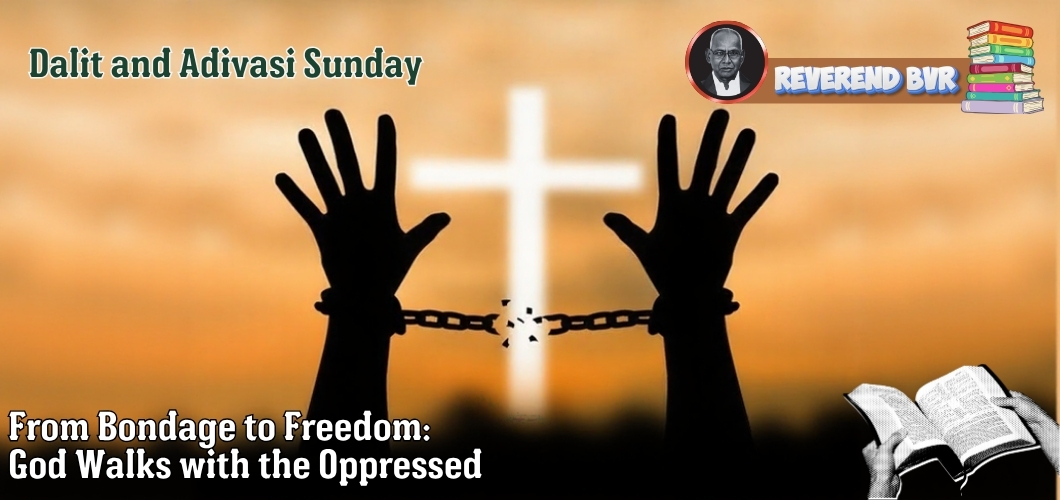
Sermon Title: From Bondage to Freedom: God Walks with the Oppressed.
Occasion: 12th Week after Pentecost | Sunday, 23 August 2026. | DALIT & ADIVASI SUNDAY.
Scripture Readings: Deuteronomy 26:5–11 | Psalm 146 | Philemon 10–18 | John 4:5–14 | Judges 6:11–16 | Acts 10:34–48.
Original Language Reflections (For deeper study, refer to the Table of Hebrew and Greek Terms in Section XII. of the sermon).
Website: www.reverendbvr.com
Theological Thesis: The God revealed in Scripture is the God who remembers the oppressed, restores their dignity, breaks every barrier that enslaves humanity, and calls His redeemed people to become agents of justice, reconciliation, and hope through Jesus Christ.
I. Introduction: Remembering the God Who Walks With His People
Freedom is one of humanity’s deepest longings. People long to be free from fear, injustice, discrimination, poverty, addiction, prejudice, and every system that diminishes human dignity. Yet the Bible reminds us that true freedom is never merely political or social. Genuine freedom begins when God enters human history, walks alongside the oppressed, and restores them into His covenant community.
Dalit and Adivasi Sunday invites the Church to remember precisely this truth. It is not simply a day to acknowledge suffering. It is a day to celebrate the God who sees, hears, remembers, and acts. Throughout Scripture, God consistently identifies Himself with those who are forgotten by society. The God of Abraham becomes the God of enslaved Israel. Jesus intentionally speaks with a Samaritan woman rejected by her community. The Holy Spirit falls upon Gentiles whom many believed were outside God’s covenant. Again and again, God overturns human boundaries to reveal that His kingdom is built not upon privilege but upon grace.
Our Collect beautifully echoes this biblical story. It remembers the God who delivered Israel from Egypt and who liberated the Samaritan woman from social exclusion. It also prays that Christ would free us from every form of bondage. This prayer prepares our hearts to hear the central message of today’s Scriptures: God does not merely rescue people from oppression, He walks with them into a new life of dignity, communion, and mission.
II. God Remembers the Story of the Oppressed (Deuteronomy 26:5–11 & Psalm 146) :
In Deuteronomy 26, Moses instructs every Israelite bringing the firstfruits to begin with a confession: “A wandering Aramean was my father…”
Notice that Israel’s worship begins not with prosperity but with memory.
- They remember slavery before abundance.
- They remember suffering before celebration.
- They remember God’s grace before their own achievements.
- The Israelites were warned never to forget that they were once powerless.
- Their harvest was not proof of their greatness but evidence of God’s faithfulness.
Biblically, remembrance is an act of discipleship. When God’s people forget their own history of deliverance, they easily become indifferent to the suffering of others.
Psalm 146 continues this same vision. The Lord executes justice for the oppressed. He feeds the hungry, He sets prisoners free, He opens blind eyes, He lifts those who are bowed down. These are not occasional acts of kindness. They describe God’s very character. Divine justice is not revenge but restoration. God’s righteousness always moves toward those whose dignity has been denied.
The Church therefore cannot worship the God of Psalm 146 while ignoring people who continue to experience exclusion, discrimination, or poverty. Worship that forgets justice forgets the heart of God.
III. Jesus Crosses Every Boundary (John 4:5–14) :
The Gospel reading brings us to Jacob’s well. No Jewish rabbi would normally seek a conversation with a Samaritan woman.
- She carried multiple layers of exclusion.
- She was a Samaritan.
- She was a woman.
- She came alone.
- She carried a complicated personal history.
- Yet Jesus begins not by condemning her but by asking for water.
The One who created rivers becomes thirsty. The Holy One receives hospitality from the one society rejects. What begins as an ordinary conversation becomes a revelation of God’s kingdom. Jesus offers “living water.”
This living water is more than spiritual comfort. It is the gift of new creation. Just as water sustains physical life, Christ alone satisfies the deepest thirst of the human soul for forgiveness, belonging, purpose, and eternal life.
More importantly, Jesus restores her dignity before He commissions her. She becomes one of the earliest witnesses in John’s Gospel. The woman who arrived carrying shame returns proclaiming Christ to her village.
God’s pattern is unmistakable. Those whom society silences often become powerful voices of the Gospel. The kingdom of God consistently overturns human expectations.
IV. Freedom Produces New Relationships (Philemon 10–18) :
Paul’s short letter to Philemon may appear to concern only one runaway slave named Onesimus.
In reality, it quietly challenges the entire logic of social hierarchy. Paul sends Onesimus back, not merely as property but “no longer as a slave… but as a beloved brother.”
Paul does not argue primarily through political slogans. He transforms relationships through the Gospel.
When Christ becomes Lord, old identities lose their ultimate power. Master and slave become brothers. Social status becomes secondary to baptismal identity.
The Church has often recognized that this letter plants seeds that later contributed to Christian opposition to slavery. The Gospel does not merely improve unjust systems; it creates a new family in which every believer shares equal dignity before Christ.
For communities that continue to experience exclusion, Philemon reminds us that Christian fellowship must never mirror society’s discrimination.
The Lord’s Table leaves no room for superiority.
V. God Calls the Least Expected (Judges 6:11–16) :
The additional Old Testament reading introduces Gideon. Israel is oppressed by Midian. Gideon is hiding in fear. Yet the angel addresses him: “The Lord is with you, mighty warrior.”
Human eyes see weakness. God sees calling.
Throughout Scripture, God’s mission often begins with unlikely people, including Moses the fugitive, David the shepherd, Mary the young village girl, fishermen from Galilee, and Gideon hiding in a winepress.
God’s calling is never limited by social standing.
Those whom the world overlooks often become instruments of God’s greatest work.
VII. God Shows No Partiality (Acts 10) :
Acts 10 marks one of the greatest turning points in the New Testament.
Peter enters the home of Cornelius, a Gentile. Everything Peter had previously assumed about religious boundaries is challenged.
He finally declares, “I truly understand that God shows no partiality.”
Before Peter finishes preaching, the Holy Spirit falls upon the Gentiles. God Himself removes the barriers that people had constructed.
The Church does not create God’s welcome. The Church discovers that God has already gone ahead of it.
Every generation of Christians must ask whether there remain people whom we unconsciously keep at the margins. Acts 10 reminds us that wherever God pours out His Spirit, the Church must open its doors and hearts.
VIII. Christ: Our True Exodus
When we place today’s readings together, one beautiful story emerges.
- Israel is delivered from Egypt.
- The psalm praises God’s justice.
- Gideon is called from fear.
- The Samaritan woman receives living water.
- Onesimus becomes a brother.
- Cornelius receives the Holy Spirit.
Each story points beyond itself. Each anticipates Jesus Christ.
Through His cross and resurrection, Christ accomplishes the ultimate Exodus, bringing deliverance not only from political oppression but also from sin, death, and every power that enslaves humanity.
The greatest bondage is separation from God. The greatest freedom is reconciliation with Him.
Christ therefore creates a new humanity where dignity is restored because every person bears God’s image and every believer belongs equally to His family.
IX. Living as a Community of Freedom
Dalit and Adivasi Sunday is therefore not merely about remembering injustice. It is about becoming the kind of Church that reflects God’s kingdom.
This begins in ordinary ways.
- We examine our hearts for prejudice.
- We reject language that humiliates others.
- We welcome those who feel invisible.
- We listen before we judge.
- We share resources generously.
- We encourage leadership from communities that have historically been marginalized.
- We remember that every ministry of compassion echoes God’s own character.
Freedom also means confronting the hidden bondages within ourselves.
Many are imprisoned by bitterness. Some by guilt. Others by fear, addiction, pride, or hopelessness.
Christ offers living water for every thirsty soul.
The Church cannot proclaim freedom to society while remaining captive to unforgiveness, division, or indifference. Instead, we become a living testimony that God’s grace creates one new family where Christ is Lord of all.
X. Conclusion
The story of Scripture is the story of a God who walks toward the oppressed.
- He walked with Israel through the wilderness.
- He stood beside Gideon in fear.
- He waited beside a Samaritan woman at a well.
- He transformed a slave into a brother.
- He welcomed Gentiles into His covenant family.
- Finally, in Jesus Christ, God walked all the way to the cross so that every captive might know true freedom.
The Church therefore proclaims not merely sympathy for the oppressed but the living Christ who breaks chains, restores dignity, reconciles divided people, and sends His redeemed people into the world as ambassadors of His kingdom.
May we become such a Church, a people who remember God’s mighty acts, welcome every neighbour, and faithfully walk with those whom Christ Himself has come to save.
XI. Let us Pray:
Merciful and Redeeming God, we thank You for remembering us when we were lost, for walking beside us in our weakness, and for setting us free through Jesus Christ. Fill us with the living water of Your Spirit, that we may become people of compassion, justice, humility, and reconciliation. Remove every prejudice from our hearts, strengthen those who suffer, restore dignity to those who have been rejected, and make Your Church a faithful witness to the freedom found in Christ alone. Send us into the world to love as You have loved us, until every tribe, nation, and people rejoice together in Your everlasting kingdom. Through Jesus Christ our Lord. Amen.
XII. Hebrew and Greek Word Study Table
| S.No | Passage | Verse | Original Word | Transliteration | Literal Meaning | Theological Significance |
| 1 | Deut. 26 | 26:7 | עֳנִי | ʿonî | affliction, misery | Israel’s worship begins by remembering oppression and God’s saving response. |
| 2 | Deut. 26 | 26:8 | יָד חֲזָקָה | yād ḥăzāqâ | strong hand | God’s deliverance is powerful, public, and covenantal. |
| 3 | Ps. 146 | 146:7 | עֲשׁוּקִים | ʿăšûqîm | the oppressed | God’s justice is directed toward those crushed by unjust power. |
| 4 | John | 4:10 | ὕδωρ ζῶν | hydōr zōn | living water | Christ gives life, dignity, and Spirit-filled renewal. |
| 5 | Philemon | 1:16 | ἀδελφὸν ἀγαπητόν | adelphon agapēton | beloved brother | The Gospel transforms hierarchy into family. |
| 6 | Acts | 10:34 | προσωπολήμπτης | prosōpolēmptēs | one who shows partiality | God rejects caste, ethnic, and social favoritism. |
XIII. Explanatory Footnotes (Notes for Further Reading) :
- Deut. 26:5-11 presents Israel’s liturgical memory as a confession of dependence upon divine deliverance rather than national self-sufficiency.
- Psalm 146 belongs to the concluding hallelujah psalms and portrays YHWH’s kingship through justice for the vulnerable.
- John 4:5-14 reveals Jesus crossing ethnic, gender, and religious boundaries while offering the gift of life associated with the Spirit.
- Philemon does not provide a modern abolitionist argument, yet its redefinition of Onesimus as a “beloved brother” deeply destabilizes slaveholding logic.
- Acts 10 marks a decisive moment in Luke-Acts where the Gentile mission is confirmed by the direct action of the Holy Spirit.
XIV. Bibliography:
- Barclay, John M. G. Colossians and Philemon. Sheffield: Sheffield Academic Press, 1997.
- Bauckham, Richard. Bible and Mission: Christian Witness in a Postmodern World. Grand Rapids: Baker Academic, 2003.
- Brown, Raymond E. The Gospel According to John I-XII. Anchor Bible 29. Garden City, NY: Doubleday, 1966.
- Brueggemann, Walter. Theology of the Old Testament: Testimony, Dispute, Advocacy. Minneapolis: Fortress, 1997.
- Dunn, James D. G. The Acts of the Apostles. Valley Forge, PA: Trinity Press International, 1996.
- Keener, Craig S. The Gospel of John: A Commentary. 2 vols. Peabody, MA: Hendrickson, 2003.
- Mays, James L. Psalms. Interpretation. Louisville: John Knox, 1994.
- Moo, Douglas J. The Letters to the Colossians and to Philemon. Pillar New Testament Commentary. Grand Rapids: Eerdmans, 2008.
- Tigay, Jeffrey H. Deuteronomy. JPS Torah Commentary. Philadelphia: Jewish Publication Society, 1996.
- Wright, Christopher J. H. Deuteronomy. New International Biblical Commentary. Peabody, MA: Hendrickson, 1996.
- BDAG: Bauer, Walter, Frederick W. Danker, William F. Arndt, and F. Wilbur Gingrich. A Greek-English Lexicon of the New Testament and Other Early Christian Literature. 3rd ed. Chicago: University of Chicago Press, 2000.
- HALOT: Koehler, Ludwig, Walter Baumgartner, and Johann Jakob Stamm. The Hebrew and Aramaic Lexicon of the Old Testament. Leiden: Brill, 1994-2000.
© 2025 ReverendBVR.com | High-Academic Sermon Series, 2026.
Content licensed under Creative Commons Attribution-NonCommercial-NoDerivatives 4.0 International (CC BY-NC-ND 4.0). You are free to share, copy and redistribute the material in any medium or format with proper attribution. No commercial use or modifications allowed without explicit permission.
For further sermons and biblical reflections, please visit 🌐 www.reverendbvr.com/sermons


Leave a Reply