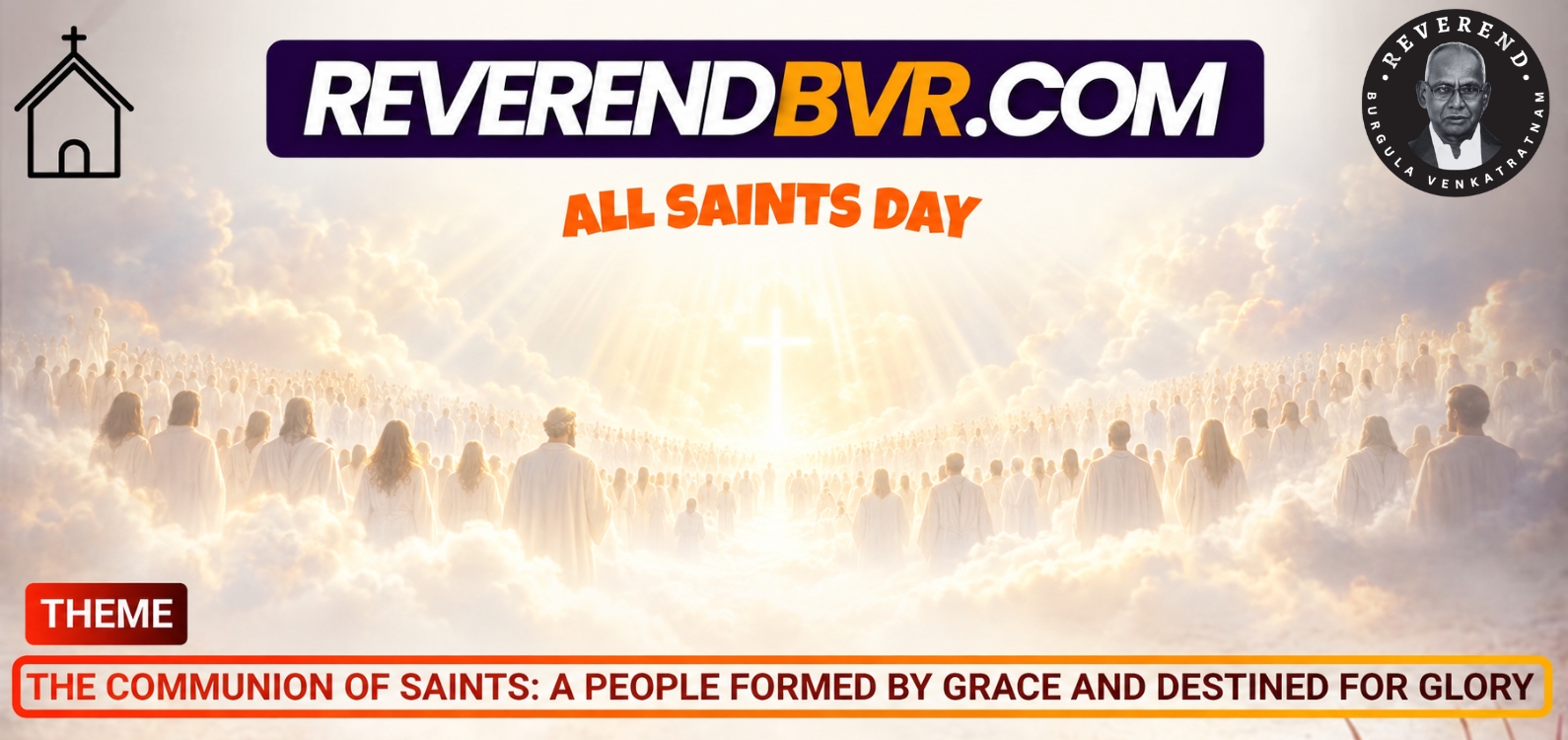
Sermon Title: The Communion of Saints: A People Formed by Grace and Destined for Glory.
Occasion: All Saint’s Day – November 1, 2026.
Scripture Readings: Jeremiah 31:31-34; Psalm 150; Revelation 7:2-4, 9-17; Matthew 5:1-12.
Original Language Reflections (For deeper study, refer to the Table of Hebrew and Greek Terms in Section VII. of the sermon).
Website: www.reverendbvr.com
Theological Thesis : All Saint’s Day celebrates not human religious achievement but the faithfulness of God. The saints are those whom God gathers into covenant, transforms from within, sustains through suffering, shapes according to the character of Christ, and finally gathers into the innumerable worshiping communion before the Lamb.
I. Introduction: Who Is a Saint?
When we hear the word saint, we may imagine extraordinary Christians: martyrs, missionaries, theologians, or people whose holiness appears far beyond ordinary life.
Scripture gives us a wider vision.
A saint is not someone who has become spiritually impressive enough for God. A saint is someone whom God has claimed, forgiven, transformed, and called into faithful communion.
That is why the Collect speaks of God having “bound together all your faithful people in one communion and fellowship in the mystical body of your Son Christ our Lord.”
All Saint’s Day therefore looks backward with gratitude, around us with fellowship, inward with repentance, and forward with hope.
- Jeremiah shows us God writing his covenant upon human hearts.
- Psalm 150 shows us the covenant community praising God.
- Revelation shows us the saints gathered before God’s throne.
- Matthew shows us what the life of those saints looks like here and now.
Together they answer one question: What kind of people is God creating for eternity?
1. Saints Are People Whose Hearts God Transforms (Jeremiah 31:31-34):
Jeremiah preached during one of Judah’s darkest periods. Jerusalem was moving toward destruction, political institutions were collapsing, and exile threatened the people’s future.
Yet into this devastation God speaks: “The days are surely coming… when I will make a new covenant with the house of Israel and the house of Judah” (Jer. 31:31).
The Hebrew word בְּרִית (berit), “covenant,” describes a binding relationship established by God.
The astonishing promise is not merely that God will issue better commandments. God says: “I will put my law within them, and I will write it on their hearts” (Jer. 31:33).
The Torah that had been written upon stone will become inwardly inscribed.
This is crucial for understanding sainthood. Christian holiness is not primarily external religious performance. It begins with divine transformation.
God continues: “I will forgive their iniquity, and remember their sin no more” (31:34).
The communion of saints is therefore first a communion of forgiven sinners.
We do not stand among God’s people because our record is flawless. We stand there because God’s mercy is greater than our failure.
Saints are not people who never needed grace. They are people who discovered that grace was sufficient.
2. Saints Become a Community of Praise (Psalm 150):
Psalm 150 concludes the Psalter with repeated cries of: “Praise the LORD!”
The Hebrew expression הַלְלוּ־יָהּ (halelu-yah) literally means, “Praise Yahweh.”
Trumpet, harp, lyre, tambourine, strings, flute, and cymbals are summoned into worship until finally: “Let everything that breathes praise the LORD!” (Ps. 150:6).
This is more than musical instruction. It describes the destiny of creation.
Human beings were made ultimately to delight in God.
Sin turns us inward. Grace turns us Godward.
The saints therefore reveal what redeemed humanity is becoming: a people whose lives become praise.
Praise is not limited to singing. Forgiveness can become praise. Generosity can become praise. Justice can become praise. Visiting the lonely can become praise. Patiently caring for someone who suffers can become praise.
A holy life is worship carried beyond the sanctuary.
3. Saints Are the Great Multitude God Brings Home (Revelation 7:2-4, 9-17):
John’s Revelation was written to Christians experiencing the pressures of empire, marginalization, compromise, and persecution.
John sees: “A great multitude that no one could count, from every nation, from all tribes and peoples and languages” standing before the throne and before the Lamb (Rev. 7:9).
This is one of Scripture’s most magnificent pictures of the Church.
God’s final community is not restricted by nationality, ethnicity, language, social status, or earthly prestige.
The saints are astonishingly diverse, yet united around one center: the Lamb.
They cry: “Salvation belongs to our God who is seated on the throne, and to the Lamb!” (7:10).
When John asks who these people are, he is told: “These are they who have come out of the great ordeal” (7:14).
The Greek θλῖψις (thlipsis) means pressure, distress, affliction, or tribulation.
Christian hope does not pretend that faith protects us from pain.
The saints know tears.
They have buried loved ones, endured injustice, resisted temptation, carried unanswered questions, suffered rejection, and sometimes paid dearly for faithfulness.
Yet suffering does not have the final word.
John hears this promise: “God will wipe away every tear from their eyes” (7:17).
Notice: God does not merely remove tears abstractly. God wipes them away. It is an extraordinarily tender image.
Christian hope is not simply that suffering ends. It is that suffering ends in the presence of God.
4. Jesus Shows Us What Saints Look Like (Matthew 5:1-12):
If Revelation shows the saints in glory, the Beatitudes show saints being formed on earth.
Jesus begins repeatedly: “Blessed are…”
The Greek word μακάριοι (makarioi) does not simply mean cheerful or emotionally happy. It describes those who live under God’s favor and within God’s kingdom.
And Jesus’ list is surprising.
Blessed are the poor in spirit.
Blessed are those who mourn.
Blessed are the meek.
Blessed are those who hunger for righteousness.
Blessed are the merciful.
Blessed are the pure in heart.
Blessed are the peacemakers.
Blessed are those persecuted for righteousness.
- The world often calls powerful people successful. Jesus calls merciful people blessed.
- The world admires domination. Jesus blesses οἱ πραεῖς (hoi praeis), “the meek”: people whose strength has been surrendered to God rather than weaponized against others.
- The world rewards those who win conflicts. Jesus says: “Blessed are the peacemakers, for they will be called children of God” (Matt. 5:9).
Saintliness therefore does not consist in escaping ordinary human life. It appears within ordinary life whenever Christ’s character becomes visible.
- Every act of mercy anticipates God’s kingdom.
- Every attempt at reconciliation resembles Christ.
- Every refusal to answer hatred with hatred bears witness to another world.
II. One Biblical Story, One Divine Movement:
These four readings form a beautiful progression.
Jeremiah: God writes his covenant upon the heart.
Psalm 150: transformed hearts become lives of praise.
Matthew 5: those lives take the shape of Christ’s kingdom.
Revelation 7: God gathers those people into everlasting communion.
This is the journey of the saints: Grace → Transformation → Discipleship → Perseverance → Glory.
The Collect therefore asks for grace “to follow your blessed saints in faith and holy obedience.”
We do not merely admire previous generations of Christians.
We continue their pilgrimage.
They followed Christ before us.
We follow Christ today.
Others will follow Christ after us.
And finally all generations meet before the throne of the Lamb.
III. Contemporary Application:
All Saint’s Day challenges the modern obsession with individualism.
Christianity is not simply “Jesus and me.” We belong to a people.
Our faith was handed to us through parents, grandparents, teachers, pastors, Sunday-school teachers, missionaries, friends, martyrs, theologians, and countless unnamed believers.
Some saints never wrote books.
Some never stood behind pulpits.
Some simply prayed faithfully, raised children compassionately, cared for aging parents, fed hungry neighbours, forgave deep wounds, resisted corruption, endured illness faithfully, or quietly served Christ for decades.
Heaven remembers lives history may forget.
Therefore ask: Whose faith helped me believe?
Then ask a second question: Whose faith might become stronger because of the way I live?
That may be one of the most important questions of All Saint’s Day.
IV. Conclusion:
- Jeremiah tells us that God writes upon the heart.
- The Psalmist tells us that transformed hearts learn to praise.
- Jesus tells us that transformed lives become merciful, meek, righteous, pure, and peace-making.
- John tells us where the journey ends: “They will hunger no more, and thirst no more… and God will wipe away every tear from their eyes” (Rev. 7:16-17).
All Saint’s Day therefore does not merely tell us where the faithful dead have gone. It reminds us where the whole people of God are going.
- We walk toward that great multitude.
- We walk toward that throne.
- We walk toward the Lamb.
And by God’s grace, we do not walk alone.
V. Closing Prayer:
God of Abraham and Sarah,
God of prophets and apostles,
God of martyrs, servants, mothers, fathers, teachers, children, and all your faithful people,
write your covenant deeply upon our hearts.
Forgive what sin has distorted within us, and shape us according to the likeness of Christ.
When we mourn, give us hope.
When power tempts us, make us meek.
When bitterness rises, make us merciful.
When conflict divides us, make us peacemakers.
When faithfulness becomes costly, give us courage to endure.
Teach us to praise you not only with our lips but through our lives.
Keep us in fellowship with your whole Church on earth and in heaven until, with that innumerable multitude from every nation, tribe, people, and language, we stand before your throne and proclaim:
Salvation belongs to our God and to the Lamb.
And when our pilgrimage is complete, wipe every tear from our eyes and bring us into that unutterable joy prepared for all who love you;
through Jesus Christ our Lord.
Amen.
VI. Original-Language Word Study
| S.No | Passage | Verse | Word | Transliteration | Literal Meaning | Theological Significance | Connection to Theme |
| 1 | Jeremiah | 31:31 | בְּרִית | berit | Covenant | God’s binding relationship with his people | Saints belong to God through grace |
| 2 | Jeremiah | 31:33 | לִבָּם | libbam | Their heart | God’s instruction becomes inward | Holiness begins with transformed hearts |
| 3 | Psalm | 150:1 | הַלְלוּ־יָהּ | halelu-yah | Praise Yahweh | Worship becomes humanity’s proper response | Saints become a praising community |
| 4 | Revelation | 7:14 | θλῖψις | thlipsis | Affliction, pressure | God’s people may suffer while remaining faithful | Saints persevere through suffering |
| 5 | Revelation | 7:15 | σκηνώσει | skēnōsei | Will dwell/tabernacle | God’s presence shelters his people | Communion culminates in God’s presence |
| 6 | Matthew | 5:3 | μακάριοι | makarioi | Blessed, favored | Kingdom blessedness reverses worldly values | Saints embody kingdom life |
| 7 | Matthew | 5:5 | πραεῖς | praeis | Meek, gentle | Strength submitted to God | Holiness rejects domination |
| 8 | Matthew | 5:9 | εἰρηνοποιοί | eirēnopoioi | Peacemakers | God’s children participate in reconciliation | Saints reveal God’s reconciling character |
VII. Footnotes for Personal Study:
- Walter Brueggemann, A Commentary on Jeremiah: Exile and Homecoming (Grand Rapids: Eerdmans, 1998).
- James L. Mays, Psalms (Interpretation; Louisville: John Knox, 1994).
- Craig R. Koester, Revelation: A New Translation with Introduction and Commentary (AYB 38A; New Haven: Yale University Press, 2014).
- Richard Bauckham, The Theology of the Book of Revelation (Cambridge: Cambridge University Press, 1993).
- R. T. France, The Gospel of Matthew (NICNT; Grand Rapids: Eerdmans, 2007).
- Dietrich Bonhoeffer, Discipleship, trans. Barbara Green and Reinhard Krauss (Dietrich Bonhoeffer Works 4; Minneapolis: Fortress, 2001).
VIII. Bibliography:
- Bauckham, Richard. The Theology of the Book of Revelation. Cambridge: Cambridge University Press, 1993.
- Brueggemann, Walter. A Commentary on Jeremiah: Exile and Homecoming. Grand Rapids: Eerdmans, 1998.
- Bonhoeffer, Dietrich. Discipleship. Translated by Barbara Green and Reinhard Krauss. Dietrich Bonhoeffer Works 4. Minneapolis: Fortress, 2001.
- France, R. T. The Gospel of Matthew. New International Commentary on the New Testament. Grand Rapids: Eerdmans, 2007.
- Koester, Craig R. Revelation: A New Translation with Introduction and Commentary. Anchor Yale Bible 38A. New Haven: Yale University Press, 2014.
- Mays, James L. Psalms. Interpretation. Louisville: John Knox, 1994.
© 2025 ReverendBVR.com | High-Academic Sermon Series, 2026.
Content licensed under Creative Commons Attribution-NonCommercial-NoDerivatives 4.0 International (CC BY-NC-ND 4.0). You are free to share, copy and redistribute the material in any medium or format with proper attribution. No commercial use or modifications allowed without explicit permission.
For further sermons and biblical reflections, please visit 🌐 www.reverendbvr.com/sermons
Leave a Reply