
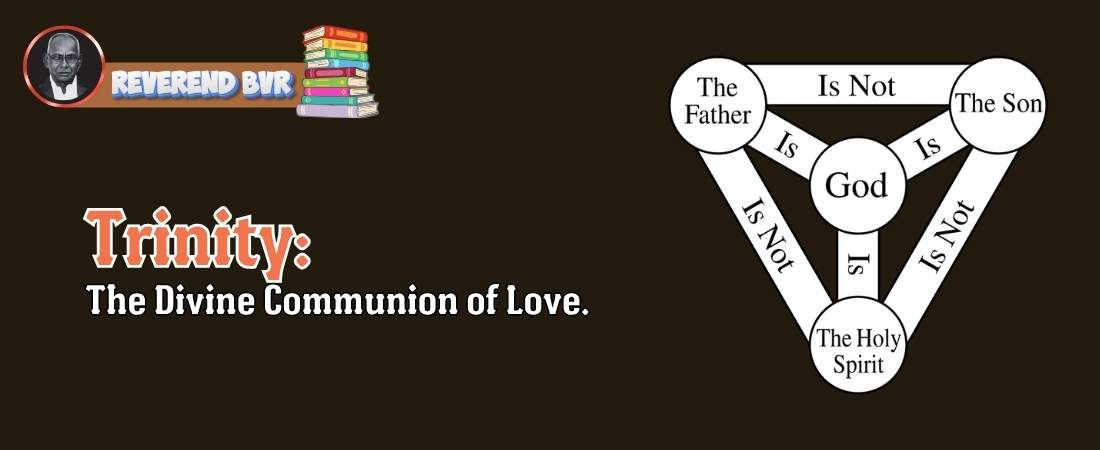
Sermon Title: Trinity: The Divine Communion of Love.
Occasion: Trinity Sunday, May 31, 2026.
Bible Readings: Isa. 48: 12-17 | Psalm 33 | Eph. 1: 3-14 | John 3: 8-16 | Num. 6: 22-27 / Rom. 1: 1-10.
Original Language Reflections (For deeper study, refer to the Table of Hebrew and Greek Terms in Section VI. of the sermon).
Website: www.reverendbvr.com
Theological Thesis: The doctrine of the Trinity is not an abstract formula but the living revelation of God as eternal communion of love—Creator, Redeemer, and Life-Giver, who draws humanity into divine fellowship. Across Scripture, the Triune God is revealed as One who creates in love, redeems through self-giving grace, and sustains life by the Spirit, inviting the world into this communion for healing, blessing, and hope.
Introduction: Beyond Arithmetic, Into Relationship
Trinity Sunday does not invite us to solve a mathematical puzzle: three equals one, but to enter a mystery of love. Scripture never defines the Trinity philosophically; instead, it narrates God’s saving action. The Father calls, the Son redeems, and the Spirit gives life not as separate agents, but as one divine movement of love.
The Collect captures this beautifully: “O Triune God, we thank you for the immense love that creates, sustains, protects, and guides us.”
Creation, redemption, and sanctification are not isolated works; they are the single outpouring of God’s triune love toward the world.
I. The Eternal God Who Calls and Teaches (Isaiah 48:12–17)
Isaiah speaks to a people in exile: fractured, disillusioned, and uncertain of God’s nearness. Into this despair comes a divine self-identification: “I am the First, and I am the Last.” (Isa 48:12)
God reveals Himself as the One who spans all time, faithful despite Israel’s unfaithfulness. Yet this sovereign God does not remain distant. He declares: “I am the LORD your God, who teaches you for your good, who leads you in the way you should go.” (v. 17)
Here we glimpse the relational nature of God not merely ruler, but teacher and guide. Christian theology later recognizes this guiding presence as the work of the Spirit, proceeding from the Father, leading God’s people into life.
Trinitarian Insight: God’s eternity (First and Last) and God’s intimacy (teacher and guide) belong together. Divine transcendence never cancels divine communion.
II. Creation Sustained by the Word of the LORD (Psalm 33)
Psalm 33 celebrates God’s creative speech: “By the word of the LORD the heavens were made, and all their host by the breath of his mouth.” (Ps 33:6)
The psalmist uses two key Hebrew terms:
- דָּבָר (dābār) means word, effective speech
- רוּחַ (rûaḥ) means breath, wind, spirit
Creation itself is Trinitarian in texture:
- The LORD who wills,
- The Word that creates,
- The Breath/Spirit that animates.
This is not speculative theology, it is worshipful recognition that the world exists because God delights in giving life.
Pastoral Word: In an age anxious about ecological collapse and human power, Psalm 33 reminds us that creation is sustained not by human control but by divine faithfulness.
III. Chosen in Love, Drawn into Divine Purpose (Ephesians 1:3–14)
Ephesians offers one of Scripture’s richest Trinitarian passages. Paul blesses God for a salvation that unfolds in divine harmony:
- The Father chooses us “before the foundation of the world” (v. 4)
- The Son redeems us “through his blood” (v. 7)
- The Spirit seals us “as a pledge of our inheritance” (v. 14)
The key Greek term here is κοινωνία (koinōnia), implied through the language of inheritance and participation, sharing in God’s own life.
“He destined us for adoption as his children through Jesus Christ.” (v. 5)
Salvation is not merely forgiveness of sin; it is adoption into divine communion.
Contemporary Challenge Addressed: In a world marked by alienation, performance anxiety, and identity crisis, the gospel proclaims: You are chosen, loved, and sealed not by merit, but by grace.
IV. God’s Love Made Flesh and Breath (John 3:8–16)
Jesus’ conversation with Nicodemus brings the Trinity into lived experience.
“The wind blows where it chooses… so it is with everyone born of the Spirit.” (John 3:8)
The Greek word πνεῦμα (pneuma) means wind, breath, spirit. The Spirit cannot be controlled, predicted, or confined, yet the Spirit gives new birth.
This movement culminates in the gospel’s most famous declaration: “For God so loved the world that he gave his only Son.” (v. 16)
Here the Trinity is revealed not as doctrine but as gift:
- The Father loves the world
- The Son is given
- The Spirit brings new life
Theological Clarity: God does not love because the world is worthy. God loves because God is love.
V. Blessed by the Name That Gives Life (Numbers 6:22–27; Romans 1:1–10)
The priestly blessing places God’s Name upon the people: “The LORD bless you and keep you…”
To bear God’s name is to live under divine presence and protection. Paul echoes this in Romans, grounding his apostleship in the grace and peace that come from God through Christ and are made effective by the Spirit.
Trinitarian Flow: Blessing → Mission → Communion
Those who receive the divine blessing are sent to embody divine love in the world.
Life Applications: Living the Trinity
- In Relationships:
The Trinity models mutuality without domination, calling the Church to communities of listening, humility, and shared life. - In Suffering:
God does not observe pain from afar. In Christ, God enters suffering; through the Spirit, God sustains hope. - In Mission:
Evangelism is not conquest but invitation into communion, reflecting God’s generous love.
Conclusion: The Trinity is not a doctrine to master but a mystery to inhabit. To believe in the Triune God is to trust that reality itself is grounded in love and that our lives find meaning when shaped by that love.
Prayer:
O God of eternal communion, Source of all life, Word made flesh, and Breath of holiness, draw us into the mystery of your love. Heal what is fractured within us, renew what is weary among us, and send us forth as signs of your reconciling grace. May our lives echo your unity, our communities reflect your mercy, and our hope rest in your unfailing promise. Through Jesus Christ, in the power of the Holy Spirit, to your eternal glory. Amen.
Key Biblical Words:
| S.No | Passage | Original Word | Language | Meaning | Theological Significance |
| 1 | Isa 48:12 | רִאשׁוֹן / אַחֲרוֹן | Hebrew | First / Last | God’s eternal sovereignty |
| 2 | Ps 33:6 | דָּבָר / רוּחַ | Hebrew | Word / Breath | Creation through Word and Spirit |
| 3 | Eph 1:5 | υἱοθεσία | Greek | Adoption | Salvation as belonging |
| 4 | John 3:8 | πνεῦμα | Greek | Wind / Spirit | New birth and freedom |
| 5 | Num 6:27 | שֵׁם | Hebrew | Name | Divine presence and blessing |
| 6 | Rom 1:5 | χάρις | Greek | Grace | Gift-based salvation |
© 2025 ReverendBVR.com | High-Academic Sermon Series, 2026.
Content licensed under Creative Commons Attribution-NonCommercial-NoDerivatives 4.0 International (CC BY-NC-ND 4.0). You are free to share, copy and redistribute the material in any medium or format with proper attribution. No commercial use or modifications allowed without explicit permission.
For further sermons and biblical reflections, please visit 🌐 www.reverendbvr.com/sermons
Bibliography:
- Augustine. De Trinitate. Translated by Edmund Hill. New York: New City Press.
- Barth, Karl. Church Dogmatics I/1. Edinburgh: T&T Clark.
- Bauckham, Richard. Bible and Theology. Cambridge: Cambridge University Press.
- Moltmann, Jürgen. The Trinity and the Kingdom. Minneapolis: Fortress Press.
- Rahner, Karl. The Trinity. New York: Crossroad.
- Wright, N. T. Paul and the Faithfulness of God. Minneapolis: Fortress Press.
- Gunton, Colin. The Promise of Trinitarian Theology. Edinburgh: T&T Clark.
- Volf, Miroslav. After Our Likeness. Grand Rapids: Eerdmans.
Leave a Reply