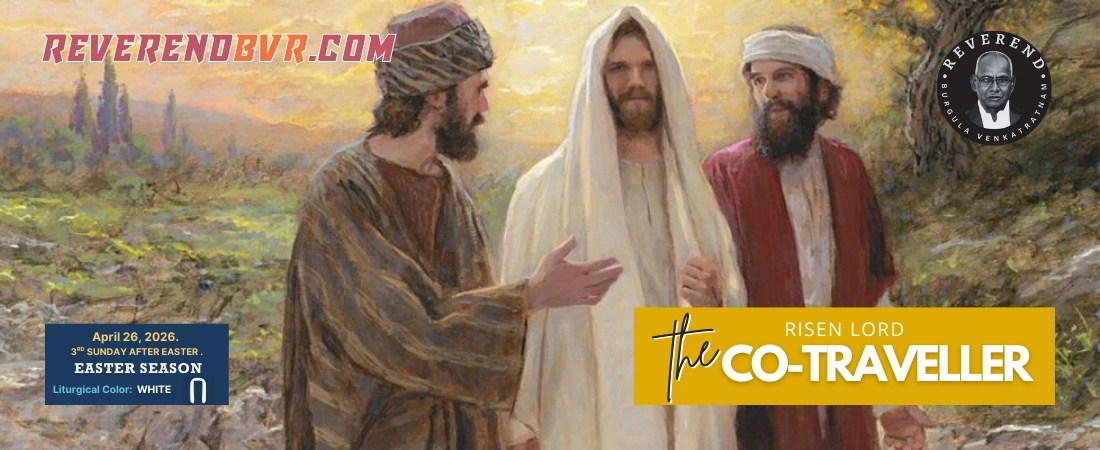
Sermon Title: Risen Lord: The Co-traveller.
Occasion: 3rd Sunday after Easter | April 26, 2026.
Bible Readings: Exo. 33: 12-16 | Psalm 121 | Acts 18: 1-11 | Luke 24: 13-33 | Exo. 13: 7-22 | Rev. 14: 1-5.
Original Language Reflections (For deeper study, refer to the Table of Hebrew and Greek Terms in Section VI. of the sermon).
Website: www.reverendbvr.com
Theological Thesis: The risen Christ is not encountered first as a distant object of belief, but as a faithful companion on the road, walking with the confused, sustaining the weary, guarding the vulnerable, and revealing God’s will gradually through Scripture, community, and sacramental recognition. Across wilderness journeys, psalms of trust, apostolic mission, and resurrection appearances, Scripture bears unified witness to a God who does not merely show the way, but walks it with us.
Introduction: God Who Walks With His People
Human life is marked by movement; migration, transition, uncertainty, loss, vocation, and hope. Faith does not remove the road; it redefines how we walk it. From Israel’s wilderness wanderings to Paul’s fragile ministry in Corinth, from anxious pilgrims lifting their eyes to the hills to confused disciples trudging toward Emmaus, the biblical story insists on this truth: God’s presence is not reserved for destinations, it is revealed along the journey.
The Easter season proclaims not only that Christ is risen, but that the risen Christ travels with us, often unrecognized, always faithful.
Exegetical and Theological Engagement with the Readings
1. Presence, Not Progress (Exodus 33:12–16)
Moses stands at a moment of crisis. Israel has been forgiven after the golden calf, but forgiveness alone is not enough. Moses dares to ask for something deeper: “If your presence does not go with us, do not send us up from here.” (Exod. 33:15)
The Hebrew word for presence, פָּנִים (pānîm), literally means face. Moses is asking not merely for divine assistance, but for relational nearness.
God’s promise: “My presence will go with you, and I will give you rest” (v.14), establishes a theology of guidance that is not about speed, conquest, or efficiency, but companionship. God’s people are marked not by geography, but by God’s walking with them.
2. The Guardian of the Journey (Psalm 121)
Psalm 121 is a pilgrim song, sung by travelers approaching Jerusalem: “I lift up my eyes to the hills, from where will my help come?” (v.1)
The psalm answers not with optimism, but with theology. Help comes from the LORD who keeps. The Hebrew verb שָׁמַר (shāmar) means to guard, keep watch, preserve, that appears six times in eight verses. “The LORD will keep your going out and your coming in from this time on and forevermore.” (v.8)
This is not episodic protection, but continuous accompaniment. A God who neither slumbers nor abandons the road.
3. Christ Beside the Fearful Servant (Acts 18:1–11)
Paul arrives in Corinth weary, economically vulnerable, and socially exposed. He works with Aquila and Priscilla, sharing both trade and faith. Opposition mounts. Fear enters.
Then the risen Christ speaks: “Do not be afraid…for I am with you.” (Acts 18:9–10). The Greek phrase ἐγώ εἰμι μετὰ σοῦ (egō eimi meta sou) echoes God’s covenantal promise throughout Scripture.
Mission is sustained not by bold personalities, but by the assurance of divine companionship. The church advances because Christ stands beside the anxious preacher, not because the preacher is fearless.
4. The Co-traveller Revealed (Luke 24:13–33)
The Emmaus Road is the interpretive heart of Easter theology. Two disciples are walking seven miles home to Emmaus. Their posture says everything: heads down, hearts heavy, using the past tense about Jesus. “We had hoped…” (v.21)
Jesus draws near and walks with them (v.15). The Greek verb ἐγγίζω (engizō) implies intentional closeness. Yet he remains unrecognized. Why?
Because resurrection is not grasped by sight alone. Christ first opens Scripture: “Beginning with Moses and all the prophets, he interpreted to them the things about himself in all the Scriptures.” (v.27)
Only later Recognition comes in the breaking of the bread.. are their eyes opened (v.31). The risen Christ is known on the road, in the Word, and at the Table.
5. God Who Goes Ahead (Exodus 13:17–22)
God does not lead Israel by the shortest route: “God did not lead them by way of the land of the Philistines…” (v.17) Instead, God goes before them as cloud and fire.
The Hebrew הָלַךְ (hālak) means to walk, defines divine leadership. God does not issue directions from afar; God walks ahead, adjusting the pace to human fear.
6. Those Who Follow the Lamb (Revelation 14:1–5)
The final vision shows the redeemed: “These are the ones who follow the Lamb wherever he goes.” (Rev. 14:4) The Greek ἀκολουθέω (akoloutheō) means to accompany, to walk behind as a disciple.
Easter discipleship culminates not in escape from the world, but in faithful following. A people shaped by presence, purity, and perseverance.
Integrating the Collect into the Sermon’s Theology:
The Collect beautifully names our condition: uncertainty, limitation, unfamiliar paths and confesses God’s response: incarnation and companionship.
It prays not merely for guidance, but for recognition:
- Christ in Scripture
- Christ in fellowship
- Christ as the One who walks with us
The prayer echoes Emmaus, Exodus, and Revelation: God with us, God before us, God among us.
Contemporary Human Challenges:
Today’s people walk roads marked by: Migration and displacement, Vocational exhaustion, Faith fatigue, Fragmented community, Silent fear.
The gospel does not promise shortcuts. It promises presence. Christ does not say, “You will understand everything.”
Christ says, “I am with you.”
Life Applications: Walking Faithfully with the Co-traveller
- Do not despise slow understanding: Christ reveals truth gradually.
- Attend to Scripture and Table: Recognition happens in Word and sacrament.
- Value companionship in faith: Christ often comes disguised as a fellow traveler.
- Trust God’s pacing: The longer road may be the safer, truer one.
- Follow, not just admire: Resurrection life is lived by walking behind the Lamb.
Prayer:
Risen Christ, faithful Companion of the uncertain, you who draw near on roads we did not choose, walk with us when hope feels delayed and understanding comes slowly.
Open our eyes through your Word, warm our hearts by your presence, and make yourself known to us in the breaking of bread and the sharing of life.
Guard our going out and our coming in. Stand beside us when fear silences courage. Lead us not by the shortest road, but by the truest one.
And when our journey ends, receive us among those who follow the Lamb, who walk in your light,
and who know at last what we only trusted on the way. Amen.
Key Biblical Terms Table:
| S.No | Passage | Verse | Original Word | Language | Meaning | Theological Significance |
| 1 | Exod. 33:14–15 | 14–15 | פָּנִים (pānîm) | Hebrew | Face, presence | God’s relational nearness |
| 2 | Psalm 121 | 3–8 | שָׁמַר (shāmar) | Hebrew | Guard, keep | Continuous divine protection |
| 3 | Exod. 13:21 | 21 | הָלַךְ (hālak) | Hebrew | To walk | God leads by accompanying |
| 4 | Luke 24:15 | 15 | ἐγγίζω (engizō) | Greek | To draw near | Christ’s intentional presence |
| 5 | Luke 24:27 | 27 | διερμήνευεν (diermēneuen) | Greek | To interpret fully | Christ as interpreter of Scripture |
| 6 | Acts 18:10 | 10 | μετὰ σοῦ (meta sou) | Greek | With you | Covenant reassurance |
| 7 | Rev. 14:4 | 4 | ἀκολουθέω (akoloutheō) | Greek | To follow | Discipleship as shared journey |
Bibliography:
- Brevard S. Childs, The Book of Exodus: A Critical, Theological Commentary, Old Testament Library (Louisville: Westminster John Knox, 1974).
- Walter Brueggemann, Theology of the Old Testament: Testimony, Dispute, Advocacy (Minneapolis: Fortress Press, 1997).
- Terence E. Fretheim, Exodus, Interpretation: A Bible Commentary for Teaching and Preaching (Louisville: Westminster John Knox, 1991).
- James L. Mays, Psalms, Interpretation: A Bible Commentary for Teaching and Preaching (Louisville: Westminster John Knox, 1994).
- N. T. Wright, Luke for Everyone (Louisville: Westminster John Knox, 2004).
- Joel B. Green, The Gospel of Luke, New International Commentary on the New Testament (Grand Rapids: Eerdmans, 1997).
- Beverly Roberts Gaventa, Acts, Abingdon New Testament Commentaries (Nashville: Abingdon Press, 2003).
- Luke Timothy Johnson, The Acts of the Apostles, Sacra Pagina Series (Collegeville, MN: Liturgical Press, 1992).
- Richard Bauckham, The Theology of the Book of Revelation (Cambridge: Cambridge University Press, 1993).
- Eugene H. Peterson, Christ Plays in Ten Thousand Places: A Conversation in Spiritual Theology (Grand Rapids: Eerdmans, 2005).
- Dietrich Bonhoeffer, Discipleship (Minneapolis: Fortress Press, 2001).
- Rowan Williams, Being Christian: Baptism, Bible, Eucharist, Prayer (Grand Rapids: Eerdmans, 2014).
- Karl Barth, Church Dogmatics, Vol. IV/1 (Edinburgh: T&T Clark, 1956).
- Craig R. Koester, Revelation and the End of All Things (Grand Rapids: Eerdmans, 2001).
- Gordon D. Fee, God’s Empowering Presence: The Holy Spirit in the Letters of Paul (Peabody, MA: Hendrickson, 1994).
© 2025 ReverendBVR.com | High-Academic Sermon Series, 2026.
Content licensed under Creative Commons Attribution-NonCommercial-NoDerivatives 4.0 International (CC BY-NC-ND 4.0). You are free to share, copy and redistribute the material in any medium or format with proper attribution. No commercial use or modifications allowed without explicit permission.
For further sermons and biblical reflections, please visit 🌐 www.reverendbvr.com/sermons
Leave a Reply