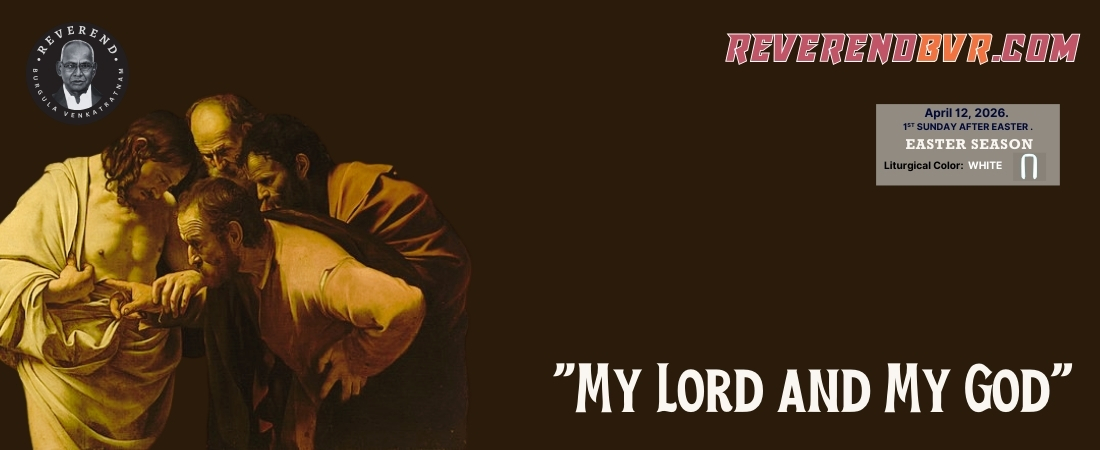
Sermon Title: My Lord and My God. (From Partial Faith to Full Confession in the Presence of the Risen Christ)
Occasion: 1st Sunday after Easter | April 12, 2026.
Bible Readings: Isa. 45:21–25 | Ps. 35:18–28 | Phil. 2:5–11 | John 20:24–29 | Exod. 3:13–18 / Rev. 1:9–20.
Original Language Reflections (For deeper study, refer to the Table of Hebrew and Greek Terms in Section XVI. of the sermon).
Website: www.reverendbvr.com
Theological Thesis: From the burning bush of Moses to the empty tomb of Easter, Scripture reveals one unfolding truth: the God who declared “I AM” has made Himself fully known in the risen Christ.
Thomas, who had long followed Jesus and believed in Him, now comes to the fullness of Easter faith. In the presence of the wounded and risen Lord, his earlier belief matures into worship, and he proclaims the church’s enduring confession: “My Lord and my God.”
I. Introduction: From Doubt to Worship/From Following Jesus to Fully Knowing Him:
Thomas’s confession in John 20:28: “My Lord and my God!” stands as one of the most profound declarations in the New Testament. It is not merely the moment when doubt disappears. It is the moment when faith reaches clarity.
Thomas had not been a stranger to Jesus. He had walked with Him, listened to His teaching, and remained among His disciples throughout His ministry. Like the others, he had already believed that Jesus was sent by God and had hoped that He was the promised Messiah. Yet, like the rest of the disciples, his understanding was still incomplete.
The resurrection changes everything.
Before Easter, the disciples knew Jesus as teacher, master, and hoped-for deliverer. After Easter, they begin to understand that the crucified Jesus is more than Messiah, He shares the very identity of the God of Israel.
Thomas therefore represents not unbelief, but faith in transition.
He believed before, yet he had not fully grasped the mystery of Christ’s identity. When the risen Lord stands before him, faith moves from loyalty to worship, from expectation to revelation.
His confession becomes the climactic declaration of John’s Gospel: The crucified and risen Jesus is both Lord and God.
II. Thomas Believed Before… But Not Yet Fully
It is important to correct a common misunderstanding. Thomas was not an unbeliever in the simple sense. He had already followed Jesus as one of the (12) Twelve. More than that, he had shown courage and devotion.
In John 11:16, when Jesus decided to return to Judea, Thomas said, “Let us also go, that we may die with him.” This is not the voice of a cynical outsider. It is the voice of a loyal disciple.
Like the others, Thomas had already accepted that Jesus was sent by God. He had believed in Him as teacher, master, and likely as Messiah. But like the other disciples, he did not yet fully understand the meaning of the cross and resurrection. His expectations, shaped by Jewish hope, were still incomplete. He knew Jesus truly, but not yet fully.
This is often how faith works in Scripture. Faith is real even when it is unfinished. The disciples believed, yet they still misunderstood. They followed, yet they still feared. They loved Christ, yet they had not yet grasped the full mystery of who He is.
Thomas therefore represents not mere unbelief, but faith in process.
And that matters pastorally. Many believers know Christ truly, yet still have much to learn. One may confess Jesus sincerely and still not yet see the full depth of His glory. Thomas’s journey reminds us that faith can be genuine even before it is mature.
III. The Name of God Revealed (Exodus 3:13–18)
At the burning bush, Moses asks the most fundamental and a great theological question: “What is His name?” He is asking not for a label, but for God’s identity, character, and presence
God answers: “I AM WHO I AM.”
In Hebrew: Ehyeh Asher Ehyeh.
This divine self-revelation tells us that God is not defined by human categories. He is the One who simply is. He is eternal, self-existent, sovereign, and faithful. The name YHWH emerges from this revelation and becomes the covenant name by which Israel knows the living God.
This means:
- God is not created.
- God is not dependent.
- God is not one among many.
- God is the One who is, who was, and who will be.
The God of the burning bush is the God who acts in history, delivers His people, and remains faithful to His promises.
This matters deeply for John 20, because Thomas’s confession is not detached from this Old Testament revelation. The One standing before Thomas is not another religious figure alongside the God of Israel. The risen Christ stands within the very identity of the God who said, “I AM.”
This same divine identity echoes throughout Scripture and eventually finds its fullest revelation in Christ.
IV. The One God Who Saves (Isaiah 45:21–25)
Isaiah proclaims a radical monotheistic declaration: “There is no God besides me, a righteous God and a Savior; there is none besides me.”
This text is remarkable because it links two divine identities:
- God alone is righteous
- God alone is Savior
In the ancient world, nations worshiped many gods, but Israel’s Scriptures insist on the uniqueness of the Lord.
Then comes a universal promise: “To me every knee shall bow, every tongue shall swear allegiance.”
This verse becomes crucial in the New Testament. Paul directly applies it to Jesus Christ.
V. Christ the Exalted Lord (Philippians 2:5–11)
Philippians 2 gives us one of the earliest and most powerful Christological hymns in the New Testament. It traces the movement of Christ’s saving work: It describes the movement of Christ’s life: Humiliation → Obedience → Crucifixion → Exaltation
Christ, though existing “in the form of God” (μορφῇ θεοῦ), humbled Himself and became obedient even unto death on a cross. Therefore, God highly exalted Him and gave Him “the name above every name.”
And The result?
“At the name of Jesus every knee should bow.” This is a direct echo of Isaiah 45.
What Isaiah said about YHWH, Paul now applies to Jesus.
The early church is proclaimed something extraordinary: the honor due to the God of Israel is now rendered to Jesus. Not because Jesus replaces the God of Israel, but because in Him the God of Israel has made Himself known.
Jesus shares the identity of the God of Israel.
VI. The Confession of Thomas (John 20:24–29)
Thomas is often called “Doubting Thomas,” but this title can be misleading. He is better understood as a disciple whose faith must pass through the crisis of the cross before it can reach Easter clarity.
When the others tell him, “We have seen the Lord,” Thomas answers that he needs to see and touch for himself. This is not mere stubbornness. In part, Thomas asks for what the others themselves had already received: an encounter with the risen Christ.
But beneath that request lies something deeper. The death of Jesus had shattered the expectations of all the disciples. The Messiah had been crucified. Their hopes had been wounded. Thomas’s words arise from the painful realism of a disciple living in the aftermath of apparent defeat.
Then Jesus appears, He comes not with condemnation, but with invitation. He shows Thomas the wounds. He meets Thomas at the precise place of his struggle. And Thomas responds, not with analysis, but with adoration:
“My Lord and my God!”
Greek: Ho Kyrios mou kai ho Theos mou
This is the climax of John’s Gospel.
John began by saying, “The Word was God” (John 1:1).
Now, at the end, a disciple finally says it aloud.
Thomas now sees what he had not fully seen before: Jesus is not only Messiah, not only Rabbi, not only risen Master. He is the Lord Himself, sharing the very identity of the God of Israel.
VII. The Jewish Meaning of “My Lord and My God”
To understand the force of Thomas’s confession, we must hear it with Jewish ears.
1. “My Lord” :
In Jewish tradition, the divine name YHWH was regarded with deep reverence. Rather than pronouncing it directly, Jews commonly said Adonai, meaning Lord. When the Hebrew Scriptures were translated into Greek, this divine title was often rendered as Kyrios means Lord.
So when Thomas says, “My Lord,” this is not merely a polite title like “sir.” It carries the weight of the sacred language used for the God of Israel.
2. “My God” :
The phrase “my God” is covenant language. It is the language of worship, prayer, and belonging. In the Psalms, faithful Israelites cry out, “My God” as an expression of trust, surrender, and devotion.
A devout Jew would not lightly address a mere human being in these terms. To say “my God” is to speak the language of worship.
3. The power of the combination :
When Thomas says “My Lord and my God,” he combines two titles deeply rooted in Israel’s Scriptures and worship. This is not a cry of astonishment thrown into the air. It is a deliberate confession. It means:
- You are the one who rules me.
- You are the God to whom I belong.
- You are worthy of my worship.
- In you, the God of Israel has come near.
This is why the statement is so theologically rich. Thomas is not abandoning Jewish faith. He is confessing that in the risen Jesus, the God whom Israel has always worshiped has revealed Himself fully and personally.
VIII. The Risen Lord of History (Revelation 1:9–20)
The Book of Revelation continues this same witness. John sees the risen Christ in majesty and hears Him declare: “I am the First and the Last… I was dead, and behold I am alive forevermore.”
These are divine titles. In Isaiah, such language belongs to God. But now the risen Jesus speaks them of Himself.
The meaning is unmistakable: the crucified Jesus reigns over history, death, time, and eternity. The resurrection is not merely the reversal of death; it is the unveiling of Christ’s universal lordship.
What Thomas confessed in the upper room, Revelation proclaims before the whole cosmos.
IX. Worship and Public Praise (Psalm 35)
Psalm 35 moves from suffering to praise, from conflict to public thanksgiving.. The psalmist promises: “I will give thanks to you in the great congregation.” This reflects the pattern seen in Thomas. Private doubt becomes public confession.
Faith is never meant to remain hidden. It becomes worship, proclamation, and testimony.
X. Theological Synthesis: The God Who Reveals Himself in Christ
When we place these readings together, a profound narrative emerges.
| Stage | Revelation |
| Exodus | God reveals His divine name “I AM” |
| Isaiah | God declares there is no other Savior |
| Philippians | Christ shares the divine identity |
| John | Thomas recognizes Jesus as Lord and God |
| Revelation | The risen Christ reigns forever |
The story of Scripture moves toward one central realization: In Jesus Christ, the living God has come near to humanity.
XI. Faith in a World of Doubt
Modern people often assume doubt is a modern invention. But Thomas shows that doubt existed even among the first disciples.
Many people imagine that doubt is the opposite of faith. But in Scripture, doubt is often the place where faith is purified and deepened.
The gospel does not condemn honest questioning. Instead, Christ meets Thomas personally.
The message of Easter is not that believers never struggle. It is that Christ meets us in our struggle. And when He does, fear becomes faith and faith becomes deeper and their questions become worship.
XII. Living the Confession: “My Lord and My God”
Thomas’s confession is not only doctrinal; it is personal.
Notice the repeated word: My.
Not simply the Lord.
Not simply the God.
But my Lord and my God.
This is where Christian faith becomes living faith.
To confess Christ as my Lord is to submit to His rule.
To confess Christ as my God is to worship Him with trust and surrender.
This means:
- trusting Him when understanding is incomplete
- obeying Him when the path is costly
- worshiping Him when the heart has been healed by grace
- confessing Him publicly in the congregation and in the world
Christian faith is not merely agreeing with truths about Jesus. It is yielding oneself to the risen Christ who stands before us still.
XIII. Conclusion
The journey from the burning bush to the empty tomb reveals one unified truth: The God who spoke to Moses, the God proclaimed by the prophets, and the God worshiped in heaven is the same God revealed in the risen Christ.
Thomas’s confession therefore becomes the confession of the entire Church: “My Lord and my God.”
And Jesus extends a blessing beyond that first Easter room to every generation of believers: “Blessed are those who have not seen and yet have believed.”
The resurrection invites every believer into this same confession, not merely as a doctrine to affirm, but as a life to live in worship, trust, and obedience before the risen Lord.
XIV. Practices of Faithful Living.
- Practice Honest Faith: Thomas reminds us that faith often begins with honest seeking. Christ welcomes our questions and meets us with grace.
- Practice Worshipful Recognition of Christ: Faithful living begins by recognizing Jesus not merely as teacher, but as the living Lord worthy of worship.
- Practice Trust in the Risen Lord: Jesus blesses those who believe without seeing. Christian faith rests on trust in God’s faithfulness even when His work is not immediately visible.
- Practice Community with Believers: Thomas encountered the risen Christ when he returned to the community of disciples. Faith grows within the life of the Church.
- Practice Public Witness: Thomas’s confession became a testimony for the world. Christian faith is not only believed privately but proclaimed through word and life.
- Practice Hope in Uncertain Times: The resurrection assures us that suffering and doubt never have the final word. The risen Christ is guiding history toward redemption.
XV. Let us Pray:
Risen Lord Jesus Christ,
You who revealed the name of God, conquered death, and stand among Your people,
Open our eyes as You opened the eyes of Thomas.
Where our faith is weak, strengthen it.
Where our hearts are fearful, fill them with Your peace.
Teach us to confess with joy and conviction: “My Lord and my God.”
May our lives become living testimonies of Your resurrection until the day when every knee bows and every tongue confesses that You are Lord. Amen.
XVI. Key Biblical Words & Phrases:
| S.No | Passage | Verse | Original Word | Language | Pronunciation (English) | Meaning |
| 1 | Exodus 3:14 | 3:14 | אֶהְיֶה אֲשֶׁר אֶהְיֶה | Hebrew | Eh-yeh Ah-sher Eh-yeh | I AM WHO I AM |
| 2 | Exodus 3:15 | 3:15 | יהוה (YHWH) | Hebrew | Yah-weh | The LORD |
| 3 | Isaiah 45:21 | 45:21 | אֵל צַדִּיק וּמוֹשִׁיעַ | Hebrew | El Tzad-dik U-mo-shee-ah | A righteous God and Savior |
| 4 | Isaiah 45:23 | 45:23 | תִּכְרַע כָּל־בֶּרֶךְ | Hebrew | Tik-ra Kol Beh-rekh | Every knee shall bow |
| 5 | Psalm 35:18 | 35:18 | אוֹדְךָ בְּקָהָל רָב | Hebrew | O-dekha Be-ka-hal Rav | I will praise you in the great assembly |
| 6 | Philippians 2:6 | 2:6 | μορφῇ θεοῦ | Greek | Mor-phē The-ou | Form / nature of God |
| 7 | Philippians 2:9 | 2:9 | ὄνομα τὸ ὑπὲρ πᾶν ὄνομα | Greek | O-no-ma to Hu-per Pan O-no-ma | The name above every name |
| 8 | Philippians 2:10 | 2:10 | πᾶν γόνυ κάμψῃ | Greek | Pan Go-nyu Kamp-sē | Every knee should bow |
| 9 | John 20:28 | 20:28 | ὁ κύριός μου καὶ ὁ θεός μου | Greek | Ho Ky-ri-os Mou Kai Ho The-os Mou | My Lord and my God |
| 10 | Revelation 1:17 | 1:17 | ὁ πρῶτος καὶ ὁ ἔσχατος | Greek | Ho Prō-tos Kai Ho Es-kha-tos | The First and the Last |
| 11 | Revelation 1:18 | 1:18 | ὁ ζῶν | Greek | Ho Zōn | The Living One |
Bibliography:
- D. A. Carson, The Gospel According to John (Grand Rapids: Eerdmans).
- Craig S. Keener, The Gospel of John: A Commentary (Peabody, MA: Hendrickson).
- Richard Bauckham, Jesus and the God of Israel: God Crucified and Other Studies on the New Testament’s Christology of Divine Identity (Grand Rapids: Eerdmans).
- N. T. Wright, The Resurrection of the Son of God (Minneapolis: Fortress Press).
- Gordon D. Fee, Paul’s Letter to the Philippians (Grand Rapids: Eerdmans).
- J. Alec Motyer, The Prophecy of Isaiah: An Introduction and Commentary (Downers Grove, IL: InterVarsity Press).
- G. K. Beale, The Book of Revelation: A Commentary on the Greek Text (Grand Rapids: Eerdmans).
- Raymond E. Brown, The Gospel According to John XIII–XXI (New Haven: Yale University Press).
- Larry W. Hurtado, Lord Jesus Christ: Devotion to Jesus in Earliest Christianity (Grand Rapids: Eerdmans).
- Frederick W. Danker, ed., A Greek-English Lexicon of the New Testament and Other Early Christian Literature (Chicago: University of Chicago Press).
© 2025 ReverendBVR.com | High-Academic Sermon Series, 2026.
Content licensed under Creative Commons Attribution-NonCommercial-NoDerivatives 4.0 International (CC BY-NC-ND 4.0). You are free to share, copy and redistribute the material in any medium or format with proper attribution. No commercial use or modifications allowed without explicit permission.
For further sermons and biblical reflections, please visit 🌐 www.reverendbvr.com/sermons
Leave a Reply