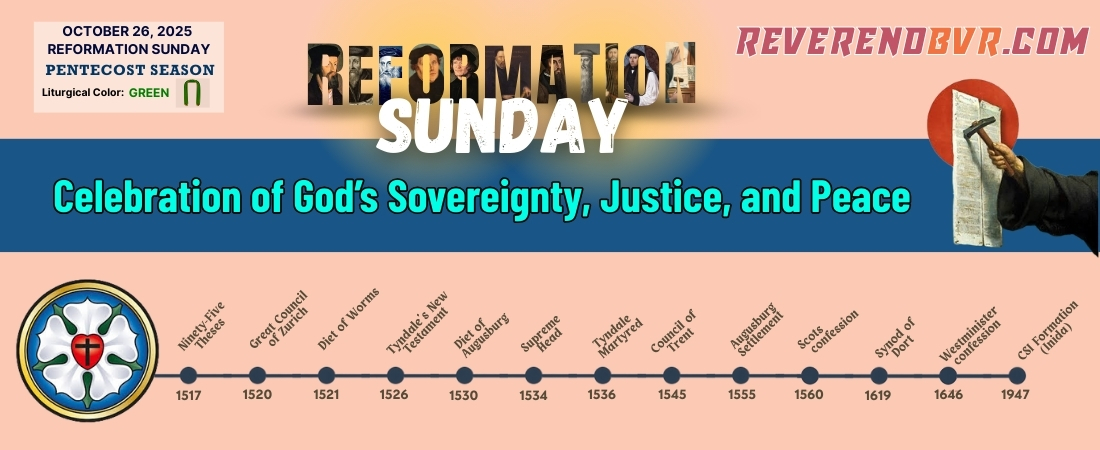
On this Reformation Sunday, we celebrate not just a historical event but the enduring sovereignty of God who calls His people into truth, justice, and peace. From Moses before Pharaoh to Christ before Pilate, Scripture reveals a divine kingdom where justice is not imposed by power but proclaimed through righteousness—and reformation remains the Church’s constant calling.
Sermon Title: Celebration of God’s Sovereignty, Justice, and Peace
Occasion: Reformation Sunday | October 26, 2025, Sunday.
Textual Foundations: Exodus 7:1-7 | Psalm 89:1-18 | Romans 13:1-7 | John.18:33-38
Original Language Reflections (For deeper study, refer to the Table of Hebrew and Greek Terms in Section 3 of the sermon).
By Reverend B.V.R. Memorial Ministry | www.reverendbvr.com
1. Introduction: Reformation as Rediscovery of God’s Sovereignty
On Reformation Sunday, we do not merely commemorate a historical shift in ecclesial structures or theological paradigms. We celebrate a divinely initiated movement that called the Church back to the truth of God’s sovereignty, justice, and peace—truths embedded deeply within the biblical narrative. The Protestant Reformation, beginning formally with Martin Luther’s 95 Theses on October 31, 1517, was not a rebellion against authority, but a return to God’s authority as revealed in Scripture alone (sola scriptura), and salvation by faith alone (sola fide).
Our lectionary readings—Exodus 7:1–7; Psalm 89; Romans 13:1–7; and John 18:33–38—showcase God’s sovereign hand over nations, His justice as the foundation of His throne, and the peace of Christ’s unearthly kingdom. Today, we dive deep into these texts, illuminating the theological substance behind the Reformation and the continuing call to reform, not only institutions, but our hearts and communities.
I. God’s Sovereignty over Earthly Powers (Exodus 7:1–7)
“See, I have made you like God to Pharaoh…” (Exodus 7:1)
God’s command to Moses is revolutionary: He empowers Moses, a reluctant, aged exile, to confront the Pharaoh, the supreme ruler of Egypt. God’s sovereignty overturns the world’s power structures. Pharaoh, who claims divine status, is brought low by the God who stretches out His hand in justice (v. 5).
This divine confrontation becomes the template for all reformations: God raises up unlikely reformers to challenge oppressive systems and proclaim liberation. Just as the Israelites were delivered from Egypt’s tyranny, so the 16th-century Reformers confronted the ecclesiastical bondage of their time—indulgences, ecclesial corruption, and Scripture being kept from the people.
God’s acts through Moses teach us that true authority is derived not from position, but from obedience to God’s Word. It is not Pharaoh, the Pope, or Caesar who governs the world—it is YHWH, the covenantal God of Israel, who rules history.
II. The Foundation of God’s Rule: Righteousness and Justice (Psalm 89:1–18)
“Righteousness and justice are the foundation of your throne; love and faithfulness go before you.” (Psalm 89:14)
Psalm 89, attributed to Ethan the Ezrahite, poetically exalts the enduring faithfulness of God, rooted in covenant and creation. The psalmist proclaims that God’s throne is not built upon coercion, military might, or wealth—but upon righteousness (צֶדֶק, tsedeq) and justice (מִשְׁפָּט, mishpat).
During the Reformation, this psalm served as theological soil from which grew the doctrine of justification—a judicial term denoting how sinners are declared righteous before God, not by works, but by grace through faith (Romans 3:28). The Reformers argued: If God is just, and humans are sinful, how can one stand before Him? The answer came through Scripture: in Christ alone (solus Christus), God’s justice and mercy meet.
For us today, this psalm invites reflection: Do our lives, our churches, and our societies reflect these same foundations? Are we walking in love, justice, and faithfulness? Reformation begins wherever God’s people return to these values.
III. God Ordains Just Authority—Not Tyranny (Romans 13:1–7)
“There is no authority except that which God has established.” (Romans 13:1)
This passage from Paul’s epistle to the Romans has often been misused to sanctify tyranny. However, the Greek term for “authority” (ἐξουσία, exousia) refers to legitimate, God-ordained order, not abusive power. Paul is not asking for blind submission, but ethical responsibility and public justice.
The Reformers wrestled with this text. Luther emphasized the two kingdoms—the spiritual and the temporal—arguing that while Christians should respect civil authority, their ultimate allegiance is to God. When the state or the church becomes oppressive, Reformation is not only a right—it is a duty.
Romans 13 therefore affirms:
- The necessity of societal order,
- The ethical limits of authority, and
- The responsibility of the Christian conscience.
This is why early Reformers like John Wycliffe and Jan Hus challenged ecclesiastical power, even at the cost of their lives. It was not rebellion—it was reform in the name of God’s justice.
IV. Christ’s Kingdom: Truth, Not Domination (John 18:33–38)
“My kingdom is not of this world… I came into the world to testify to the truth.” (John 18:36–37)
Christ’s dialogue with Pilate reveals the paradox of divine kingship. Jesus refuses political manipulation, opting instead for a kingdom rooted in truth (aletheia), not territory. His kingdom is not apolitical, but rather supra-political—a reality that calls all rulers, religious or secular, to account.
Pilate’s infamous question—“What is truth?”—echoes through history, and especially during the Reformation. The Reformers answered: God’s Word is truth (John 17:17). In contrast to the relativism and manipulation of truth for institutional control, Luther stood at the Diet of Worms in 1521 and said: “Unless I am convinced by Scripture and plain reason… I cannot and will not recant.”
Jesus’ model of kingship calls us to embrace:
- Servant leadership over hierarchical dominance,
- Moral courage over political convenience, and
- Truth-telling in the face of public pressure.
V. Reformation: A Celebration of God’s Ongoing Work
The Reformation did not begin with Luther. It has biblical roots in:
- Josiah’s rediscovery of the Law (2 Kings 22),
- Ezra’s public reading of Scripture (Nehemiah 8),
- And most powerfully, in Jesus Christ, who reformed Israel by calling people to repent and enter the kingdom of God (Mark 1:15).
Each Reformation movement—from Wycliffe, Hus, Luther, Calvin, to the English Reformation under Tyndale and Cranmer—was a rediscovery of the biblical vision of God’s sovereignty, justice, and peace.
And this work is not over.
Reformation is not a one-time event. It is ecclesia semper reformanda—the Church always reforming. In every generation, we must ask: Are we being faithful to the gospel? Are we making peace or serving power? Are we living under God’s reign or our own ideologies?
Practical Implications for Today & Conclusion:
- Stand for truth, even when it costs you: Like Moses, Luther, and Christ, truth-tellers are often unpopular—but they are faithful.
- Live justly: Reform begins with small acts—how we treat workers, migrants, neighbors, and the marginalized.
- Trust in God’s sovereignty: Even in chaos—whether in politics, church, or personal trials—God is working through it all.
- Be peacemakers: Not passive, but active bearers of the kingdom that does not come with violence, but with truth, justice, and love.
Reformation Sunday reminds us that God is not finished with His Church. From Pharaoh’s court to Pilate’s judgment hall, from the psalmist’s pen to Paul’s pastoral letters, the witness of Scripture declares: God reigns in truth, justice, and peace. The Reformation is not behind us—it is within us. As we remember the saints who stood for Scripture and truth, let us become reformers in our time—people through whom God’s sovereignty is known, His justice pursued, and His peace proclaimed.
2. Closing Prayer
Sovereign Lord, King of all creation, You whose throne is founded on righteousness and justice, we thank You for raising reformers in every generation. Teach us to walk in Your truth, to live in Your peace, and to act justly in our daily lives. Where our churches have strayed, reform us. Where our hearts have grown cold, revive us. Let Your kingdom come in our communities, our families, and our nations. We offer ourselves anew to You on this Reformation Sunday—here we stand, we can do no other. In the name of Jesus Christ, the Truth and the King, Amen.
3. Learn Words from the Original Scriptures (For deeper understanding and meditation on today’s theme)
| S. No. | Term (Transliteration) | Language | Meaning | Scripture Reference |
| 1 | אֱלֹהִים (Elohim) | Hebrew | God, Mighty One (plural of majesty) | Exodus 7:1 |
| 2 | נָבִיא (nāvî’) | Hebrew | Prophet, spokesperson | Exodus 7:1 |
| 3 | כָּבֵד (kāvēd) | Hebrew | To be heavy, to harden (used for Pharaoh’s heart) | Exodus 7:3 |
| 4 | מוֹפֵת (môphēṯ) | Hebrew | Sign, wonder, miracle | Exodus 7:3 |
| 5 | מִשְׁפָּט (mishpāṭ) | Hebrew | Justice, judgment | Psalm 89:14 |
| 6 | צֶדֶק (ṣedeq) | Hebrew | Righteousness | Psalm 89:14 |
| 7 | אֱמוּנָה (’emûnāh) | Hebrew | Faithfulness, steadiness | Psalm 89:1,14 |
| 8 | חֶסֶד (ḥeseḏ) | Hebrew | Covenant love, steadfast love, mercy | Psalm 89:1 |
| 9 | סוּס (sus) | Hebrew | Horse (symbolizing strength, often found in battle contexts) | Psalm 89 (symbolic) |
| 10 | ἐξουσία (exousía) | Greek | Authority, power | Romans 13:1 |
| 11 | διάκονος (diákonos) | Greek | Servant, minister | Romans 13:4 |
| 12 | μάχαιρα (máchaira) | Greek | Sword (symbol of judicial power) | Romans 13:4 |
| 13 | συνείδησις (syneídēsis) | Greek | Conscience, moral awareness | Romans 13:5 |
| 14 | βασιλεία (basileía) | Greek | Kingdom, reign | John 18:36 |
| 15 | ἀλήθεια (alḗtheia) | Greek | Truth, reality | John 18:37–38 |
| 16 | ἀκούω (akoúō) | Greek | To hear, to listen | John 18:37 |
4. Bibliography
- Alister E. McGrath, Reformation Thought: An Introduction. Oxford: Wiley-Blackwell, 2021.
- Roland Bainton, Here I Stand: A Life of Martin Luther. New York: Penguin, 1995.
- Timothy George, Theology of the Reformers. Nashville: B&H Academic, 2013.
- John Calvin, Institutes of the Christian Religion, ed. John T. McNeill, trans. Ford Lewis Battles. Louisville: Westminster John Knox, 2006.
- N.T. Wright, Paul and the Faithfulness of God. Minneapolis: Fortress Press, 2013.
- Scripture quotations from the Holy Bible, New International Version (NIV).
5. Reformation Video: A Glimpse into Reformation History – Reflecting on God’s Sovereignty, Justice, and Peace”
© 2025 ReverendBVR.com | High-Academic Sermon Series, 2025.
Content licensed under Creative Commons Attribution-NonCommercial-NoDerivatives 4.0 International (CC BY-NC-ND 4.0). You are free to share — copy and redistribute the material in any medium or format with proper attribution. No commercial use or modifications allowed without explicit permission.
For further sermons and biblical reflections, please visit 🌐 www.reverendbvr.com/sermons
Leave a Reply