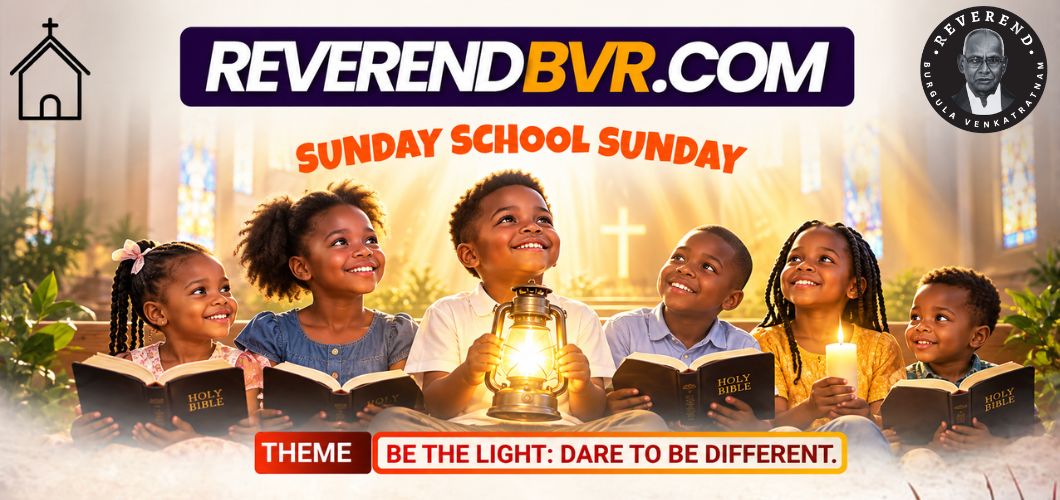
Sermon Title: Be the Light: Dare to Be Different.
Occasion: 22nd Week after Pentecost | World Sunday School Sunday – November 1, 2026.
Scripture Readings: Daniel 3:16-30; Psalm 119:9-16; Philippians 2:14-16; Matthew 5:13-16 & Isaiah 60:1-3; Galatians 5:22-24.
Original Language Reflections (For deeper study, refer to the Table of Hebrew and Greek Terms in Section VII. of the sermon).
Website: www.reverendbvr.com
Theological Thesis: Christian difference is not the desire to appear unusual. It is the courage to belong so completely to Christ that our character, choices, words, and actions reflect his light in a world often shaped by fear, conformity, selfishness, and darkness.
God does not merely command us to shine. He gives us his presence, his Word, his Spirit, and ultimately Christ himself, so that his light may become visible through ordinary human lives.
I. Introduction: What Does It Mean to Be Different?
Jesus says: “You are the light of the world.” (Matthew 5:14)
Notice what Jesus does not say. He does not say, “Try very hard to become light.”
He says, “You are the light.”
Christian witness begins with identity before it becomes activity.
The question, therefore, is not simply, How can I stand out? It is: How can my life reveal Christ?
On World Sunday School Sunday this question is especially important. Children are often told, “You are the future of the Church.” But Scripture gives them a greater dignity: children and young people are part of the Church now. They can pray now, serve now, speak truth now, forgive now, resist evil now, and shine for Christ now.
The readings today show us what such light looks like.
1. Light Refuses to Bow (Daniel):
Daniel 3 takes us into Babylon, where King Nebuchadnezzar erects an enormous golden image and commands everyone to worship it.
Music plays. Officials gather. Society bows. But three young Jewish exiles remain standing.
Shadrach, Meshach, and Abednego tell the king: “Our God whom we serve is able to deliver us… But if not… we will not serve your gods.” (Daniel 3:17-18)
- These may be among the most courageous words in Scripture.
- Their faith is not based upon a bargain with God.
- They do not say, “We will obey God because we know he will prevent suffering.”
- They say, in effect: God is able to rescue us. But even if the furnace remains, God is still worthy of our faithfulness.
That is mature faith. The temptation of Babylon was not simply atheism. Babylon demanded conformity: Bow because everybody else is bowing.
That pressure still exists.
Children experience it at school. Teenagers encounter it through friendships and social media. Adults experience it in workplaces, communities, politics, business, and culture.
Sometimes the most difficult Christian word is simply “No.”
- No to dishonesty.
- No to cruelty.
- No to racism and prejudice.
- No to cheating.
- No to degrading another person for entertainment.
- No to compromising conscience merely because everyone else has done so.
Yet Daniel 3 contains something even deeper. The king expects three people in the furnace but sees four. God does not always remove his people from the furnace. Sometimes God meets them inside it.
The Christian promise is not that faithful people will never suffer. The promise is that suffering cannot separate the faithful from the presence of God.
2. Difference Begins in the Heart (Psalm 119):
The psalmist asks: “How can young people keep their way pure? By guarding it according to your word.” (Psalm 119:9)
Christian distinctiveness cannot survive on courage alone. Courage needs formation.
The psalmist therefore says: “I have hidden your word in my heart, that I might not sin against you.” (Psalm 119:11)
Sunday School exists for precisely this reason.
We do not teach Scripture simply so children can answer Bible questions correctly. Scripture must travel from the page into the heart, and from the heart into life.
The Hebrew idea behind keeping one’s way pure concerns a life that is cleansed, ordered, and directed toward God.
The world forms us continually. Advertisements form us. Entertainment forms us. Friends form us. Algorithms form us. Our fears form us.
The question is not whether we are being formed. The question is who is forming us. Psalm 119 says that God’s Word must shape imagination, conscience, desires, speech, and decisions.
Before Daniel’s friends could stand before the golden image, their hearts had already learned whom they belonged to.
Public courage begins with private formation.
3. Shine Without Grumbling (Philippians):
Paul writes: “Do everything without grumbling or arguing… Then you will shine among them like stars in the sky.” (Philippians 2:14-15)
The Greek word phōstēres means lights or heavenly luminaries. Paul imagines Christians like stars illuminating a dark sky. But notice the surprising context. He does not begin with dramatic missionary achievements.
He speaks about grumbling, relationships, character, and everyday conduct.
Sometimes we imagine Christian witness as something spectacular. Paul suggests that light can appear in very ordinary ways.
- A student who refuses to bully another child shines.
- A person who apologizes sincerely shines.
- A family that welcomes someone lonely shines.
- A Christian who refuses gossip shines.
- A church that serves people whom society overlooks shines.
- A believer who disagrees without hatred shines.
Paul therefore connects witness with character. The world does not merely listen to what Christians say about Christ. It watches what Christians become because of Christ.
4. Jesus: You Are the Light of the World
Jesus declares: “You are the salt of the earth… You are the light of the world.” (Matthew 5:13-14. These words come immediately after the Beatitudes.
The poor in spirit, the merciful, the peacemakers, the pure in heart, and those who suffer for righteousness are then told: You are the world’s light.
The Greek word phōs means light: that which illuminates and makes things visible.
Jesus continues: “Let your light shine before others, that they may see your good works and glorify your Father in heaven.” (Matthew 5:16)
Christian visibility therefore has a purpose.We do not shine so that people will say, “What wonderful Christians!” We shine so that people will say, “What a gracious God!”
This protects Christian witness from pride. A lamp does not advertise itself. It illuminates the room. Likewise, the Christian does not ask, “How can people notice me?” The Christian asks, “How can someone encounter God’s goodness through me?”
5. One Biblical Message: Presence, Word, Character, Witness
These readings form a beautiful progression.
- Daniel 3 teaches us to stand faithfully when society pressures us to bow.
- Psalm 119 teaches us that such courage grows from hearts shaped by God’s Word.
- Philippians 2 teaches us that God’s people shine through Christlike character.
- Matthew 5 reveals that our light exists so that others may glorify God.
The evening readings complete the picture. Isaiah cries: “Arise, shine, for your light has come.” (Isaiah 60:1) And Galatians describes what this illuminated life looks like: “Love, joy, peace, patience, kindness, generosity, faithfulness, gentleness, and self-control.”
Light is not merely something Christians proclaim. Light becomes visible as the fruit of the Spirit.
II. The Collect: From Command to Transformation:
Today’s Collect asks God to “renew our minds and transform us to be more like” Jesus. This is essential. Christian discipleship is not simply God saying, “Be better.” It is God transforming us through grace. The prayer asks that we become “channels of love and light.”
That language beautifully connects the readings.
- Daniel’s friends become channels of courage.
- The psalmist becomes a channel of God’s Word.
- The Philippian church becomes a community of shining witnesses.
- Jesus’ disciples become lamps through whom God’s goodness becomes visible.
The Christian life is therefore not self-generated brightness. Christ is the light; we reflect him.
III. Dare to Be Different Today:
To “dare to be different” does not mean becoming argumentative, strange, or morally superior. Christian difference is cruciform. It resembles Jesus.
- It means telling the truth when lying would be easier.
- Being kind when cruelty is fashionable.
- Remaining faithful when compromise is rewarded.
- Listening when everyone else is shouting.
- Forgiving when revenge seems satisfying.
- Welcoming someone who has been excluded.
- Refusing online humiliation and gossip.
- Serving when nobody is watching.
- And trusting God even when obedience leads through the furnace.
For children and young people, perhaps one of the greatest questions is: Who decides who I will become?
- Friends?
- Social media?
- Popularity?
- Fear?
- Success?
- Or Jesus Christ?
The Christian answer is not withdrawal from the world. Jesus places the lamp inside the house. God sends his people into classrooms, universities, families, offices, neighborhoods, churches, and communities.
The darkness is precisely where the lamp belongs.
V. Conclusion:
Nebuchadnezzar had a furnace, The psalmist had God’s Word.
Paul saw stars shining in darkness, Jesus saw lamps illuminating a house.
And all these images tell us the same truth: God’s people are called to live visibly different lives because they belong to a visibly different kingdom.
- Not different because we think we are better. Different because Christ is changing us.
- Not different through arrogance. Different through holiness.
- Not different merely in words. Different in love, courage, mercy, integrity, and service.
So,
- when the world says, Bow, remember Daniel.
- When your heart becomes confused, remember the Psalm: Hide God’s Word within you.
- When relationships become difficult, remember Paul: Shine like stars.
- And when you wonder whether one ordinary life can make any difference, remember Jesus: “You are the light of the world.”
Therefore arise. Stand faithfully. Love courageously. Serve quietly. Speak truthfully. And let the world see enough of Christ in us that someone else begins looking toward the Light.
VI. Closing Prayer
God of uncreated Light,
who stood with your servants in the furnace,
who speaks through your life-giving Word,
and who has revealed your glory in Jesus Christ,
guard our hearts from every idol before which the world asks us to bow.
Plant your Word deeply within us,
until truth shapes our thoughts,
grace governs our speech,
and love directs our actions.
When obedience is costly, give us courage.
When darkness surrounds us, keep our lamps burning.
When pride tempts us, teach us to shine not for ourselves but for your glory.
Form in us the fruit of your Spirit:
love instead of hatred,
peace instead of hostility,
kindness instead of cruelty,
faithfulness instead of compromise,
and self-control instead of selfish desire.
Bless especially the children and young people of your Church.
May they know that they belong to Christ today,
that their prayers matter,
their choices matter,
their witness matters,
and their lives can reflect your kingdom.
Renew our minds, transform our hearts,
and make us channels of your love and light,
until those who see our lives are drawn beyond us
to Jesus Christ, the true Light of the world,
who lives and reigns with you and the Holy Spirit,
one God, now and forever.
Amen.
VII. Original-Language Word Study
| S.No | Passage | Exact Verse | Original Word | Transliteration | Literal Meaning | Theological Significance | Connection to Theme |
| 1 | Daniel 3 | 3:18 | צְלֵם¹ | ṣĕlem | image, statue | The imperial image demands allegiance that belongs to God | God’s people refuse idolatrous conformity |
| 2 | Psalm 119 | 119:9 | זכה | zākhâ | to be clean/pure | God’s Word orders and purifies one’s way of life | Difference begins through inward formation |
| 3 | Philippians 2 | 2:15 | φωστῆρες | phōstēres | lights, luminaries | God’s people resemble stars illuminating darkness | Christians visibly embody Christ’s character |
| 4 | Matthew 5 | 5:14 | φῶς | phōs | light | Disciples participate in Christ’s illuminating mission | Christian identity becomes public witness |
| 5 | Matthew 5 | 5:16 | λαμψάτω | lampsatō | let it shine | The disciple’s life is intentionally visible | Good works direct attention toward God |
| 6 | Isaiah 60 | 60:1 | קוּמִי אוֹרִי | qûmî ʾôrî | arise, shine | God’s arriving glory creates the people’s radiance | We shine because God’s light has come |
| 7 | Galatians 5 | 5:22 | καρπός | karpos | fruit | The Spirit produces visible Christlike character | Light is expressed through transformed living |
¹ Daniel 3 is written in Biblical Aramaic, not Hebrew; ṣĕlem is therefore an Aramaic term.
VIII. Footnotes for Personal Study:
- John J. Collins, Daniel: A Commentary on the Book of Daniel, Hermeneia (Minneapolis: Fortress, 1993).
- John Goldingay, Daniel, Word Biblical Commentary 30 (Dallas: Word Books, 1989).
- James L. Mays, Psalms, Interpretation (Louisville: John Knox, 1994).
- Gordon D. Fee, Paul’s Letter to the Philippians, New International Commentary on the New Testament (Grand Rapids: Eerdmans, 1995).
- Moisés Silva, Philippians, 2nd ed., Baker Exegetical Commentary on the New Testament (Grand Rapids: Baker Academic, 2005).
- W. D. Davies and Dale C. Allison Jr., A Critical and Exegetical Commentary on the Gospel according to Saint Matthew, International Critical Commentary (Edinburgh: T&T Clark, 1988-1997).
- Ulrich Luz, Matthew 1-7: A Commentary, Hermeneia (Minneapolis: Fortress, 2007).
IX. Bibliography:
- Collins, John J. Daniel: A Commentary on the Book of Daniel. Hermeneia. Minneapolis: Fortress, 1993.
- Davies, W. D., and Dale C. Allison Jr. A Critical and Exegetical Commentary on the Gospel according to Saint Matthew. International Critical Commentary. Edinburgh: T&T Clark, 1988-1997.
- Fee, Gordon D. Paul’s Letter to the Philippians. New International Commentary on the New Testament. Grand Rapids: Eerdmans, 1995.
- Goldingay, John. Daniel. Word Biblical Commentary 30. Dallas: Word Books, 1989.
- Luz, Ulrich. Matthew 1-7: A Commentary. Hermeneia. Minneapolis: Fortress, 2007.
- Mays, James L. Psalms. Interpretation. Louisville: John Knox, 1994.
- Silva, Moisés. Philippians. 2nd ed. Baker Exegetical Commentary on the New Testament. Grand Rapids: Baker Academic, 2005.
© 2025 ReverendBVR.com | High-Academic Sermon Series, 2026.
Content licensed under Creative Commons Attribution-NonCommercial-NoDerivatives 4.0 International (CC BY-NC-ND 4.0). You are free to share, copy and redistribute the material in any medium or format with proper attribution. No commercial use or modifications allowed without explicit permission.
For further sermons and biblical reflections, please visit 🌐 www.reverendbvr.com/sermons
Leave a Reply