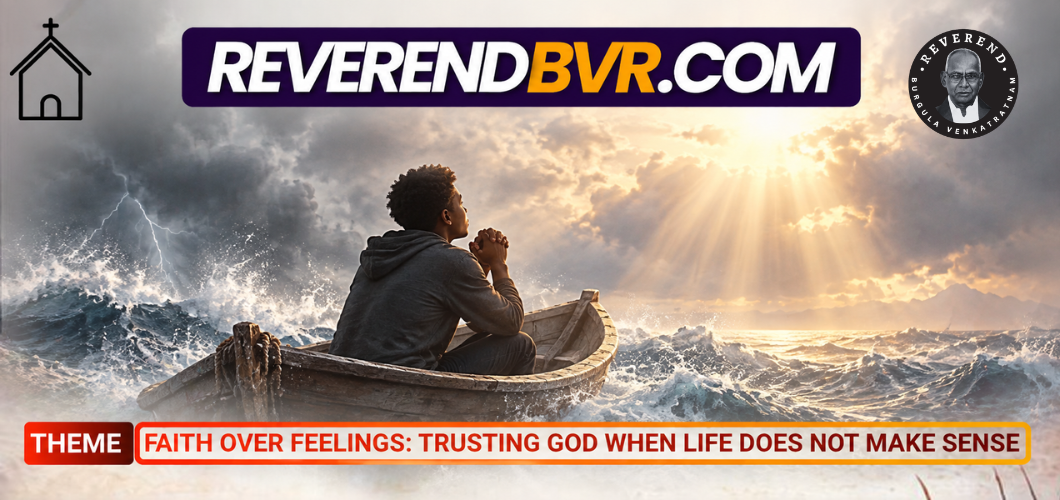
Sermon Title: Faith Over Feelings: Trusting God When Life Does Not Make Sense.
Occasion: 20th Week after Pentecost | Youth Sunday | 3rd Sunday in October |Date: October 18, 2026.
Scripture Readings: Jeremiah 29:10-14; Psalm 37:23-40; Hebrews 11:17-31; Mark 4:35-41 & Evening: Proverbs 3:5-18; Romans 12:1-8.
Original Language Reflections (For deeper study, refer to the Table of Hebrew and Greek Terms in Section VII. of the sermon).
Website: www.reverendbvr.com
Theological Thesis: Biblical faith is not the denial of emotion, fear, disappointment, or unanswered questions. Faith is the courageous entrusting of our whole life, including our feelings, to the character, promises, and presence of God. Feelings describe what we are experiencing; faith determines whom we will trust while experiencing it.
I. Introduction: When What We Feel and What God Says Seem to Conflict
Youth often hear two opposite messages.
The world says, “Follow your feelings.” Sometimes the church responds, “Ignore your feelings and have faith.”
Neither is sufficient.
The Bible never teaches us to become emotionless. The Psalms contain fear, anger, grief, confusion, loneliness, joy, and hope. Jesus himself wept, experienced sorrow, and cried out in anguish.
The problem is not that we have feelings. The problem comes when a temporary feeling becomes our final authority.
- Fear may say, “Everything is over.”
- Faith asks, “But what has God said?”
- Disappointment may say, “God has forgotten me.”
Faith remembers, “God is still present.”
The four readings for this Youth Sunday move through exile, waiting, costly obedience, and a violent storm. None describes an easy life. Yet each declares that circumstances we cannot understand do not cancel the faithfulness of God.
1. Trust God When the Future Looks Delayed (Jeremiah 29:10–14):
Jeremiah speaks to Israelites living as exiles in Babylon. Jerusalem had fallen, families had been displaced, and many were living far from the land they associated with God’s promises.
Then comes one of Scripture’s most loved promises: “For surely I know the plans I have for you… plans for your welfare and not for harm, to give you a future with hope” (Jer 29:11).
This promise is frequently treated as though God were promising immediate personal success. But its original setting is much harder. Jeremiah has just announced that the exile would last seventy years. The promise therefore belongs to people who may not personally see its complete fulfilment. God’s “future and hope” emerge through patient covenant faithfulness, not instant gratification. The word translated “welfare” is Hebrew shalom, meaning wholeness, peace, flourishing, and well-being.
God does not say, “Everything happening to you is good.” He says, in effect, “Your suffering will not have the final word.”
That distinction matters.
A failed examination, broken friendship, rejected application, family crisis, uncertain career, or unanswered prayer may make the future feel closed. Jeremiah reminds us that we cannot measure God’s future by today’s circumstances.
Faith says: I do not know the whole plan, but I know the One who holds the future.
2. Trust God When the Road Is Uneven (Psalm 37:23–40):
Psalm 37 comes from Israel’s wisdom tradition. It wrestles with a question familiar to every generation: Why do people who ignore God sometimes appear successful while those trying to live faithfully struggle?
The psalm does not offer a quick answer. Instead it teaches patient confidence: “Our steps are made firm by the LORD… though we stumble, we shall not fall headlong” (Ps 37:23–24).
Notice the realism. It does not say, “The faithful never stumble.” It says, “Though we stumble.”
Faith does not guarantee an uninterrupted upward journey. A Christian can experience confusion, weakness, failure, temptation, grief, and seasons when God appears silent.
Later the psalm commands: “Wait for the LORD, and keep to his way” (Ps 37:34).
The Hebrew verb qavah carries the sense of waiting with expectation. Biblical waiting is therefore not passive resignation. It is continuing in God’s way while the answer has not yet arrived.[1]
For young Christians living in a culture of instant messages, instant entertainment, instant purchases, and instant comparison, waiting can feel unbearable.
Yet spiritual maturity is often formed precisely in the space between God’s promise and its fulfilment.
3. Faith Moves Before Everything Makes Sense (Hebrews 11:17–31):
- Hebrews gives us a gallery of people who trusted God under extraordinary uncertainty.
- Abraham walks toward Mount Moriah with Isaac.
- Joseph speaks about an exodus he will never personally witness.
- Moses rejects the privileges of Pharaoh’s household.
- Israel walks toward the sea.
- Rahab risks her security by receiving Israel’s spies.
Again and again the chapter repeats the words “By faith.”
The Greek word pistis means faith, trust, confidence, and faithfulness. Faith here is not merely agreeing that God exists. It is trust strong enough to shape one’s decisions.
Moses demonstrates this particularly powerfully: “He persevered as though he saw him who is invisible” (Heb 11:27).
That is one of the great descriptions of Christian discipleship.
Faith means living according to an invisible reality that is more trustworthy than the visible pressure surrounding us.
- Moses could see Pharaoh’s palace.
- He could see Egyptian power.
- He could see wealth.
- He could see danger.
God was the One he could not physically see. Yet Moses treated the invisible God as more real than visible power.
That is faith over feelings.
It is choosing integrity when cheating seems easier, purity when temptation feels powerful, forgiveness when anger feels justified, truth when lying seems safer, and obedience when popularity demands compromise.
Faith is not simply something we feel during worship. Faith becomes visible through the choices we make after worship.
4. Trust Christ When the Storm Is Louder Than His Promise (Mark 4:35–41):
The Gospel brings all these themes into one unforgettable scene.
Jesus says: “Let us go across to the other side” (Mark 4:35).
The disciples obey. And then a storm comes.
That is important. The storm did not come because they were outside God’s will. It came while they were obeying Jesus.
Following Christ does not guarantee storm-free living.
The Sea of Galilee was capable of sudden dangerous squalls, and Mark deliberately sets the crossing in the evening. Jesus and the disciples are also travelling toward Gentile territory, so the journey literally carries them toward unfamiliar territory.
Waves fill the boat while Jesus sleeps. The disciples finally cry: “Teacher, do you not care that we are perishing?” (Mark 4:38).
Perhaps that is the most human prayer in today’s readings… “God, do you care?”
- When prayers seem unanswered.
- When illness enters a family.
- When someone we trusted hurts us.
- When our future becomes uncertain.
- When faith itself feels difficult.
Jesus does not condemn them for waking him. But after silencing the storm he asks: “Why are you afraid? Have you still no faith?” (Mark 4:40).
Jesus commands the sea, “Peace! Be still!” Mark’s Greek is striking: Siōpa, pephimōso = “Be silent! Be muzzled!” Similar language appears when Jesus confronts hostile spiritual powers elsewhere in Mark. The miracle therefore reveals not simply that Jesus can change weather, but that destructive chaos cannot ultimately overcome the authority of Christ.
The greatest question comes afterward: “Who then is this, that even the wind and the sea obey him?” (Mark 4:41).
That is the real question behind every storm.
Faith is not primarily confidence that everything will happen as I want. Faith is confidence in who Jesus is when it does not.
II. One Unified Message:
The readings form a remarkable progression:
- Jeremiah: Trust God when the promise seems delayed.
Psalm 37: Trust God while you wait.
Hebrews 11: Trust God enough to obey.
Mark 4: Trust Christ when circumstances become frightening.
Together they teach us that Christian faith rests neither on predictable circumstances nor stable emotions, but on the faithful character of God.
III. The Collect: From Fear to Faithful Walking:
The Collect names shame, emotional wounds, physical danger, rejection, criticism, failure, catastrophe, unanswered questions, and shattered hopes.
Its movement is deeply biblical:
- “Speak” –> that we may hear God’s voice.
“Lead” –> that we may recognize God’s hand.
“Teach”–> that we may know God’s will.
“Send” –>that we may walk by faith.
That is exactly what today’s Scriptures describe. Faith listens, sees, learns, and then walks.
IV. Contemporary and Practical Application:
For young Christians, “faith over feelings” should never mean pretending pain is unreal. Feelings can reveal exhaustion, grief, fear, loneliness, or wounds that need attention. Prayer, wise friendship, pastoral care, counseling, and appropriate professional help need not compete with faith.
But feelings must not become our god.
Before making a major decision because of fear, anger, attraction, embarrassment, or disappointment, ask:
- What am I feeling? Name it honestly.
- What is actually true? Separate facts from assumptions.
- What has God revealed? Return to Scripture.
- What response reflects Christ? Choose faithful obedience.
- Can I trust God with what I cannot control?
Feelings may be important passengers, but they were never designed to be the driver.
V. Conclusion:
- Faith does not say, “There is no storm.”; Faith says, “Christ is in the boat.”
- Faith does not say, “I understand everything.”; Faith says, “I know whom I have trusted.”
- Faith does not say, “I am never afraid.”; Faith says, “My fear will not have the final word.”
When life makes no sense, when prayers seem unanswered, when the future appears uncertain, and when the waves become louder than the promise, remember:
The God who promised hope to the exiles, upheld those who stumbled, strengthened Moses to see the invisible, and commanded the sea to be still is still faithful.
Therefore, do not build your life upon the changing weather of emotion. Build it upon the unchanging character of God.
VI. Let us Pray:
Faithful God, when the future is hidden from us, teach us to trust your promise.
When waiting becomes painful, keep our feet upon your way.
When obedience costs more than we expected, give us courage to see the One who is invisible.
When storms rise without warning and fear becomes louder than faith, remind us that Christ is still in the boat.
Speak when confusion fills our minds. Show us your hand when we cannot understand your ways. Teach us your will when many voices compete for our hearts. Send us into the world not ruled by fear, but grounded in truth, shaped by love, strengthened by hope, and walking by faith.
Lord Jesus, speak again over the chaos within us and around us: “Peace. Be still.” And by your Holy Spirit make us faithful until what we now believe becomes sight.
Through Jesus Christ our Lord. Amen.
VII. Original-Language Word Study
| S.No | Passage | Exact Verse | Original Word | Transliteration | Literal Meaning | Theological Significance | Theme Connection |
| 1 | Jeremiah | 29:11 | שָׁלוֹם | shalom | Peace, wholeness, well-being | God’s intention for the exiles is restoration rather than their destruction. | Faith trusts God’s good purpose beyond present disruption. |
| 2 | Psalm | 37:34 | קַוֵּה | qavveh / qavah | Wait, hope expectantly | Waiting for God is active, hopeful perseverance. | Faith remains obedient before the answer arrives. |
| 3 | Hebrews | 11:17 | πίστει | pistei from pistis | By faith, by trust | Faith is relational reliance on God expressed through action. | Faith obeys even when circumstances seem contradictory. |
| 4 | Mark | 4:39 | πεφίμωσο | pephimōso | Be muzzled; be silenced | Jesus exercises sovereign authority over threatening chaos. | Faith rests ultimately in Christ’s identity and authority. |
VIII. Footnotes for Personal Study:
- John Goldingay, Psalms, Volume 1: Psalms 1–41, Baker Commentary on the Old Testament Wisdom and Psalms (Grand Rapids: Baker Academic, 2006).
- Walter Brueggemann, A Commentary on Jeremiah: Exile and Homecoming (Grand Rapids: Eerdmans, 1998).
- Harold W. Attridge, The Epistle to the Hebrews, Hermeneia (Philadelphia: Fortress, 1989).
- William L. Lane, Hebrews 9–13, Word Biblical Commentary 47B (Dallas: Word Books, 1991).
- R. T. France, The Gospel of Mark, New International Greek Testament Commentary (Grand Rapids: Eerdmans, 2002).
- Joel Marcus, Mark 1–8, Anchor Bible 27 (New York: Doubleday, 2000).
- Walter Bauer et al., A Greek-English Lexicon of the New Testament and Other Early Christian Literature, 3rd ed. (Chicago: University of Chicago Press, 2000).
- Ludwig Koehler, Walter Baumgartner, and Johann Jakob Stamm, The Hebrew and Aramaic Lexicon of the Old Testament (Leiden: Brill, 1994–2000).
IX. Bibliography:
- Attridge, Harold W. The Epistle to the Hebrews. Hermeneia. Philadelphia: Fortress, 1989.
- Brueggemann, Walter. A Commentary on Jeremiah: Exile and Homecoming. Grand Rapids: Eerdmans, 1998.
- France, R. T. The Gospel of Mark. New International Greek Testament Commentary. Grand Rapids: Eerdmans, 2002.
- Goldingay, John. Psalms, Volume 1: Psalms 1–41. Grand Rapids: Baker Academic, 2006.
- Lane, William L. Hebrews 9–13. Word Biblical Commentary 47B. Dallas: Word Books, 1991.
- Marcus, Joel. Mark 1–8. Anchor Bible 27. New York: Doubleday, 2000.
© 2025 ReverendBVR.com | High-Academic Sermon Series, 2026.
Content licensed under Creative Commons Attribution-NonCommercial-NoDerivatives 4.0 International (CC BY-NC-ND 4.0). You are free to share, copy and redistribute the material in any medium or format with proper attribution. No commercial use or modifications allowed without explicit permission.
For further sermons and biblical reflections, please visit 🌐 www.reverendbvr.com/sermons
Leave a Reply