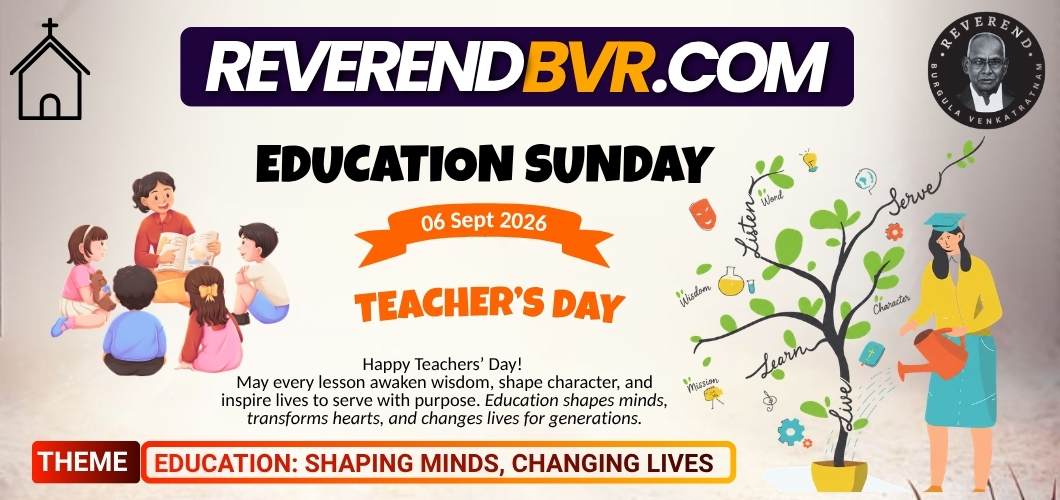
Sermon Title: Education: Shaping Minds, Changing Lives | The School of Grace: Education That Shapes Minds and Changes Lives
Occasion: 14th Sunday after Pentecost | Education Sunday, 06 September 2026. | Teachers Day
Scripture Readings: Isaiah 50:4–7; Psalm 119:9–16; Titus 2:1–10; Luke 5:1–11 & Proverbs 4:1–9; 2 Peter 1:3–11
Original Language Reflections (For deeper study, refer to the Table of Hebrew and Greek Terms in Section VII. of the sermon).
Website: www.reverendbvr.com
Theological Thesis: Biblical education is not merely the transfer of information. It is God’s work of forming the whole person. God awakens the ear, fills the heart with his Word, shapes character through obedience, gives wisdom for life, and sends disciples into the world to serve others.
The movement of today’s readings is simple: Listen → Learn → Live → Serve.
I. Introduction: What Is Education For?
We live in an age overflowing with information. A person carrying a smartphone can access more knowledge in minutes than earlier generations could gather in years. Yet information is not the same as wisdom.
A person may be highly educated and still lack compassion. A Christian may know many Bible verses and still remain proud, impatient, or unforgiving.
So, Scripture asks a deeper question: Not simply, “What do you know?” but “What is your knowledge making you become?”
The Bible understands education as formation. God teaches us so that we may become wise, faithful, loving, courageous, and useful in his mission.
The Collect for this Sunday beautifully asks God to give us “a teacher’s tongue and a disciple’s ear.”
That order matters. Before we can teach, we must learn to listen.
1. The Disciple’s Ear (Isaiah 50:4-7) :
Isaiah says: “The Lord GOD has given me the tongue of a disciple… morning by morning he wakens my ear to listen as those who are taught.”
The Hebrew expression לְשׁוֹן לִמּוּדִים, leshon limmudim means “the tongue of those who are taught” or “the tongue of disciples.”
The servant can teach because the servant remains teachable. God awakens the ear before he uses the tongue.
Isaiah also says that the servant is taught: “to sustain the weary with a word.”
That is a beautiful definition of good education. The purpose of knowledge is not to impress others but to strengthen them.
Teachers, parents, pastors, and leaders should therefore ask: Do my words merely display what I know, or do they give life?
Isaiah also connects education with courage. The servant suffers but says: “The Lord GOD helps me… therefore I have set my face like flint.”
Education must form courage as well as intelligence. We need wisdom not only to know what is right but to remain faithful when doing right becomes difficult.
2. The Word in the Heart (Psalm 119:9-16):
Psalm 119 asks: “How can young people keep their way pure? By guarding it according to your word.”
Verse 11 says: “I treasure your word in my heart, so that I may not sin against you.”
The Hebrew word צָפַן, tsaphan means “to hide, treasure, or store securely.” The psalmist does not merely possess God’s Word. He internalizes it. This is the difference between information and formation.
Biblical education happens when truth moves:
from the page to the mind,
from the mind to the heart,
from the heart to conduct,
and from conduct to character.
The psalmist also says: “I will meditate on your precepts and fix my eyes on your ways.”
True learning requires attention.
In a world of constant notifications, scrolling, and distraction, Christian education must teach us how to pay attention again: to God, Scripture, truth, suffering, and one another.
3. When Doctrine Becomes a Life (Titus 2:1-10) :
Paul tells Titus: “Teach what is consistent with sound doctrine.”
The Greek expression ὑγιαινούσῃ διδασκαλίᾳ, hygiainousē didaskalia means literally “healthy teaching.”
Paul expects healthy teaching to produce healthy lives.
He speaks about older people, younger people, leaders, families, and workers. Christian doctrine is not merely something we believe. It must become something we live.
Titus is told: “Show yourself in all respects a model of good works.”
The Greek word τύπος, typos mean “pattern,” “example,” or “model.”
A teacher’s life is part of the lesson.
Children learn not only from what adults say but from what they see. Congregations learn humility by watching leaders. Students learn integrity by watching teachers admit mistakes.
Paul then says believers should live: “so that in everything they may adorn the doctrine of God our Savior.”
The Greek verb κοσμέω, kosmeō means “to adorn, arrange beautifully, make attractive.”
Our lives do not create the beauty of the gospel. They make that beauty visible.
When Christians are honest when dishonesty is profitable, compassionate when indifference is easier, and faithful when compromise is convenient, the gospel becomes visible through their lives.
4. The Teacher Enters the Boat (Luke 5:1–11):
Luke tells us that Jesus entered Simon Peter’s boat.
The classroom became a fishing boat.
Jesus met Peter in his ordinary workplace.
This reminds us that God’s education does not happen only inside churches. It happens in classrooms, kitchens, offices, hospitals, laboratories, farms, and homes.
Jesus tells Peter: “Put out into the deep water and let down your nets for a catch.”
Peter replies: “Master, we have worked all night long but have caught nothing.”
Peter was an experienced fisherman. Yet Jesus asks him to try again.
Peter responds: “At your word, I will let down the nets.”
The Greek term ῥῆμα, rhēma means “word” or “spoken saying.”
Peter has experience saying, “It will not work.” Jesus gives him a word saying, “Try again.”
Faith begins when Peter trusts Christ more deeply than his disappointment.
This does not mean abandoning knowledge or experience. It means recognizing that our knowledge is never complete.
What I know is real, but what I know is not everything.
The miraculous catch causes Peter to fall before Jesus and say: “Go away from me, Lord, for I am a sinful man!”
At first Jesus was “Master.” Now he is “Lord.”
Education has become revelation.
Peter learns something about Jesus and, at the same time, something about himself.
But Jesus does not reject him.
He says: “Do not be afraid; from now on you will be catching people.”
The Greek verb ζωγρέω, zōgreō can mean “to capture alive” or “to take alive.”
Ordinarily, fishermen catch living fish and the fish die. Jesus transforms the image. Peter will now participate in a mission that draws people toward life.
Peter’s education now becomes mission. This is the deepest purpose of Christian education.
Christ does not simply change what Peter knows. Christ changes what Peter’s life is for.
5. Wisdom Must Become Character (Proverbs and 2 Peter):
Proverbs says: “Get wisdom; get insight.”
The Hebrew word חָכְמָה, chokmah means wisdom or skill for living rightly.
- Knowledge asks: “What can I do?”
- Wisdom asks: “What should I do?”
Knowledge gives power. Wisdom teaches us how to use that power faithfully.
Then 2 Peter tells believers to add to faith: virtue, knowledge, self-control, endurance, godliness, mutual affection, and love.
- Knowledge is important, but knowledge does not stand alone.
- Knowledge without love can become arrogance.
- Knowledge without self-control can become dangerous.
Christian learning is complete when knowledge bears fruit in character.
II. One Unified Message:
All the readings form one beautiful progression.
- Isaiah gives us the ear. God teaches us to listen.
- Psalm 119 gives us the heart. God’s Word becomes internalized.
- Titus gives us character. Truth becomes visible in life.
- Luke gives us vocation. Christ transforms learners into servants.
- Proverbs gives us wisdom.
- 2 Peter gives us maturity.
The movement is: Ear → Heart → Character → Vocation → Mission.
This is what Christian education is meant to accomplish.
III. Contemporary Application
Our world urgently needs this understanding of education. We can produce enormous quantities of information while remaining unsure how to use knowledge wisely.
Therefore, education must ask:
Not only, “Can this be done?” but, “Should it be done?”
Not only, “Will this make me successful?” but, “Will this make me faithful?”
Not only, “How much does my child know?” but, “What kind of person is my child becoming?”
Not only, “Can I win the argument?” but, “Can I speak truth with love?”
Christian education must form conscience as well as competence.
IV. Practical Life Applications
- To Teachers Ask God for Isaiah’s gift: a tongue that can sustain the weary. Students often carry hidden burdens, family struggles, loneliness, financial problems, fear of failure, bullying, or anxiety. Good teachers maintain standards while remembering the dignity of the learner.
- To Students Seek more than success, Seek wisdom. Study deeply, ask questions, develop excellence, but never let knowledge make you arrogant. The highest form of learning should make us more capable of service.
- To Parents The home is a classroom. Children learn from how adults use money, handle conflict, speak about others, pray, forgive, and admit mistakes. Sometimes one of the greatest lessons a parent can teach is: “I was wrong. Please forgive me.”
- To the Church The church must become a learning community. We should teach people not merely what to believe but how to live: how to pray, forgive, discern, serve, engage other people respectfully, endure suffering, handle money, pursue justice, and live faithfully.
- To Society Christian concern for education must include those at the margins. We should care about children without resources, students with disabilities, girls denied opportunity, poor communities, migrants, and others whose potential is ignored. Education can become a ministry of dignity.
V. Conclusion:
Today’s readings ask us one central question: What is our education making us become?
- Are we becoming more humble?
- More truthful?
- More compassionate?
- More courageous?
- More willing to serve?
- More like Christ?
The final evidence of Christian education is not the certificate on the wall. It is the character of the person.
Christ still enters ordinary boats. He still awakens disciples. He still says: “Put out into the deep.”
May our churches become schools of grace, our homes schools of wisdom, our classrooms places of dignity, our teachers’ lifelong disciples, and our learning an offering of love to God and neighbour.
VI. Let us Pray:
God of wisdom and truth,
awaken our ears morning by morning. Give us a disciple’s ear and a teacher’s tongue, so that our words may strengthen the weary. Plant your Word deeply within us. Move it from our minds into our hearts, from our hearts into obedience, and from obedience into lives that reveal Christ. Give wisdom to teachers, courage to students, patience to parents, humility to scholars, integrity to leaders, and opportunity to those denied the gift of learning.
- Where knowledge has made us proud, teach us humility.
- Where education has become competition, teach us service.
- Where disappointment has emptied our nets, speak again: “Put out into the deep.”
Lord Jesus, enter the boats of our ordinary lives and give us faith to say: “At your word, we will let down the nets.” Form in us knowledge with virtue, perseverance with hope, and above all, love. May our lives adorn the gospel, our words sustain the weary, and our learning draw people toward your life. Through Jesus Christ, our Teacher and Lord. Amen.
VII. Original-Language Word Study Table:
| Passage | Verse | Word | Transliteration | Literal Meaning | Theological Significance | Theme Connection |
| Isaiah 50 | 50:4 | לִמּוּדִים | limmudim | Disciples, those taught | The servant teaches because God first teaches him | Education begins in listening |
| Isaiah 50 | 50:7 | חַלָּמִישׁ | challamish | Flint | Steadfastness under suffering | Learning must form courage |
| Psalm 119 | 119:11 | צָפַן | tsaphan | Hide, treasure | God’s Word is internalized | Truth must enter the heart |
| Psalm 119 | 119:15 | שִׂיחַ | siach | Meditate, ponder | Deep learning requires reflection | Formation requires attention |
| Proverbs 4 | 4:5, 7 | חָכְמָה | chokmah | Wisdom | Skill for faithful living | Education must produce wisdom |
| Titus 2 | 2:1 | ὑγιαίνω | hygiainō | Be healthy, sound | True doctrine produces spiritual health | Healthy teaching shapes lives |
| Titus 2 | 2:7 | τύπος | typos | Model, pattern | The teacher’s life becomes an example | Education is embodied |
| Titus 2 | 2:10 | κοσμέω | kosmeō | Adorn | Faithful conduct displays gospel beauty | Character makes truth visible |
| Luke 5 | 5:5 | ῥῆμα | rhēma | Word, saying | Peter acts because of Christ’s word | Learning becomes obedience |
| Luke 5 | 5:10 | ζωγρέω | zōgreō | Capture alive | Peter is called into life-giving mission | Education leads to mission |
| 2 Peter 1 | 1:5 | γνῶσις | gnōsis | Knowledge | Knowledge belongs among other virtues | Information must become formation |
| 2 Peter 1 | 1:7 | ἀγάπη | agapē | Self-giving love | Christian formation culminates in love | Love is education’s highest fruit |
Bibliography:
- Blenkinsopp, Joseph. Isaiah 40–55. Anchor Bible 19A. New York: Doubleday, 2002.
- Green, Joel B. The Gospel of Luke. NICNT. Grand Rapids: Eerdmans, 1997.
- Koehler, Ludwig, Walter Baumgartner, and Johann Jakob Stamm. The Hebrew and Aramaic Lexicon of the Old Testament. Leiden: Brill, 1994–2000.
- Towner, Philip H. The Letters to Timothy and Titus. NICNT. Grand Rapids: Eerdmans, 2006.
- Waltke, Bruce K. The Book of Proverbs: Chapters 1–15. NICOT. Grand Rapids: Eerdmans, 2004.
© 2025 ReverendBVR.com | High-Academic Sermon Series, 2026.
Content licensed under Creative Commons Attribution-NonCommercial-NoDerivatives 4.0 International (CC BY-NC-ND 4.0). You are free to share, copy and redistribute the material in any medium or format with proper attribution. No commercial use or modifications allowed without explicit permission.
For further sermons and biblical reflections, please visit 🌐 www.reverendbvr.com/sermons

Leave a Reply