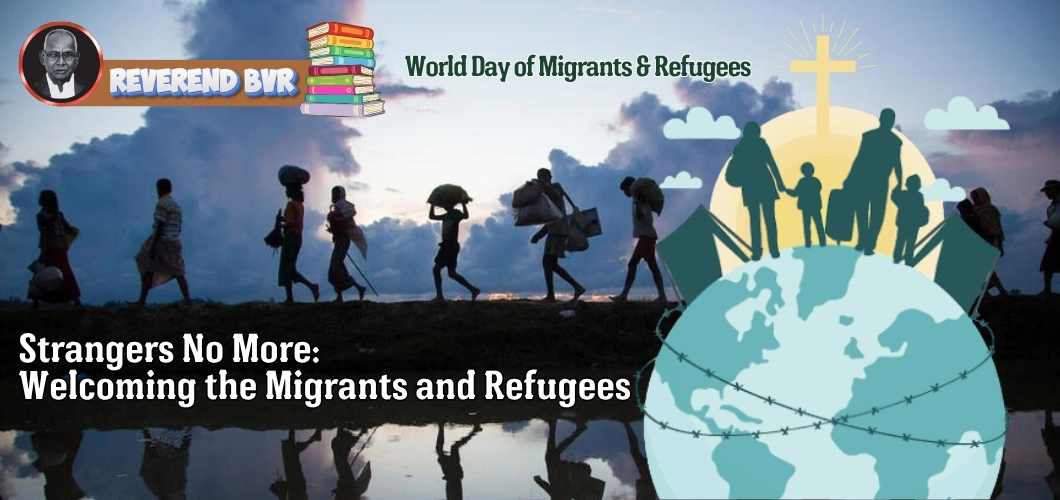
Sermon Title: Strangers No More: Welcoming the Migrants and Refugees.
Occasion: 13th Sunday after Pentecost | Sunday, 30 August2026. | World Day of Migrants & Refugees.
Scripture Readings: Leviticus 19:9–10, 33–37 | Psalm 146 | Ephesians 2:11–22 | Luke 10:25–37 | Deuteronomy 24:17–22 | Acts 10:30–35.Original Language Reflections (For deeper study, refer to the Table of Hebrew and Greek Terms in Section IX. of the sermon).
Website: www.reverendbvr.com
Theological Thesis: Because God welcomes the stranger and reconciles the outsider through Jesus Christ, the Church is called to become a community where migrants, refugees, and every marginalized person are received not as strangers but as members of God’s household.
Introduction: A World on the Move
Our generation is witnessing one of the greatest movements of people in human history. Millions flee wars, persecution, poverty, climate disasters, and political unrest. Others leave their homes seeking education, employment, or safety. Some become refugees crossing international borders; others are internally displaced within their own nations.
Yet migration is not merely a political issue, It is deeply biblical: From Abraham leaving Ur to Israel’s exodus from Egypt, from Ruth the Moabite finding refuge in Bethlehem to Joseph and Mary fleeing to Egypt with the infant Jesus, Scripture tells the story of people on the move. We must understand that Even our Lord Jesus Christ experienced life as a refugee.
The Collect for today beautifully reminds us that God is “the shelter of refugees, the sanctuary of the socially segregated, the bridge connecting the disconnected.” This is not a poetic exaggeration, it is the very character of God revealed throughout Scripture.
Today’s readings invite us to see migrants and strangers not as problems to solve but as neighbors to love and fellow citizens whom Christ desires to welcome into His family.
I. God Remembers the Stranger (Leviticus 19; Deuteronomy 24):
The Old Testament begins with a remarkable truth: Israel was commanded to structure its society around compassion for the vulnerable.
- Leviticus commands landowners not to harvest every corner of their fields but to leave food for “the poor and the stranger.”
- Similarly, Deuteronomy commands Israel not to deprive foreigners of justice and to leave portions of the harvest for the widow, orphan, and immigrant.
These commands were not the acts of charity alone; they were the acts of covenant faithfulness.
Israel was repeatedly reminded: “Remember that you were slaves in Egypt.”
Memory shaped morality Because Israel once lived as foreigners, they were never permitted to forget the pain of exclusion. (Their memory of God’s grace became the foundation of their moral responsibility.)
The Hebrew word גֵּר (gēr) refers to the resident foreigner, someone living among Israel without ancestral land or family protection. Such people depended entirely upon the justice and generosity of God’s people.
Notice something remarkable here: God does not merely tolerate the stranger, God legislates dignity.
Justice is measured by how society treats those with the least power.
The harvest laws reveal that God’s economy always includes room for those who have nowhere else to belong.
II. The God Who Defends the Vulnerable (Psalm 146):
Psalm 146 expands this picture. The psalmist praises the Lord because “He watches over the strangers.”
Kings often protect their own citizens But God protects those who belong nowhere.
The Psalm places foreigners alongside widows and orphans, the three groups who possessed little legal or economic protection in the ancient world. Throughout Scripture these three appear together because they represent those who cannot repay kindness.
God’s love always moves toward the vulnerable. His kingdom is measured not by military strength or economic success but by justice, compassion, and faithful love.
The Church worships this God. Therefore, our worship loses credibility if compassion does not accompany our praise.
III. Christ Removes Every Wall (Ephesians 2) :
Paul now takes the Old Testament vision to its glorious fulfillment.
The church in Ephesus consisted of Jews and Gentiles. These communities had been divided for centuries by suspicion, religion, culture, and history.
Paul describes Gentiles as “strangers to the covenants of promise.” Yet through Christ everything changes.
Jesus does not simply forgive individual sins. He creates a new humanity. The cross reconciles vertically with God and horizontally with one another.
Paul declares that Christ has broken down the “dividing wall of hostility.” This image probably recalls the physical barrier in the Jerusalem Temple beyond which Gentiles could not enter under penalty of death. Through Christ, that wall is gone.
The Greek word ξένος (xenos), meaning “stranger” or “foreigner,” no longer defines Christian identity. Instead, believers become “fellow citizens with the saints and members of the household of God.”
Notice Paul’s beautiful progression: Strangers become citizens. Citizens become family. And that family becomes God’s dwelling place.
The Church therefore cannot build walls that Christ died to remove. Every congregation is called to become a visible demonstration of reconciliation. Ethnicity, nationality, language, social class, and migration status no longer determine one’s worth before God.
The Church is not merely an organization, It is God’s new humanity.
IV. The Good Samaritan: Love Beyond Boundaries (Luke 10):
Jesus then illustrates what reconciliation looks like in everyday life.
The lawyer asks, “And who is my neighbor?” This question attempts to limit responsibility. But Jesus answers by eliminating limits altogether.
The hero of the story is shocking, It is Not the priest nor the Levite but But the Samaritan.
For Jewish listeners, Samaritans represented religious and ethnic outsiders. Yet this outsider becomes the model of faithful obedience.
The Greek verb σπλαγχνίζομαι (splagchnizomai), “to be moved with compassion,” describes the Samaritan’s response.
This is more than sympathy. It refers to deep, gut-level mercy. It is the same verb frequently used of Jesus Himself.
The Samaritan crosses every boundary: He approaches –> He touches –> He bandages –> He transports –> He pays –> He promises continued care.
Love becomes visible through costly action. Also Notice the setting. The injured man has no identifiable ethnicity or religion. Jesus deliberately removes every social label. Only Need becomes the only qualification for mercy.
Neighborliness is therefore not determined by proximity, nationality, or shared identity. Neighborliness is created through compassion.
The lawyer asked, “Who is my neighbor?” then Jesus asks, “Who became a neighbor?”
The difference changes everything. Christian discipleship is not asking whom we must love. It is becoming people who love.
V. Peter Learns God’s Heart (Acts 10) :
The lesson continues in Acts.
Cornelius is a Roman centurion. Politically, he belongs to the occupying empire. Religiously, he is a Gentile. That means, Socially, he stands outside Israel. Yet God orchestrates a meeting between Peter and Cornelius.
Peter finally confesses, “I truly understand that God shows no partiality.” This sentence marks one of the great turning points in Christian history. The Gospel crosses ethnic borders because God’s grace is never confined by them. The early Church discovered that hospitality is not optional. It is essential to the mission of God.
Every barrier removed by Christ becomes an opportunity for witness. The Church grows whenever it welcomes those whom society excludes.
VI. Becoming the Household of God Today:
These passages speak powerfully into today’s world.
Migration often creates fear. People worry about economic security, cultural change, or political stability.
Scripture does not ignore these complexities.
Governments have responsibilities regarding justice and order. Yet the Church has a distinct calling.
Our first question is not political. It is theological.
How does God see the stranger?
Today’s readings answer clearly.
- God remembers.
- God protects.
- God welcomes.
- God reconciles.
Therefore, His people must do likewise. This applies not only to international refugees.
Many people experience displacement without crossing borders:
- Students living far from home.
- Workers migrating for employment.
- Widows who feel forgotten.
- Children entering new schools.
- People rejected because of caste, ethnicity, disability, language, or poverty.
- Even newcomers entering a church for the first time may feel like strangers.
Every congregation should ask:
- Does our worship communicate welcome?
- Do our friendships cross social boundaries?
- Do newcomers find belonging?
- Do we see Christ in those society overlooks?
Hospitality is not merely opening our homes, It is opening our hearts.
The Gospel invites us to replace suspicion with compassion, exclusion with fellowship, and fear with faithful love. In Christ, strangers become family.
VII. Conclusion: No Longer Strangers
The Bible begins with a garden open to humanity and ends with people from every nation gathered before God’s throne.
Between Genesis and Revelation runs one consistent story:
- God seeks those who are far away.
- He gathers the scattered.
- He heals divisions.
- He builds one household.
On the cross, Jesus Himself became the rejected One so that the rejected might be welcomed. He was cast outside the city so that outsiders could enter the Kingdom.
Because Christ welcomed us when we were strangers to God’s covenant, we now welcome others in His name. The Church should become the safest place in every community for those who have nowhere else to belong…
For in Christ there are truly strangers no more.
VIII. Let us Pray:
Gracious Father, You welcomed us when we were far from You and made us members of Your household through Jesus Christ. Fill our hearts with Your compassion for migrants, refugees, strangers, and all who feel forgotten or displaced. Remove every wall of prejudice, fear, and hostility that remains within us. Teach us to love as Christ loved, to serve as the Good Samaritan served, and to build communities where every person may experience the grace of Your Kingdom. May our churches become places of refuge, reconciliation, and hope until people from every nation worship together before Your throne. Through Jesus Christ our Lord. Amen.
IX. Hebrew and Greek Word Study Table
| S.No | Passage | Verse | Original Word | Transliteration | Literal Meaning | Theological Significance |
| 1 | Leviticus 19 | 33 | גֵּר | gēr | Resident foreigner, sojourner | God’s covenant includes legal protection and dignity for immigrants living among His people. |
| 2 | Deuteronomy 24 | 17 | מִשְׁפָּט | mishpat | Justice, legal judgment | God’s justice protects the vulnerable, especially foreigners, widows, and orphans. |
| 3 | Psalm 146 | 9 | שָׁמַר | shāmar | To guard, preserve | The Lord actively watches over and protects strangers. |
| 4 | Ephesians 2 | 19 | ξένος | xenos | Stranger, foreigner | In Christ believers are no longer outsiders but members of God’s household. |
| 5 | Ephesians 2 | 14 | εἰρήνη | eirēnē | Peace, reconciliation | Christ Himself embodies the peace that removes hostility between peoples. |
| 6 | Luke 10 | 33 | σπλαγχνίζομαι | splagchnizomai | To be moved with deep compassion | Describes Christ-like mercy expressed through costly action. |
| 7 | Acts 10 | 34 | προσωπολήμπτης | prosōpolēmptēs | One who shows partiality | God welcomes all people without favoritism, forming the basis for the Church’s universal mission. |
X. Explanatory Footnotes (Notes for Further Reading) :
- Unless otherwise noted, Scripture quotations are from the New Revised Standard Version Updated Edition (NRSVue).
- The “dividing wall” in Ephesians 2:14 likely alludes to the temple barrier separating Gentiles from Jewish worshipers, symbolizing Christ’s removal of ethnic and religious hostility.
- The gēr in the Pentateuch refers to a resident foreigner living under Israel’s protection and therefore entitled to covenantal justice.
- The verb splagchnizomai frequently describes Jesus’ own compassionate ministry (e.g., Matt. 9:36; Mark 6:34), reinforcing the Christ-centered character of the Samaritan’s mercy.
XI. Bibliography:
- Bauckham, Richard. Bible and Mission: Christian Witness in a Postmodern World. Grand Rapids: Baker Academic, 2003.
- Bock, Darrell L. Luke. 2 vols. Baker Exegetical Commentary on the New Testament. Grand Rapids: Baker Academic, 1994–1996.
- Brueggemann, Walter. Deuteronomy. Abingdon Old Testament Commentaries. Nashville: Abingdon Press, 2001.
- Bruce, F. F. The Epistles to the Colossians, to Philemon, and to the Ephesians. New International Commentary on the New Testament. Grand Rapids: Eerdmans, 1984.
- Goldingay, John. Psalms, Volume 3: Psalms 90-150. Baker Commentary on the Old Testament Wisdom and Psalms. Grand Rapids: Baker Academic, 2008.
- Green, Joel B. The Gospel of Luke. New International Commentary on the New Testament. Grand Rapids: Eerdmans, 1997.
- Keener, Craig S. Acts: An Exegetical Commentary. 4 vols. Grand Rapids: Baker Academic, 2012–2015.
- Milgrom, Jacob. Leviticus 17-22. Anchor Yale Bible 3A. New Haven: Yale University Press, 2000.
- Silva, Moisés, ed. New International Dictionary of New Testament Theology and Exegesis. 2nd ed. Grand Rapids: Zondervan, 2014.
- VanGemeren, Willem A., ed. New International Dictionary of Old Testament Theology and Exegesis. 5 vols. Grand Rapids: Zondervan, 1997.
- Wright, Christopher J. H. Old Testament Ethics for the People of God. Downers Grove, IL: IVP Academic, 2004.
© 2025 ReverendBVR.com | High-Academic Sermon Series, 2026.
Content licensed under Creative Commons Attribution-NonCommercial-NoDerivatives 4.0 International (CC BY-NC-ND 4.0). You are free to share, copy and redistribute the material in any medium or format with proper attribution. No commercial use or modifications allowed without explicit permission.
For further sermons and biblical reflections, please visit 🌐 www.reverendbvr.com/sermons


Leave a Reply