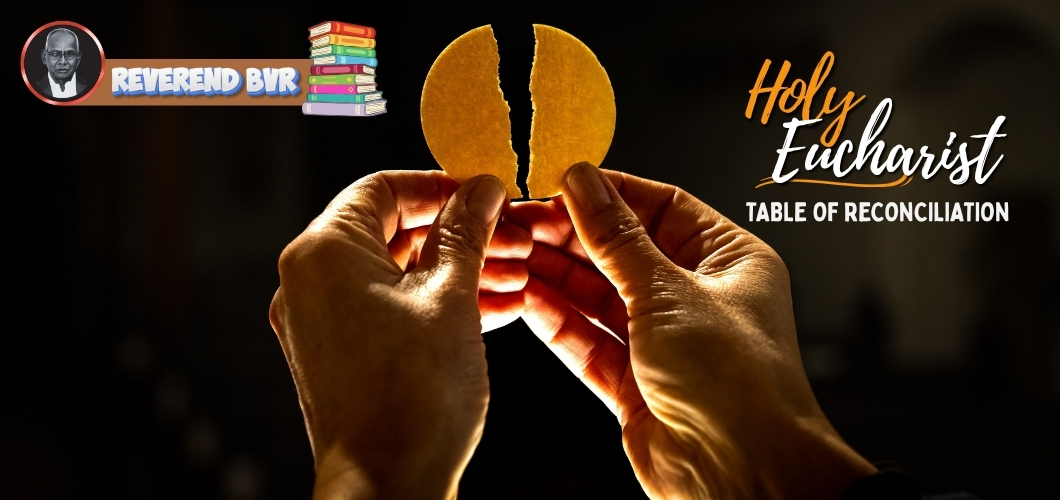
Sermon Title: Holy Eucharist: The Table of Reconciliation.
Occasion: 11th Week after Pentecost | Sunday, 16 August 2026.
Scripture Readings: Exodus 24:3–11 | Psalm 85 | 1 Corinthians 10:14–22 | Matthew 5:23–26 | Isaiah 25:6–9 | 2 Corinthians 5:11–21.
Original Language Reflections (For deeper study, refer to the Table of Hebrew and Greek Terms in Section XI. of the sermon).
Website: www.reverendbvr.com
Collect: Loving and Grateful God, we are grateful for the act of Love. We beseech you reconcile us through Jesus Christ our Lord, who lives and reigns with you and the Holy Spirit, one God, world without end. Amen.
Theological Thesis: The Holy Eucharist is God’s covenant meal of reconciliation, where Christ restores broken humanity to God and calls His people to become a reconciled community that embodies His peace before the world.
I. At the Lord’s Table, More Than a Meal:
Every family knows that a table can unite or divide., Some tables are filled with laughter, thanksgiving, and stories. Others remain painfully silent because relationships have been wounded. Sometimes the meal is prepared, but someone is absent because reconciliation has not yet taken place.
The Bible repeatedly portrays the table as a place where relationships are restored. God’s story begins with fellowship in Eden, is interrupted by sin, and reaches its climax in Jesus Christ, who welcomes sinners to His table and prepares an eternal banquet for His redeemed people.
Today’s readings invite us to see the Holy Eucharist not merely as a sacred ritual but as God’s table of reconciliation. Here heaven meets earth. Here sinners receive grace. Here enemies become family. Here Christ nourishes His Church so that she may become an agent of reconciliation in a fractured world.
The Collect captures this beautifully. We thank God for His supreme act of love and pray that through Christ we ourselves may become reconciled people. That prayer echoes throughout every Scripture appointed for today.
II. The Covenant Meal: God Invites His People into Fellowship (Exodus 24:3-11):
Exodus 24 marks one of the most remarkable moments in Israel’s history. After delivering Israel from Egypt, God establishes His covenant with His people at Sinai. Moses reads the Book of the Covenant, Israel promises obedience, sacrifices are offered, and blood is sprinkled upon both altar and people.
Then something astonishing occurs. The elders of Israel ascend the mountain. “They saw the God of Israel… they beheld God, and they ate and drank.”
In the ancient Near East, eating together signified peace, trust, and covenant friendship. One did not share a meal with an enemy. The meal on Sinai therefore proclaims an extraordinary truth: the holy God welcomes redeemed sinners into covenant fellowship.
Yet this covenant remained incomplete. Animal sacrifices could symbolize cleansing, but they could never permanently remove sin. Sinai pointed beyond itself toward another mountain, Calvary, where Christ would establish the new covenant through His own blood.
Every celebration of Holy Communion echoes Sinai, yet surpasses it. We no longer approach through the blood of bulls and goats, but through the once-for-all sacrifice of Jesus Christ.
III. Peace and Mercy Meet (Psalm 85):
Psalm 85 reflects Israel’s longing after judgment and exile. The psalmist remembers God’s forgiveness in the past and pleads for renewed restoration. Its most beautiful verse declares: “Steadfast love and faithfulness meet; righteousness and peace kiss each other.”
This poetic image reveals the heart of the Gospel. Human beings often separate justice from mercy. Justice without mercy becomes condemnation. Mercy without justice ignores evil.
At the cross, however, God’s holiness and His love meet perfectly.
- Sin is judged.
- The sinner is forgiven.
- Justice and peace embrace.
Every Eucharistic celebration remembers that costly reconciliation. The bread and cup proclaim not cheap forgiveness but redemption purchased through Christ’s sacrifice.
IV. One Table, One Lord (1 Corinthians 10:14-22):
Paul addresses a church struggling with divided loyalties. Some believers assumed they could participate both in pagan temple feasts and in the Lord’s Supper.
Paul firmly rejects this idea. “The cup of blessing… the bread that we break…” Participation in Communion is not merely remembering Christ intellectually.
The Greek word κοινωνία (koinōnia) means participation, fellowship, or sharing. Believers truly share in Christ’s saving work and simultaneously share life with one another.
Paul therefore reminds the church: “Because there is one bread, we who are many are one body.”
The Eucharist is therefore both vertical and horizontal.
- We commune with Christ.
- We commune with His people.
This explains why division, bitterness, prejudice, or hatred fundamentally contradict the Lord’s Table. Communion without reconciliation becomes contradiction.
V. First Be Reconciled (Matthew 5:23-26):
Jesus’ teaching in the Sermon on the Mount is startling.
Imagine a worshiper standing before the altar with an offering prepared. Suddenly he remembers that a brother or sister has something against him. Jesus commands: “Leave your gift… First be reconciled.”
Notice that Jesus does not minimize worship. Rather, He deepens it. True worship cannot be separated from transformed relationships. God refuses worship that ignores broken fellowship.
This teaching prepares believers to approach the Eucharistic table with humility and repentance. Throughout Christian history many liturgies have included the exchange of peace before Communion.
That practice reflects Jesus’ teaching. Before receiving God’s gift, we examine our hearts.
- Whom have we wounded?
- Whom have we refused to forgive?
- Where have pride, jealousy, anger, or resentment quietly grown?
The Lord’s Table invites honest self-examination, not to exclude sinners, but to welcome repentant sinners into restored fellowship.
VI. Christ, Our Ministry of Reconciliation (2 Corinthians 5:11-21):
Paul now reveals the deepest meaning of reconciliation. “God was in Christ reconciling the world to Himself.” This is one of the richest theological statements in the New Testament.
Humanity did not first seek God. God sought humanity. The offended party initiated reconciliation.
The Greek word καταλλαγή (katallagē) means restoration of a broken relationship into peaceful friendship.
Paul declares that believers not only receive reconciliation but also become its ambassadors.
The Church therefore exists not merely to preserve religious tradition but to extend God’s reconciling mission into the world.
Families, Churches, Communities, Nations... Everywhere relationships have fractured, Christians are called to bear witness that reconciliation is possible because Christ has first reconciled us to God.
The Eucharist strengthens precisely this vocation. We receive Christ’s peace so that we may become peacemakers.
VII. The Great Banquet Yet to Come (Isaiah 25:6-9):
Isaiah broadens the horizon beyond Israel. God prepares “a feast of rich food” for all peoples. Death itself will be swallowed up. Every tear will be wiped away. This prophetic vision reaches beyond every earthly Communion service. Each Eucharist becomes a foretaste of the coming kingdom.
The Lord’s Table points forward to the Marriage Supper of the Lamb, where every tribe, language, and nation will gather around Christ forever.
Communion therefore lives between memory and hope.
We remember the cross.
We anticipate the kingdom.
We proclaim, “Christ has died. Christ is risen. Christ will come again.”
VIII. Living as a Eucharistic People:
How then should this shape our lives?
- First, approach Communion with gratitude rather than routine. The table is God’s gracious invitation, not our achievement. We come because Christ has made a way.
- Second, examine your relationships honestly. Reconciliation may not always be immediately possible, but believers should never willingly nurture bitterness, vengeance, or hatred. Sometimes reconciliation requires difficult conversations, confession, forgiveness, patience, or wise boundaries. The Gospel calls us to pursue peace wherever faithfulness allows.
- Third, become ambassadors of reconciliation. Our polarized world desperately needs Christians who listen before judging, forgive before retaliating, and seek restoration rather than victory. The credibility of our witness often depends upon whether our relationships reflect the Gospel we proclaim.
- Finally, live with hope. Every Eucharist reminds us that history is moving toward God’s great banquet. The risen Christ who feeds us today will one day welcome His redeemed people into everlasting fellowship where sin, death, division, and sorrow shall be no more.
IX. Conclusion:
The story of Scripture moves from covenant meal to covenant meal.
- Sinai.
- The Upper Room.
- The Lord’s Table.
- The Marriage Supper of the Lamb.
At every stage, God is the One who graciously invites His people into fellowship.
Today, Christ still prepares His table.
- He welcomes the repentant.
- He forgives the guilty.
- He restores the broken.
- He nourishes His Church.
- Then He sends us back into the world as ambassadors of reconciliation.
May we never leave His table unchanged. For those who have received the Bread of Life must become people through whom God’s reconciling love becomes visible. Amen.
X. Closing Prayer:
Gracious Father, we thank You for Your immeasurable love revealed in Jesus Christ, who reconciled us to Yourself through His cross and welcomes us to His holy table. Cleanse our hearts of pride, resentment, and division. Grant us the humility to seek forgiveness, the courage to forgive others, and the grace to live as faithful ambassadors of reconciliation. As we receive Christ by faith, strengthen us to bear witness to His peace in our homes, our churches, and our communities until the day when we join the everlasting feast in Your heavenly kingdom. Through Jesus Christ our Lord, who lives and reigns with You and the Holy Spirit, one God, now and forever. Amen.
XI. Hebrew and Greek Word Study Table:
| S.No | Passage | Verse | Original Word | Transliteration | Literal Meaning | Theological Significance |
| 1 | Exodus 24 | 8 | בְּרִית | berît | Covenant | God’s binding relationship established through sacrificial blood; fulfilled in Christ’s new covenant. |
| 2 | Psalm 85 | 10 | חֶסֶד | ḥesed | Steadfast love, covenant mercy | God’s faithful love that sustains His covenant despite human failure. |
| 3 | Psalm 85 | 10 | שָׁלוֹם | šālôm | Peace, wholeness | More than absence of conflict; restored relationship with God and others. |
| 4 | Isaiah 25 | 6 | מִשְׁתֶּה | mišteh | Banquet, feast | Symbol of God’s final kingdom and universal salvation. |
| 5 | 1 Corinthians 10 | 16 | κοινωνία | koinōnia | Participation, fellowship | Believers share in Christ and are united as one body. |
| 6 | 2 Corinthians 5 | 18 | καταλλαγή | katallagē | Reconciliation | Restoration of broken relationship through Christ’s atoning work. |
| 7 | Matthew 5 | 24 | διαλλάγηθι | diallagēthi | Be reconciled | Jesus commands restored human relationships as an expression of genuine worship. |
XII. Explanatory Footnotes (Notes for Further Reading) :
- The covenant meal in Exodus 24 serves as the theological background for later biblical covenant meals, culminating in the Lord’s Supper (cf. Heb. 9:15-22).
- Psalm 85:10 poetically depicts the harmony of God’s justice and mercy, themes fulfilled in Christ’s atoning work (Rom. 3:21-26).
- Paul’s use of koinōnia in 1 Corinthians 10 emphasizes genuine participation in Christ rather than mere symbolic remembrance.
- The “ministry of reconciliation” in 2 Corinthians 5 forms one of the foundational New Testament texts for the Church’s mission in the world.
- Isaiah 25:6-9 significantly shapes New Testament imagery concerning the messianic banquet (cf. Matt. 8:11; Rev. 19:6-9).
XIII. Bibliography:
- Beale, G. K., and D. A. Carson, eds. Commentary on the New Testament Use of the Old Testament. Grand Rapids: Baker Academic, 2007.
- Block, Daniel I. Covenant: The Framework of God’s Grand Plan of Redemption. Grand Rapids: Baker Academic, 2021.
- Brueggemann, Walter. Theology of the Old Testament. Minneapolis: Fortress Press, 1997.
- Fee, Gordon D. The First Epistle to the Corinthians. NICNT. Grand Rapids: Eerdmans, 1987.
- France, R. T. The Gospel of Matthew. NICNT. Grand Rapids: Eerdmans, 2007.
- Hafemann, Scott J. 2 Corinthians. NIVAC. Grand Rapids: Zondervan, 2000.
- Keener, Craig S. The Gospel of Matthew: A Socio-Rhetorical Commentary. Grand Rapids: Eerdmans, 2009.
- Longman III, Tremper. Psalms. Tyndale Old Testament Commentaries. Downers Grove, IL: IVP Academic, 2014.
- Oswalt, John N. The Book of Isaiah: Chapters 1-39. NICOT. Grand Rapids: Eerdmans, 1986.
- Wright, N. T. Paul and the Faithfulness of God. Minneapolis: Fortress Press, 2013.
- Brown, Francis, S. R. Driver, and Charles A. Briggs. The Brown-Driver-Briggs Hebrew and English Lexicon. Peabody, MA: Hendrickson, 1996.
- Danker, Frederick W., ed. A Greek-English Lexicon of the New Testament and Other Early Christian Literature. 3rd ed. Chicago: University of Chicago Press, 2000.
© 2025 ReverendBVR.com | High-Academic Sermon Series, 2026.
Content licensed under Creative Commons Attribution-NonCommercial-NoDerivatives 4.0 International (CC BY-NC-ND 4.0). You are free to share, copy and redistribute the material in any medium or format with proper attribution. No commercial use or modifications allowed without explicit permission.
For further sermons and biblical reflections, please visit 🌐 www.reverendbvr.com/sermons
Leave a Reply