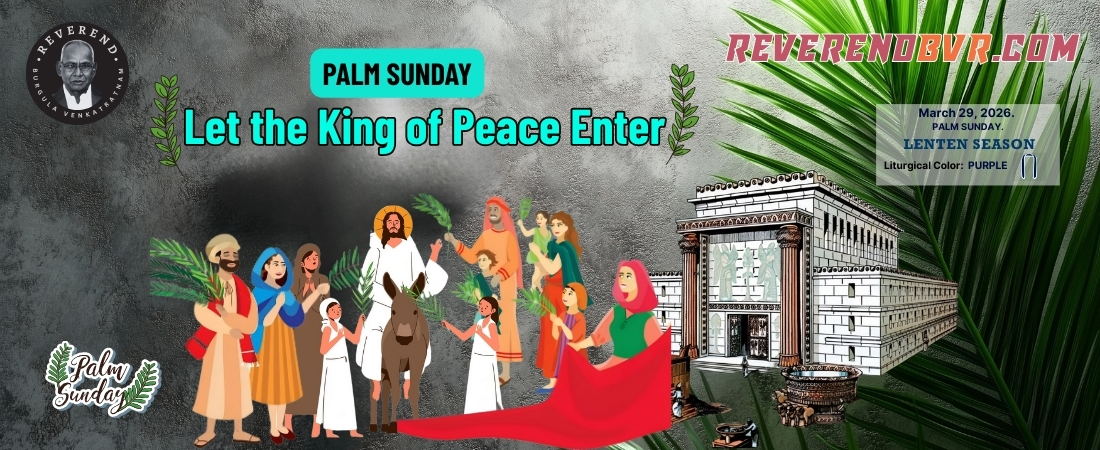
Sermon Title: Let the King of Peace Enter.
Occasion: March 29, 2026 – Palm Sunday.
Bible Readings: 2 Kings 7: 3-20 | Psalm 24 | Phil. 4: 4-13 | Mark 11: 1-11 | Zech. 9:1-12 and Colo. 3: 12-17.
Original Language Reflections (For deeper study, refer to the Table of Hebrew and Greek Terms in Section VIII. of the sermon).
Website: www.reverendbvr.com
Theological Thesis: Palm Sunday proclaims a paradox at the heart of the gospel: God’s reign of peace enters the world not through coercive power but through humble, reconciling love. The King who comes riding a donkey does not conquer by violence; He disarms fear, heals scarcity, gathers the fractured, and clothes His people in a peace strong enough to face suffering. Across all the readings, God reveals a character consistent and coherent, a peace that saves, restores, and sends.
This is the peace we are invited not merely to admire, but to receive and embody.
1. Entering the Story: Psalm 24 as the Gate
“Lift up your heads, O gates! … that the King of glory may come in.” (Ps 24:7)
Psalm 24 frames Palm Sunday as a liturgical drama. Jerusalem is not merely a city with streets and gates; it is a threshold. The question: “Who is this King of glory?”, is not rhetorical. It is posed to every generation.
The Psalm names God as strong, but strong in righteousness, holiness, and faithfulness. Palm Sunday answers the Psalm’s question not with chariots or armies, but with a man on a colt, entering amid the poor and the praising.
2. The King Who Ends Siege, Not by Force (2 Kings 7:3-20)
This startling narrative of deliverance during siege and famine exposes a deep truth: God’s salvation often arrives from the margins.
Four lepers: excluded, powerless, unclean, discover that the enemy camp is empty. Abundance appears where only death was expected. The story rebukes despair and unbelief, especially the officer who scoffs at God’s promise and cannot enter the joy he refuses to trust.
Palm Sunday echoes this pattern. Jerusalem expects a military liberator. Instead, God sends a Prince of Peace whose victory looks like vulnerability. Those who trust enter the feast; those who cling to cynicism remain outside the joy.
3. Rejoicing That Defies Circumstances (Philippians 4:4-13)
“Rejoice in the Lord always… The Lord is near.” (Phil 4:4-5)
Paul writes from confinement, yet insists on joy, not as optimism, but as confidence in God’s nearness. Peace here is not the absence of trouble but the presence of God guarding the heart.
Palm Sunday joy is fragile and fierce at once. The same city that shouts “Hosanna!” will soon cry “Crucify!” Yet Christ enters anyway. The King of Peace does not wait for safe conditions. He brings a peace that can stand in the storm.
4. The Triumphal Entry Reimagined (Mark 11:1-11)
“Hosanna! Blessed is the one who comes in the name of the Lord!” (Mk 11:9)
Jesus deliberately fulfills prophecy by riding a colt, an enacted sermon drawn from Zechariah. This is kingship without spectacle, authority without domination.
He enters the city, looks around the temple, and leaves quietly. Mark’s restraint is profound: the true drama of peace unfolds not in applause but in obedience. Palm Sunday is not the climax; it is the doorway into the cross, where peace will be purchased at great cost.
5. The Prophetic Lens: Zechariah 9:9-12
“Lo, your king comes to you; triumphant and victorious is he, humble and riding on a donkey.” (Zech 9:9)
Zechariah redefines victory. This king cuts off the chariot and war-horse, proclaiming peace to the nations. His dominion stretches not by conquest but by covenant faithfulness.
Palm branches become symbols of hope, but also of misunderstanding. Christ comes as promised, yet not as expected. Peace does not mean appeasement; it means the costly restoration of right relationship.
6. Clothed for Peaceful Living (Colossians 3:12-17)
“As God’s chosen ones… clothe yourselves with compassion, kindness, humility…” (Col 3:12)
If Palm Sunday reveals the character of God’s King, Colossians describes the character of God’s people. Peace is not only received; it is practiced.
The peace of Christ is to rule, to act as umpire in the community’s life. Forgiveness replaces vengeance. Gratitude replaces rivalry. The word of Christ dwells richly where peace reigns.
II. The Collect as Theological Compass
The Collect names Jesus as King of Peace and resists the world’s assumptions about power. It asks not merely that Christ enter history, but that He enter hearts, churches, societies, and global realities scarred by conflict.
The prayer’s movement is intentional:
- From praise (who Christ is),
- To petition (where peace is broken),
- To vocation (we become bearers of hope and reconciliation).
Palm Sunday thus becomes not a memory to reenact, but a mission to live.
III. Contemporary Resonance:
In a world exhausted by violence, polarized by ideology, and numbed by despair, Palm Sunday insists:
- Peace is not naïve, Humility is not weakness, Hope is not denial.
The King of Peace enters places where fear governs policy, anger governs speech, and despair governs imagination. He does not shame the world; He redeems it from within.
IV. Life Applications:
- Welcome Christ daily: Ask where His peace is resisted in your habits, fears, or relationships.
- Practice non-anxious faith: Let prayer, not panic, be your reflex.
- Become peace-bearers: In families, churches, workplaces—embody reconciliation rather than winning.
- Hold joy and suffering together: Like Palm Sunday itself, faith rejoices while walking toward the cross.
V. A Concluding Prayer
Gracious King of Peace, enter the cities of our lives where fear builds walls and hope feels fragile.
Ride gently into our conflicts, our divided communities, our weary hearts. Disarm us of pride; clothe us with compassion.
Let Your peace rule where anxiety shouts the loudest, and Your love remain when applause fades into silence. Make us signs of Your kingdom; not with banners of triumph, but with lives shaped by mercy, courage, and faithful hope.
Through Jesus Christ, who comes humbly, reigns faithfully, and restores all things. Amen.
VI. Key Biblical Terms & Original-Language Notes:
| S.No | Passage | Verse | Original Word | Language | Literal Meaning | Theological Weight |
| 1 | Psalm 24 | v.7 | כָּבוֹד (kābôd) | Hebrew | Weight, glory | God’s presence carries transforming weight |
| 2 | 2 Kings 7 | v.9 | בְּשׂוֹרָה (besōrāh) | Hebrew | Good news | Salvation proclaimed from the margins |
| 3 | Zech 9 | v.9 | עָנִי (ʿānî) | Hebrew | Humble, afflicted | Messianic humility, not weakness |
| 4 | Mark 11 | v.9 | Ὡσαννά (Hōsanna) | Greek | Save us, we pray | Praise that is also a plea |
| 5 | Phil 4 | v.7 | εἰρήνη (eirēnē) | Greek | Wholeness, peace | God’s peace as guarding presence |
| 6 | Col 3 | v.15 | βραβευέτω (brabeuetō) | Greek | To rule/umpire | Peace governs community life |
© 2025 ReverendBVR.com | High-Academic Sermon Series, 2026.
Content licensed under Creative Commons Attribution-NonCommercial-NoDerivatives 4.0 International (CC BY-NC-ND 4.0). You are free to share, copy and redistribute the material in any medium or format with proper attribution. No commercial use or modifications allowed without explicit permission.
For further sermons and biblical reflections, please visit 🌐 www.reverendbvr.com/sermons
Bibliography:
- Walter Brueggemann, Theology of the Old Testament: Testimony, Dispute, Advocacy (Minneapolis: Fortress Press, 1997).
- Walter Brueggemann, Peace (St. Louis: Chalice Press, 2001).
- Terence E. Fretheim, First and Second Kings (Louisville: Westminster John Knox Press, 1999).
- James L. Mays, Psalms (Louisville: Westminster John Knox Press, 1994).
- N. T. Wright, Jesus and the Victory of God (Minneapolis: Fortress Press, 1996).
- N. T. Wright, Paul and the Faithfulness of God (Minneapolis: Fortress Press, 2013).
- Ched Myers, Binding the Strong Man: A Political Reading of Mark’s Story of Jesus (Maryknoll, NY: Orbis Books, 1988).
- R. T. France, The Gospel of Mark (Grand Rapids: Eerdmans, 2002).
- Elizabeth Johnson, She Who Is: The Mystery of God in Feminist Theological Discourse (New York: Crossroad, 1992).
- John Howard Yoder, The Politics of Jesus (Grand Rapids: Eerdmans, 1994).
- Richard B. Hays, The Moral Vision of the New Testament (San Francisco: Harper San Francisco, 1996).
- Beverly Roberts Gaventa, Our Mother Saint Paul (Louisville: Westminster John Knox Press, 2007).
- Gordon D. Fee, Paul’s Letter to the Philippians (Grand Rapids: Eerdmans, 1995).
- Marianne Meye Thompson, Colossians and Philemon (Grand Rapids: Eerdmans, 2005).
- Claus Westermann, The Praise of God in the Psalms (Richmond: John Knox Press, 1965).
Leave a Reply