
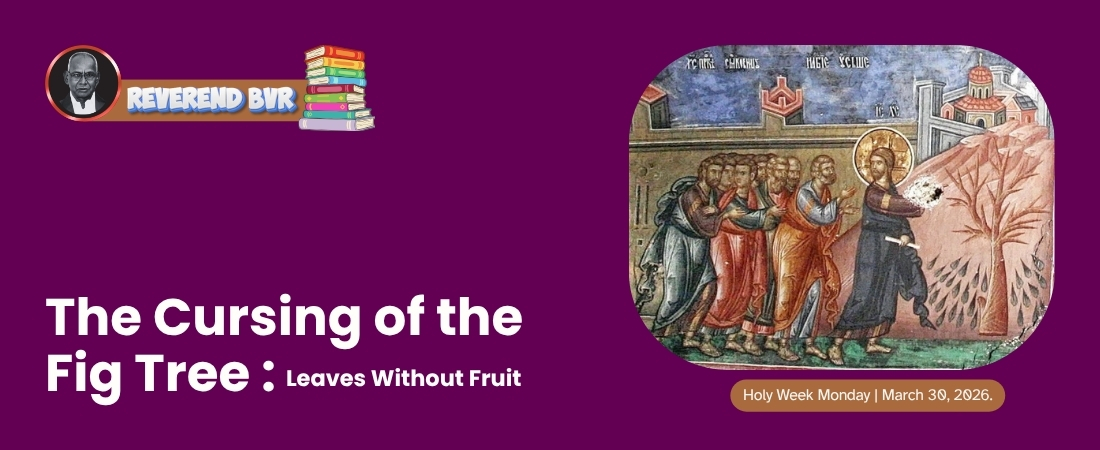
Incident on Holy Monday: The Cursing of the Fig Tree | Sermon Title:“Leaves Without Fruit”
Occasion: Holy Monday – 1st Day of Holy Week (After Palm Sunday), March 30, 2026.
Bible Readings: Genesis 3:7 | Mark 11:12–25 | Matthew 21:18–19 | James 2:26 | Galatians 5:22–23 | John 15:5–8.
Original Language Reflections (For deeper study, refer to the Table of Hebrew and Greek Terms in Section V. of the sermon).
Website: www.reverendbvr.com
God is not looking for religious appearance (leaves); He is looking for spiritual fruit produced through a living relationship with Christ. Centuries ago, On this Monday of Holy Week, Jesus performs a miracle unlike any other… He does not heal, He does not bless and He curses a fig tree. At first, it seems strange. But this moment is a living parable. The tree had leaves but no fruit. It looked alive but was empty. And Jesus uses that tree to teach a powerful truth: God is not impressed by leaves. God is looking for fruit.
I. Important Note from Mark’s Gospel:
There is an important connection in Mark 11. The story of the fig tree surrounds the cleansing of the Temple.
Jesus first curses the fig tree (Mark 11:12–14), then cleanses the Temple (Mark 11:15–17), and the next day the disciples see the fig tree withered from the roots (Mark 11:20). This is not accidental. The fig tree represents the spiritual condition of the Temple and the religious system of Israel. Just like the tree had leaves but no fruit, the Temple had many rituals and activities but lacked true righteousness and prayer.
That is why Jesus said: “My house shall be called a house of prayer for all nations, but you have made it a den of robbers.” (Mark 11:17)
Through this living parable, Jesus teaches that God is not looking for religious activity alone; He is looking for spiritual fruit. From this powerful moment, Jesus teaches us (3) three important lessons about our spiritual lives:
1.The Danger of Spiritual Appearance (Leaves Without Fruit) :
From the beginning of the Bible, humans have tried to hide behind fig leaves. “They sewed fig leaves together and made coverings for themselves.” (Genesis 3:7).
Instead of repentance, Adam and Eve chose appearance. In the same way, the fig tree in Mark 11 looked healthy because it had leaves. But when Jesus examined it carefully, there was no fruit. This represents religion without righteousness.
Our life’s may have: church attendance, religious language and outward identity, But God looks deeper and Today God asks us one question: Is there fruit?
2. The Judgment on Fruitless Faith
Jesus said (Matt 21:19): “May no fruit ever come from you again.”
The next day the tree had withered from the roots. We all must consider This miracle as a warning. Faith that never produces transformation is spiritually dead.
James explains this clearly ((James 2:26) : “Faith without works is dead.” Jesus is not condemning weakness. He is confronting hypocrisy.
A tree that never produces fruit eventually dies from the inside. The same happens with faith that remains only external and inactive.
3. The Secret of True Spiritual Fruit
Jesus gives the answer later (John 15:5): “I am the vine; you are the branches… apart from me you can do nothing.”
Fruit does not come from effort alone, it (Fruit) comes from connection. When we remain in Christ, the Spirit produces fruit within us: Love, joy, peace, patience, kindness, goodness, faithfulness, gentleness and self-control.
Fruit is not forced, It (Fruit) is grown by God’s Spirit.
II. Conclusion:
On this Monday of Holy Week, the fig tree asks us a question: Are we living with leaves or fruit?
Leaves represent appearance, Fruit represents transformation. Jesus is not looking for perfect people, But He is looking for lives that are connected to Him and growing in fruit.
So today we ask God: “Lord, remove the leaves of hypocrisy and Produce the fruit of your Spirit in us.”
“Leaves may impress people, but only fruit pleases God. God is not deceived by leaves; He searches for fruit.”
III. Let us Pray:
Lord Jesus, You search our hearts just as You searched the fig tree.
Where our lives display leaves without fruit, forgive us.
Where our faith has become only words, renew us.
Draw us deeper into Your life,
that we may bear the fruit of love, faithfulness, and righteousness.
As we journey through this Holy Week,
teach us to abide in You,
so that our lives may glorify the Father.
IV. Greek, Hebrew Word Study Table: Holy Monday: The Fig Tree and Spiritual Fruit
| S.No | Theme | Hebrew / Greek Word | Transliteration | Literal Meaning | Key Biblical References | Theological Insight |
| 1 | Fig Tree | Hebrew: תְּאֵנָה | Te’enah | Fig tree | Gen 3:7; Hos 9:10; Micah 7:1 | In the OT the fig tree symbolizes Israel’s spiritual condition, peace, and covenant blessing. |
| 2 | Fig Tree | Greek: συκῆ | Sykē | Fig tree | Mark 11:13–21; Matt 21:19 | Represents outward religion without inward righteousness in Jesus’ prophetic act. |
| 3 | Leaves | Greek: φύλλον | Phyllon | Leaf, foliage | Mark 11:13 | Leaves represent appearance or external life. The tree looked healthy but lacked fruit. |
| 4 | Fruit | Greek: καρπός | Karpos | Fruit, produce, result | Mark 11:13; Gal 5:22; John 15:2 | Symbol of spiritual evidence of true life with God. Fruit shows the authenticity of faith. |
| 5 | Seek / Look for | Greek: ζητέω | Zēteō | To seek, search for | Mark 11:13 | Jesus “seeking fruit” symbolizes God examining human hearts (Jer 17:10). |
| 6 | Withered | Greek: ἐξηράνθη | Exēranthē | To dry up, shrivel | Mark 11:20 | Spiritual barrenness results in judgment and lifelessness. |
| 7 | Root | Greek: ῥίζα | Rhiza | Root, source of life | Mark 11:20 | Withering from the roots indicates complete spiritual death from the inside. |
| 8 | Abide | Greek: μένω | Menō | To remain, dwell, stay connected | John 15:4–5 | Spiritual fruit grows only through continuous union with Christ. |
| 9 | Spirit | Greek: πνεῦμα | Pneuma | Spirit, breath, life-force | Gal 5:22 | The Holy Spirit produces the fruit, not human effort alone. |
| 10 | Faith | Greek: πίστις | Pistis | Faith, trust, loyalty | Mark 11:22; James 2:26 | True faith produces visible transformation and obedience. |
| 11 | Dead | Greek: νεκρός | Nekros | Dead, lifeless | James 2:26 | Faith without works is inactive and spiritually lifeless. |
| 12 | Hypocrisy | Greek: ὑπόκρισις | Hypokrisis | Acting, pretending | Matt 23:27–28 | Jesus condemns religious performance without true devotion. |
| 13 | Vine | Greek: ἄμπελος | Ampelos | Vine plant | John 15:5 | Christ is the source of spiritual life, believers are branches drawing life from Him. |
| 14 | Branch | Greek: κλῆμα | Klēma | Branch or shoot | John 15:5 | A branch bears fruit only when attached to the vine (Christ). |
| 15 | Covering | Hebrew: חֲגֹרֹת | Chagorot | Coverings, belts | Gen 3:7 | Symbol of human attempts to hide sin instead of repentance. |
V. The Chronological Movements of Jesus During Holy Week: From Palm Sunday to the Crucifixion
| Day | Location / Movement | Event | Bible References |
| Palm Sunday | Bethany → Bethphage → Jerusalem → Bethany | Triumphal Entry into Jerusalem; people wave palm branches and shout “Hosanna.” Jesus visits the Temple briefly and returns to Bethany for the night. | Matt 21:1–11, Mark 11:1–11, Luke 19:28–44, John 12:12–19 |
| Holy Monday | Bethany → Jerusalem → Bethany | On the way Jesus curses the fig tree. In Jerusalem He cleanses the Temple by driving out money changers. In the evening He returns to Bethany. | Matt 21:12–19, Mark 11:12–19 |
| Holy Tuesday | Bethany → Jerusalem → Mount of Olives → Bethany | Disciples see the withered fig tree. Jesus teaches in the Temple, debates religious leaders, and gives the Olivet Discourse about the end times. | Matt 21–25, Mark 11:20–13:37, Luke 20–21 |
| Holy Wednesday | Likely Bethany / Jerusalem area | Quiet day in the Gospel narrative. Meanwhile, Judas agrees to betray Jesus to the chief priests. | Matt 26:14–16, Mark 14:10–11, Luke 22:3–6 |
| Maundy Thursday | Bethany → Jerusalem (Upper Room) | Last Supper, washing of disciples’ feet, institution of the Lord’s Supper. Later Jesus prays in Gethsemane and is arrested. | Matt 26:17–56, Mark 14:12–52, Luke 22:7–53, John 13–18 |
| Good Friday (early morning) | High Priest’s house → Pilate → Herod → Pilate | Jesus is tried by Jewish and Roman authorities. | Matt 26:57–27:26, Mark 14:53–15:15, Luke 22:54–23:25, John 18 |
| Good Friday (later) | Jerusalem → Golgotha | Jesus carries the cross and is crucified at Golgotha. | Matt 27:27–56, Mark 15:16–41, Luke 23:26–49, John 19 |
| Good Friday evening | Golgotha → Garden Tomb | Jesus is buried in Joseph of Arimathea’s tomb. | Matt 27:57–61, Mark 15:42–47, Luke 23:50–56, John 19:38–42 |
VI. Key Teaching Insight
This word study reveals a powerful biblical progression: Genesis → Prophets → Jesus → Apostles.
| Stage | Biblical Message |
| Genesis 3 | Humans cover themselves with fig leaves (appearance) |
| Prophets | Israel described as a fruitless fig tree |
| Jesus (Holy Monday) | The fig tree is judged |
| Apostolic teaching | True believers produce fruit of the Spirit |
© 2025 ReverendBVR.com | High-Academic Sermon Series, 2026.
Content licensed under Creative Commons Attribution-NonCommercial-NoDerivatives 4.0 International (CC BY-NC-ND 4.0). You are free to share — copy and redistribute the material in any medium or format with proper attribution. No commercial use or modifications allowed without explicit permission.
For further sermons and biblical reflections, please visit 🌐 www.reverendbvr.com/sermons