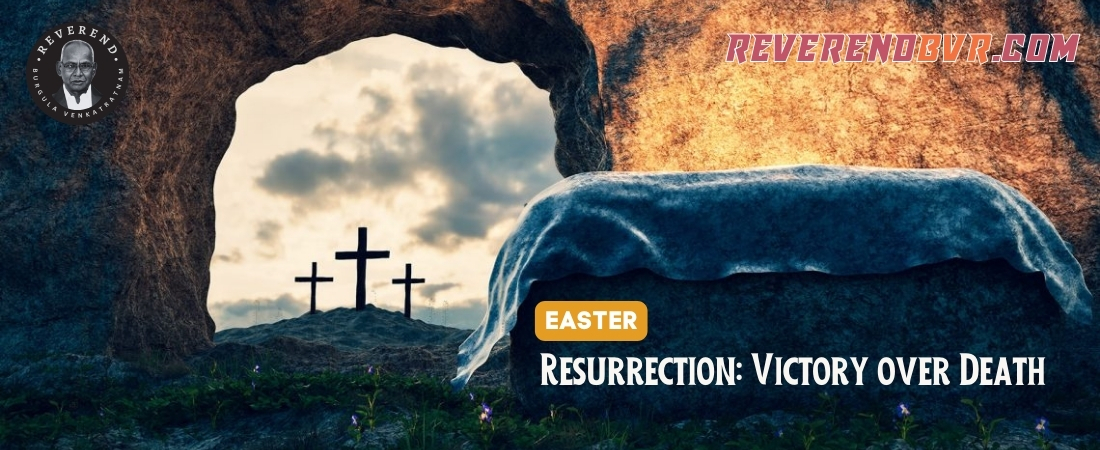
Sermon Title: Resurrection: Victory over Death.
Occasion: Easter Sunday, April 5, 2026.
Bible Readings: Ezek. 37: 1-14 | Psalm 49 | 2 Cor. 5: 1-10 | Mark 16: 1-11/John 20: 1-18 |Dan. 12:1-13/Rom. 6: 1-11
Original Language Reflections (For deeper study, refer to the Table of Hebrew and Greek Terms in Section VI. of the sermon).
Website: www.reverendbvr.com
Theological Thesis: The Resurrection proclaims not merely that Jesus lives again, but that death itself has been decisively unseated as the final authority over human life. Across all the appointed readings, God reveals a single, coherent act: the Creator who breathes life into dust, bones, and tombs is faithful to restore, transform, and dwell with humanity beyond death. Resurrection is not escape from the world, but the renewal of life through God’s Spirit, beginning now and consummated eternally.
The Easter Gospel, therefore, is not optimism, it is ontological victory. Death still exists, but it no longer reigns.
1. From Dry Bones to Living Breath (Ezekiel 37:1–14)
Ezekiel speaks to a people in exile, stripped of land, temple, and future. Israel confesses: “Our bones are dried up, and our hope is lost” (v.11).
The vision is deliberately graphic: a valley not of corpses, but bones- beyond death, beyond decay. Yet God asks a question that frames Easter faith: “Mortal, can these bones live?” (v.3)
Life returns in two movements:
- Structure: bones, sinews, flesh
- Spirit: breath enters and they live
The Hebrew word רוּחַ (ruaḥ) means breath, wind, spirit. Resurrection is not mechanical repair but Spirit-infused restoration.
“I will put my Spirit within you, and you shall live” (v.14)
Easter begins here: life comes not from human possibility, but from divine promise.
2. Death Exposed as a False Security (Psalm 49)
Psalm 49 dismantles humanity’s ancient illusion: that wealth, status, or legacy can negotiate with death.
“No one can ransom a life, or give to God the price of life” (v.7)
Yet the Psalm refuses despair: “God will ransom my soul from the power of Sheol” (v.15)
“Sheol” is not yet resurrection hope, but deliverance from final abandonment. Easter fulfills what the Psalm anticipates: God does not merely rescue from death, God defeats it.
3. Living Between Tent and House (2 Corinthians 5:1–10)
Paul reframes mortality with astonishing calm: “If the earthly tent we live in is destroyed, we have a building from God” (v.1)
“Tent” (σκῆνος, skēnos) suggests fragility and impermanence. “Building” (οἰκοδομή, oikodomē) signals stability and divine craftsmanship.
Crucially, resurrection is not disembodied escape. Paul speaks of being clothed, not stripped (v.4). Resurrection is transformation, not abandonment, of embodied life.
“We walk by faith, not by sight” (v.7)
Easter faith lives forward, confident not because death is gone, but because Christ has gone through it first.
4. The Empty Tomb and the Fearful Witnesses (Mark 16:1–8)
Mark’s Gospel ends unsettlingly: “They said nothing to anyone, for they were afraid” (v.8)
There is no triumphant appearance here, only an empty tomb and a promise. Resurrection is announced before it is understood. Faith begins not in certainty, but in obedient trust.
This is Easter realism: God acts decisively before human comprehension catches up.
5. Resurrection as Recognition and Relationship (John 20:1–18)
John’s resurrection account is deeply personal. Mary Magdalene mistakes Jesus for a gardener, until he speaks her name: “Mary!” (v.16)
Recognition precedes proclamation. Resurrection is not merely historical fact; it is relational encounter.
“I have seen the Lord” (v.18)
The Greek verb ἑώρακα (heōraka) means to see with understanding. Easter faith moves from confusion to communion.
6. Resurrection as Cosmic Hope (Daniel 12:1–3)
Daniel offers one of Scripture’s clearest resurrection affirmations: “Many of those who sleep in the dust of the earth shall awake” (v.2)
Resurrection here is justice-oriented, not all awaken to the same end. God’s victory restores moral order to history.
7. Raised with Christ…Now (Romans 6:1–11)
Paul presses Easter into daily discipleship: “Just as Christ was raised… so we too might walk in newness of life” (v.4)
The Greek καινότης ζωῆς (kainotēs zōēs) means qualitatively new life. Resurrection is not postponed spirituality—it is present transformation.
“Death no longer has dominion over him” (v.9) And therefore, not over us.
II. Integrating the Collect:
The Collect rightly names resurrection as Spirit-breathed living. Like Ezekiel’s bones and Mary’s awakening faith, God forms Easter people who live courageously in hope, not denial of death, but confidence beyond it.
III. Contemporary Human Challenge:
We live amid technological advancement yet existential fragility, pandemics, wars, climate anxiety, and private grief. Easter does not promise exemption from suffering. It promises meaning that survives it.
Resurrection declares: Your losses do not get the last word.
IV. Faithful Living: Resurrection Practices
- Hope with courage: resist despair’s inevitability narrative
- Embodied faithfulness: honor bodies, justice, and creation
- Witness through love: like Mary, speak what you have seen
- Live ethically now: resurrection reshapes present choices
V. Prayer:
God of the empty tomb and the living voice, You who call life from dust and names from grief, Breathe again upon your people.
Where hope lies buried, speak. Where fear seals our mouths, loosen our tongues. Clothe us with courage beyond death’s shadow, That we may live as those already raised, Faithful in the present, fearless for the future, Until all creation stands renewed in your life. Through Christ our risen Lord. Amen.
VI. Key Textual & Original-Language Notes:
| S.No | Passage | Verse | Original Word | Language | Meaning | Sermon Emphasis |
| 1 | Ezek. 37 | v.14 | רוּחַ (ruaḥ) | Hebrew | Breath / Spirit | Life comes from God’s Spirit |
| 2 | Psalm 49 | v.15 | שְׁאוֹל (Sheol) | Hebrew | Realm of death | God’s power beyond death |
| 3 | 2 Cor. 5 | v.1 | σκῆνος (skēnos) | Greek | Tent | Mortal fragility |
| 4 | 2 Cor. 5 | v.1 | οἰκοδομή (oikodomē) | Greek | Building | Eternal dwelling |
| 5 | Mark 16 | v.6 | ἠγέρθη (ēgerthē) | Greek | He has been raised | Divine action |
| 6 | John 20 | v.16 | ἑώρακα (heōraka) | Greek | I have seen (understood) | Faith as recognition |
| 7 | Daniel 12 | v.2 | יָקִיצוּ (yāqîṣû) | Hebrew | Shall awake | Resurrection hope |
| 8 | Rom. 6 | v.4 | καινότης ζωῆς | Greek | Newness of life | Present transformation |
© 2025 ReverendBVR.com | High-Academic Sermon Series, 2026.
Content licensed under Creative Commons Attribution-NonCommercial-NoDerivatives 4.0 International (CC BY-NC-ND 4.0). You are free to share — copy and redistribute the material in any medium or format with proper attribution. No commercial use or modifications allowed without explicit permission.
For further sermons and biblical reflections, please visit 🌐 www.reverendbvr.com/sermons