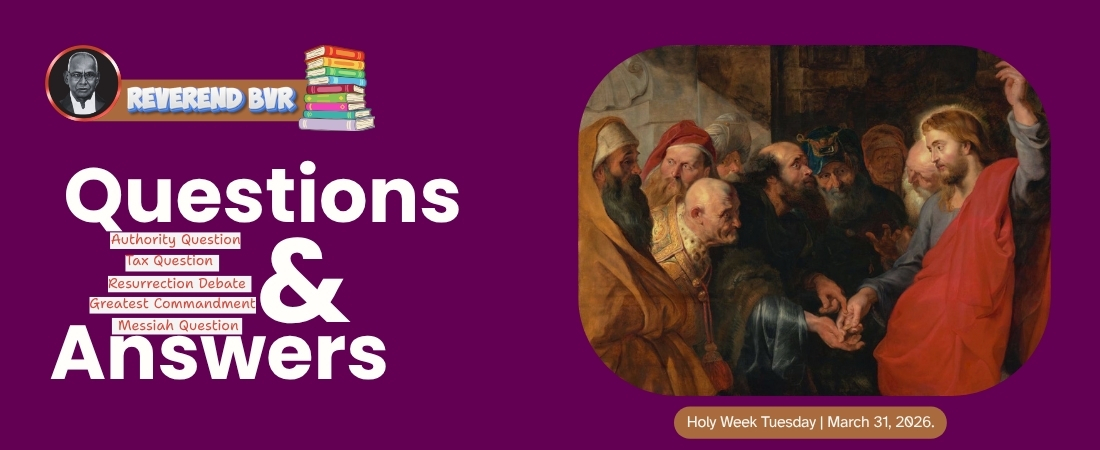
Holy Tuesday Sermon Title: “Questions and Answers”
Occasion: Holy Tuesday – 2nd Day of Holy Week, March 31, 2026.
Bible Readings: Gospel of Mark 11:27-12:37.
Original Language Reflections (For deeper study, refer to the Table of Hebrew and Greek Terms in Section V. of the sermon).
Website: www.reverendbvr.com
I. Questions and Answers: The Authority of Christ and the Wisdom of the Kingdom
Introduction: The Day of Questions: Holy Week is not only a week of suffering; it is also a week of deep theological confrontation. On Holy Tuesday, the temple in Jerusalem becomes the setting for a remarkable dialogue. Religious leaders—chief priests, scribes, and elders all approach Jesus not to learn but to test Him.
The passage from Mark 11:27-12:37 presents a sequence of questions directed toward Jesus. These questions concern authority, politics, resurrection, law, and identity. Yet what begins as an interrogation becomes a revelation. Every question posed to Jesus reveals more about the nature of God’s kingdom and the identity of the Messiah.
Theological Thesis: The questions asked of Jesus expose human attempts to control God, while the answers of Jesus reveal divine authority, wisdom, and the call to wholehearted devotion.
Today on this Holy Tuesday, it invites us into a spiritual reflection: Are we questioning Christ in order to resist Him, or in order to understand Him?
1. The Question of Authority (Mark 11:27–33) : Who gives Jesus the right to act?
After Jesus cleanses the temple the day before (Holy Monday), the religious leaders confront Him in the temple courts.
“By what authority are you doing these things?” (Mark 11:28)
This is not merely curiosity; it is a challenge to legitimacy. In Jewish religious culture, authority normally came through recognized institutions: the priesthood, rabbinic training, or lineage.
Yet Jesus answers their question with another question i.e., about John the Baptist’s baptism.
This method was common in Jewish rabbinic teaching. A counter-question forced the listener to reveal their true motives.
The leaders refuse to answer because their concern is not truth but public reputation.
Theological Insight:
The irony is striking: The leaders question Jesus’ authority while standing in God’s temple, speaking to God’s Son. Their refusal to answer reveals spiritual blindness. Authority is not recognized because their hearts are hardened.
Applying This Truth in Practice Today:
Many people today ask questions about God, not always to seek truth, but to avoid obedience.
There is a difference between
- honest questioning, which leads to faith, and
- defensive questioning, which protects pride.
Faith begins when we stop questioning Christ’s authority and start listening to His voice.
2 The Question of Loyalty (Mark 12:13–17): Should we pay taxes to Caesar?
The Pharisees and Herodians present one of the most politically dangerous questions imaginable.
“Is it lawful to pay taxes to Caesar, or not?”
If Jesus says yes, He alienates the Jewish people who resent Roman rule.
If He says no, He becomes guilty of rebellion against Rome.
Jesus asks for a coin and responds:
“Render to Caesar the things that are Caesar’s, and to God the things that are God’s.”
Theological Depth:
The coin bears Caesar’s image. Therefore, it belongs to Caesar. But human beings bear God’s image (Genesis 1:27). Therefore, Jesus’ statement goes deeper than taxation.
Coins belong to Caesar, and Your life belongs to God.
Applying This Truth in Practice Today:
Christ calls believers to live faithfully within society while remembering that ultimate allegiance belongs to God. Christians may participate in political systems, but their deepest loyalty is not to governments, parties, or ideologies. It is/ must be to the Kingdom of God.
3. The Question of Resurrection (Mark 12:18–27): What happens after death?
The Sadducees deny the resurrection. They present a hypothetical scenario involving seven brothers marrying the same woman according to the law of levirate marriage.
Their question is meant to mock the idea of resurrection.
“In the resurrection, whose wife will she be?”
Jesus exposes two errors in their thinking:
- They do not understand Scripture
- They do not understand the power of God
Jesus explains that resurrection life transcends earthly categories. Marriage belongs to this age, but resurrection life belongs to a transformed creation.
Then He cites God’s words to Moses: “I am the God of Abraham, Isaac, and Jacob.” –> God did not say “I was.” –> He said “I am.” Therefore, the patriarchs are alive to God.
Theological Insight:
God’s covenant does not end at death. The living God sustains a living relationship with His people. Resurrection is not merely future hope; it is the continuation of God’s faithfulness.
Applying This Truth in Practice Today:
In a world filled with uncertainty and mortality, the resurrection reminds us: Death does not have the final word. God’s promises extend beyond the grave.
4. The Question of the Greatest Commandment (Mark 12:28–34)
One scribe approaches Jesus sincerely and asks: “Which commandment is the greatest?”
Jesus responds with the Shema, Israel’s foundational confession: “Hear, O Israel: The Lord our God, the Lord is one.”
And then He summarizes the law:
- Love God with all your heart, soul, mind, and strength
- Love your neighbour as yourself
Theological Meaning:
All commandments flow from love. Religion becomes distorted when it focuses on rules without relationship. The kingdom of God is rooted in devotion to God and compassion toward others.
Jesus tells the scribe: “You are not far from the kingdom of God.”
This is one of the few moments in the Gospels where Jesus affirms a religious leader.
Applying This Truth in Practice Today:
Faith is not measured by religious performance but by love.
- Love for God that shapes our worship
- Love for neighbor that shapes our actions
5. The Question of the Messiah (Mark 12:35–37) : Who is the Son of David?
Finally, Jesus asks a question Himself Quoting Psalm 110, He asks how the Messiah can be both David’s son and David’s Lord.
The answer points toward the mystery of Christ’s identity. The Messiah is not merely a political descendant of David. He is the divine Lord who reigns over David himself. The crowd listens with delight because Jesus reveals a vision of the Messiah far greater than expected.
Theological Conclusion:
Jesus is both:
- Son of David (human lineage)
- Lord of David (divine authority)
Holy Tuesday therefore prepares us for the coming revelation of the cross, where Christ’s kingship will be revealed not through power but through sacrifice.
II. Greek Word Study Table (Holy Tuesday Passage)
| S.No | Verse | Greek Word | Transliteration | Meaning | Theological Insight |
| 1 | Mark 11:28 | ἐξουσία | exousia | Authority, delegated power | Jesus possesses divine authority |
| 2 | Mark 12:17 | εἰκών | eikōn | Image | Humans bear God’s image |
| 3 | Mark 12:24 | δύναμις | dynamis | Power | God’s power raises the dead |
| 4 | Mark 12:30 | καρδία | kardia | Heart | Inner devotion to God |
| 5 | Mark 12:30 | ψυχή | psychē | Soul, life | Entire being offered to God |
| 6 | Mark 12:30 | διάνοια | dianoia | Mind | Loving God intellectually |
| 7 | Mark 12:31 | πλησίον | plēsion | Neighbor | Ethical love toward others |
| 8 | Mark 12:36 | κύριος | kyrios | Lord | Title affirming Christ’s divine authority |
III. Narrative Flow of the Passage:
| S.No | Section | Theme | Key Verse | Message |
| 1 | Authority Question | Who authorizes Jesus | Mark 11:28 | Jesus’ authority comes from God |
| 2 | Tax Question | Loyalty to Caesar vs God | Mark 12:17 | God deserves ultimate allegiance |
| 3 | Resurrection Debate | Life after death | Mark 12:27 | God is the God of the living |
| 4 | Greatest Commandment | Essence of the law | Mark 12:30–31 | Love is the heart of faith |
| 5 | Messiah Question | Identity of Christ | Mark 12:36 | Jesus is both Lord and Messiah |
IV. Contemporary Reflection:
Modern life is filled with many questions, some of them include:
- Does faith matter in a secular world?
- Where is God in suffering?
- How should believers engage politics and society?
Holy Tuesday reminds us that Christ is not threatened by questions. But He transforms them. When we bring our questions honestly to Christ, His answers lead us deeper into truth, humility, and love.
V. Conclusion:
The leaders of Jerusalem came to Jesus with questions meant to trap Him. But in every exchange, Jesus revealed something greater:
- His authority comes from God
- Our loyalty belongs to God
- God’s power conquers death
- The law is fulfilled in love
- The Messiah is both Lord and Savior
Holy Tuesday therefore invites us not merely to ask questions of Jesus. It invites us to ask a deeper question: Who is Jesus for us?
VI. Let us Pray:
Lord of truth and wisdom,
You who answered the questions of the temple courts with words of eternal life,
Open our hearts to hear Your voice.
Where our questions come from doubt, give us faith.
Where our questions come from pride, give us humility.
Where our questions come from longing, give us Your presence.
Teach us to love You with all our heart,
all our soul,
all our mind,
and all our strength.
And teach us to love our neighbors with the compassion of Christ.
May our lives bear witness that Jesus is both
the Son of David
and the Lord of all creation.
Lead us through this Holy Week
until we stand before the mystery of the cross
and the glory of the resurrection.
Amen.
© 2025 ReverendBVR.com | High-Academic Sermon Series, 2026.
Content licensed under Creative Commons Attribution-NonCommercial-NoDerivatives 4.0 International (CC BY-NC-ND 4.0). You are free to share — copy and redistribute the material in any medium or format with proper attribution. No commercial use or modifications allowed without explicit permission.
For further sermons and biblical reflections, please visit 🌐 www.reverendbvr.com/sermons