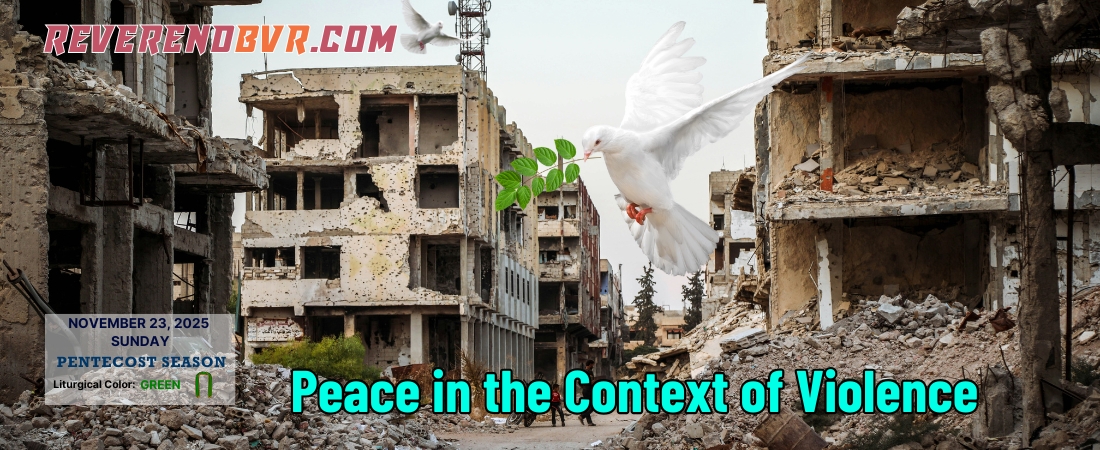
In a world unraveling under violence and division, the gospel calls us not to retaliate but to radiate peace shaped by divine love. True peace, as seen in David’s mercy, Paul’s exhortation, and Jesus’ revolution of grace, is not the absence of conflict but the courageous presence of God’s justice and mercy in the face of evil.
Sermon Title: Peace in the Context of Violence
Date: Sunday, November 9, 2025.
Textual Foundations: 1 Samuel 24:1–12 | Psalm 52 | Romans 12:14–21 | Matthew 5:38–48..
Original Language Reflections (For deeper study, refer to the Table of Hebrew and Greek Terms in Section 3 of the sermon).
By Reverend B.V.R. Memorial Ministry | www.reverendbvr.com
1. Introduction: Living Peace in Violent Times
In an age increasingly marred by geopolitical conflict, social unrest, domestic abuse, and ideological extremism, the biblical witness of peace amidst violence emerges as a radical call and divine imperative. Peace, in Scripture, is not merely the absence of conflict but the embodiment of God’s character and kingdom purposes in a broken world. On this Sunday, November 9, 2025, we turn to four compelling texts that speak into our moment with piercing relevance. These readings challenge us to live not reactively but redemptively—offering not retaliation but reconciliation, not hatred but holy resistance through love.
I. David and the Cave of Mercy (1 Samuel 24:1–12)
The desert narrative in En Gedi stands as one of the most arresting moments in the Davidic saga. Here, David has the military and moral opportunity to eliminate Saul, his persecutor. Instead, he restrains his hand. The key term is mashiach YHWH (משּיח יהוה) — “the Lord’s anointed.” David’s decision not to harm Saul rests not on the character of Saul but on the sanctity of divine appointment. The deeper ethical force lies not in passive tolerance but active reverence for God’s providence.
David’s words, “May the Lord judge between me and you… but my hand shall not be against you” (v.12), echo the Hebrew principle of shalom (שׁלום)—not mere peace, but holistic harmony, justice, and right relationship. David upholds peace not because Saul deserves it, but because God commands it.
II. The Psalmist’s Protest (Psalm 52)
Psalm 52 is a denunciation of deceitful and violent leaders, possibly a direct response to Doeg the Edomite’s betrayal of David (1 Sam. 22). The psalm names the moral inversion of the wicked: “You love evil more than good” (v.3). The Hebrew word hesed (חסד), translated “unfailing love” (v.8), becomes the axis of contrast. The wicked trust in their violence and wealth, but David compares himself to an olive tree flourishing in God’s house—a symbol of peace, resilience, and sacred vocation.
This contrast teaches that peace does not mean neutrality in the face of evil. Rather, it entails rootedness in divine love while speaking truth to destructive power.
III. The Apostle Paul: Overcoming Evil with Good (Romans 12:14–21)
Paul’s exhortation to the Roman church, located at the heart of an imperial machine notorious for its violence and persecution, is nothing short of revolutionary. Verses 14–21 form a concentric structure where love for enemies (vv.14, 17–21) is interwoven with communal empathy and humility (vv.15–16). At the center is the radical principle: “If it is possible, as far as it depends on you, live at peace with everyone” (v.18).
Paul quotes Deuteronomy 32:35: “Vengeance is mine; I will repay, says the Lord.” He invokes the Hebrew principle of mishpat (מִשׁפַט) — divine justice — to prohibit personal vengeance. The Greek phrase “mē nika… all’ enika en toi agathoi” (v.21) is a literary gem: “Do not be conquered by evil, but conquer evil with good.”
IV. Jesus and the Revolution of Grace (Matthew 5:38–48)
Jesus subverts the lex talionis (“eye for eye”) tradition not by abrogating justice, but by transforming its implementation. The ethic of agapē (ἀγάπη) love in Matthew 5:44 is neither sentimental nor passive; it is active, sacrificial, and aimed at the redemption of the enemy.
“Be perfect, therefore, as your heavenly Father is perfect” (v.48) recalls the Hebrew idea of tamim (תַּמים) — complete, whole, or blameless. The Sermon on the Mount calls disciples to a higher righteousness that mirrors God’s own integrity and impartial grace. Peace, therefore, is not a social concession but a divine imitation.
V. Theological Reflections: Peace as Eschatological Witness
To seek peace in the context of violence is to live prophetically, bearing witness to the coming kingdom where swords will become plowshares (Isaiah 2:4). The church’s refusal to retaliate or hate is not weakness but spiritual resistance. It draws from the eschatological hope that God will ultimately vindicate the just and judge the wicked. Christians are thus called to be signs of that future by living in peace now—even and especially when it costs.
VI. Practical Implications for Today
- Conflict Resolution: Choose mercy over revenge. Like David, be guided not by what is permissible but by what is spiritually faithful.
- Public Discourse: Resist the culture of outrage. Speak truth with grace.
- Personal Relationships: Practice enemy-love in family, work, and community.
- Church Witness: Model communal forgiveness and advocate for nonviolence as a gospel imperative.
Conclusion:
As we depart into a world where violence often shouts louder than virtue, let us remember that our call is to embody a deeper peace—shalom rooted in the heart of God. May we, like David, Paul, and our Lord Jesus, choose the harder path of mercy over vengeance, love over hate, and grace over retaliation. In so doing, we become not just recipients of peace but its agents—living testimonies of the kingdom to come, where justice and compassion will reign forever. Amen.
2. Closing Prayer
O Prince of Peace, You who turned the cheek to your oppressors, Teach us to bear the image of your love in a world torn by hatred. Help us, like David, to honor even our enemies; Like Paul, to overcome evil with good; Like the psalmist, to root ourselves in your steadfast love; And like Jesus, to be perfect as you are perfect. Make us agents of your shalom Until justice rolls down like waters, And peace flows like an ever-living stream. In the name of the Crucified and Risen Lord we pray, Amen.
3. Learn Words from the Original Scriptures (For deeper understanding and meditation on today’s theme):
| S.No | Term – Click on each term to view its lexical details | Language | Meaning |
| 1 | מָשִׁיחַ (mashiach) | Hebrew | Anointed one |
| 2 | שָׁלוֹם (shalom) | Hebrew | Peace, wholeness |
| 3 | חֶסֶד (hesed) | Hebrew | Steadfast love, mercy |
| 4 | מִשְׁפָּט (mishpat) | Hebrew | Justice, judgment |
| 5 | ἀγάπη (agapē) | Greek | Self-giving love |
| 6 | תָּמִים (tamim) | Hebrew | Complete, blameless |
4. Bibliography
- Alter, Robert. The David Story: A Translation with Commentary of 1 and 2 Samuel. W. W. Norton, 1999.
- Wright, N. T. Paul and the Faithfulness of God. Fortress Press, 2013.
- Bonhoeffer, Dietrich. The Cost of Discipleship. SCM Press, 1959.
- Brueggemann, Walter. Peace. Chalice Press, 2001.
- Stassen, Glen H., and David P. Gushee. Kingdom Ethics: Following Jesus in Contemporary Context. IVP Academic, 2003.
- Wenham, Gordon J. The Psalms as Torah: Reading Biblical Song Ethically. Baker Academic, 2012.
“Blessed are the peacemakers, for they shall be called children of God.” (Matthew 5:9)
© 2025 ReverendBVR.com | High-Academic Sermon Series, 2025.
Content licensed under Creative Commons Attribution-NonCommercial-NoDerivatives 4.0 International (CC BY-NC-ND 4.0). You are free to share — copy and redistribute the material in any medium or format with proper attribution. No commercial use or modifications allowed without explicit permission.
For further sermons and biblical reflections, please visit 🌐 www.reverendbvr.com/sermons