This sermon explores profound biblical terms such as Maranatha and Parousia, inviting believers to anticipate the coming of the Lord with hope and faith. Through the richness of Hebrew and Greek, we uncover deeper meanings of God’s Word (Logos), His dwelling among us (Eskenōsen), and the divine instructions (Torah) that guide our journey in Christ.
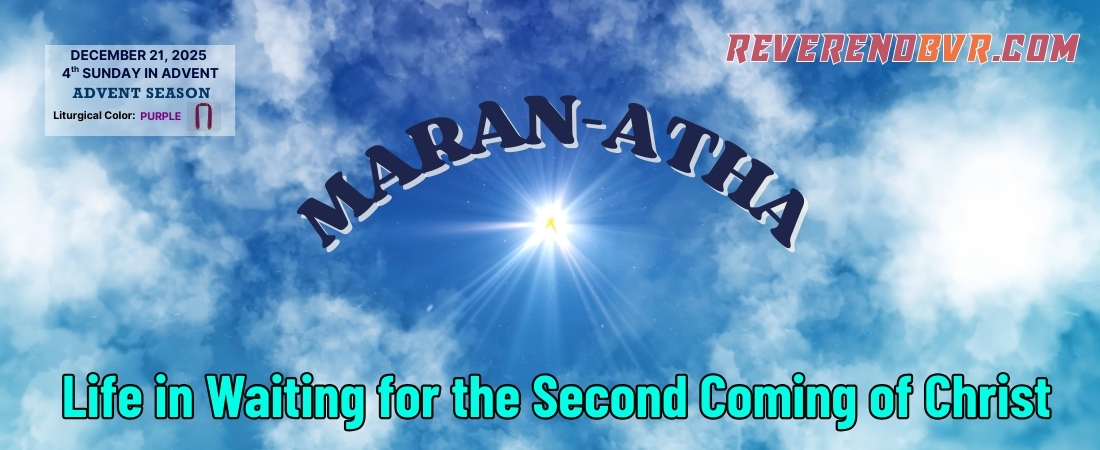
Sermon Title: Maranatha: Life in Waiting. (Emphasis – The Second Coming of Christ)
Occasion: 5th Sunday in Advent | December 21, 2025.
Bible Readings: Isaiah 2:2-5 | Psalm 75 | Revelation 22:10-21 | John 1:1-14 | Luke 12:32-40.
Original Language Reflections (For deeper study, refer to the Table of Hebrew and Greek Terms in Section 3 of the sermon).
Website: www.reverendbvr.com
Introduction
“Maranatha!” This early Aramaic expression (מָרַנָא אֲתָא), transliterated as Maranatha (Greek: Μαραναθά), means either “Come, O Lord” or “Our Lord has come” (cf. 1 Corinthians 16:22). In the tension between the Incarnation and Parousia (Παρουσία), Advent celebrates both the first coming of Christ in humility and the awaited second coming in glory. As we stand on the threshold of Christmas, this Fourth Sunday of Advent is not merely about awaiting the Christ child; it is a summons to live in vigilance, expectation, and holy readiness for the return of the risen and reigning Lord.
This is a call to life in waiting — not passive, but active; not despairing, but hopeful. The Church is not merely an audience waiting for the final act, but the Bride (νύμφη Χριστοῦ) awaiting her Bridegroom with lamps burning (Matthew 25:1-13).
I. The Eschatological Vision: Isaiah 2:2-5
Isaiah proclaims a vision of the last days (Hebrew: בְּאַחֲרִית הַיָּמִים), when the mountain of the Lord’s house shall be established above all others. This prophetic oracle anticipates a cosmic reordering where Zion becomes the spiritual center for all nations. The eschaton is envisioned as a time of universal peace: “they will beat their swords into plowshares” — a motif later echoed in Micah 4:1-4 and symbolically inscribed outside the United Nations headquarters.
Theologically, this text affirms that God’s judgment brings reconciliation, not mere condemnation. The torah (הוֹרָה) from Zion becomes the ethical and spiritual compass for the world. This shapes our Advent waiting: not in escapism, but by walking “in the light of the Lord” — in justice, discipleship, and peacemaking.
II. Divine Sovereignty and Judgment: Psalm 75
This psalm presents God as the eschatological Judge. The repeated image of the cup (כּוֹס בְּיַד יְהוָה) full of foaming wine (v.8) alludes to divine wrath (cf. Revelation 14:10; Isaiah 51:17). God’s judgment is not arbitrary but righteous (Hebrew: מִשְׁפָּט בְּמֵישָׁר יִשְׁפָּט בָּמֵישָׁר).
Psalm 75 is a reminder that human power is transient, but divine justice is enduring. Advent calls believers to trust God’s perfect timing (“I choose the appointed time”) — a concept reinforced by Jesus’ parables of watchfulness (Luke 12:35-40).
III. The Culmination of Revelation: Revelation 22:10-21
The final chapter of Revelation brings together themes of urgency, hope, and moral clarity. The repeated refrain “I am coming soon” (Greek: ἔρχομαι ταχύ) underscores that the second coming is imminent — not merely temporally, but theologically near.
The alpha-omega (ἀλφα καὶ ὠ) declaration signifies Christ’s total sovereignty. He is the origin and telos of all history. The call of the Spirit and the Bride to “Come” (ἔρχου) is both a yearning and an invitation — a missionary summons to the thirsty and a doxological cry for the Parousia.
This Advent, we echo that cry: Maranatha — Come, Lord Jesus! But this cry also judges our present. It calls us to wash our robes (Rev. 22:14), to live purified, faithful lives in hope of entering the New Jerusalem.
IV. The Word Made Flesh: John 1:1-14
John opens his Gospel with a majestic theological hymn. The Word (λόγος) who was with God and was God became flesh (σὰρξ ἐγένετο) and “tabernacled” among us (Greek: ἐσκήνωσεν ἡμῶν). This Incarnation is the basis of all eschatological hope. The Advent of Christ in history assures us of His coming in glory. The darkness has not overcome the light — a promise that should empower every believer facing trials, persecution, or doubt.
The Word became flesh not merely to dwell among us, but to redeem us and prepare us for eternal communion. Thus, Advent waiting is incarnational: we bear the light in this world, even as we long for the fullness of that light in the age to come.
V. Living as Ready Servants: Luke 12:32-40
This passage presents the ethical shape of eschatological hope. “Do not be afraid, little flock” — God has already given the kingdom. Our task is readiness: lamps burning, loins girded, hearts watchful.
The servant imagery mirrors that of the ancient Jewish wedding where the bridegroom could arrive at any hour. The message is clear: the second coming is sudden and disruptive, but for the faithful, it is glorious and affirming. Faithful waiting means active stewardship: generosity, hospitality, worship, and justice.
VI. Conclusion: Maranatha Spirituality
To live in Advent is to live in kairos time — the sacred moment when eternity touches the present. It is to resist apathy, fear, or despair. It is to align one’s life with the values of the coming kingdom: truth, righteousness, mercy, and justice.
Maranatha is more than a prayer; it is a way of life. We wait not idly, but faithfully, hopefully, and lovingly. Let every Advent candle lit this season shine with the cry, “Come, Lord Jesus!”
2. Closing Prayer
O Lord of time and eternity,
We thank You for the promise of Your coming — once in humility, and again in glory. Teach us to live in holy expectation, not with fear but with faith; not in slumber but in service. Let the cry of our hearts echo the final prayer of Scripture: Maranatha! Come, Lord Jesus.
Strengthen our lamps to keep burning. Let our lives be radiant with your truth, generous with your love, and bold with your justice.
In the name of the Alpha and the Omega, the Beginning and the End, we pray.
Amen.
3. Learn Words from the Original Scriptures (For deeper understanding and meditation on today’s theme)
| S.No | Term – Click on each term to view its lexical details | Language | Translation |
| 1 | Maranatha (מְרָנָא אֲתָא) | Aramaic/Greek | Our Lord, come! |
| 2 | Parousia (Παρουσία) | Greek | Coming, presence |
| 3 | Logos (λόγος) | Greek | Word |
| 4 | Eskenōsen (ἐσκήνωσεν) | Greek | Dwelt/tabernacled |
| 5 | Torah (תּוֹרָה) | Hebrew | Instruction/Law |
| 6 | Cup (כּוֹס) | Hebrew | Divine judgment or blessing |
4. Bibliography
- Bauckham, Richard. The Theology of the Book of Revelation. Cambridge University Press, 1993.
- Wright, N.T. Surprised by Hope. SPCK, 2007.
- Moltmann, J\u00fcrgen. The Theology of Hope. Fortress Press, 1967.
- Koester, Craig R. Revelation and the End of All Things. Eerdmans, 2001.
- Brown, Raymond E. The Gospel According to John I-XII. Yale University Press, 1966.
- Brueggemann, Walter. Isaiah 1-39. Westminster John Knox Press, 1998.
“Yes, I am coming soon.” Amen. Come, Lord Jesus.
Revelation 22:20
© 2025 ReverendBVR.com | High-Academic Sermon Series, 2025.
Content licensed under Creative Commons Attribution-NonCommercial-NoDerivatives 4.0 International (CC BY-NC-ND 4.0). You are free to share — copy and redistribute the material in any medium or format with proper attribution. No commercial use or modifications allowed without explicit permission.
For further sermons and biblical reflections, please visit 🌐 www.reverendbvr.com/sermons