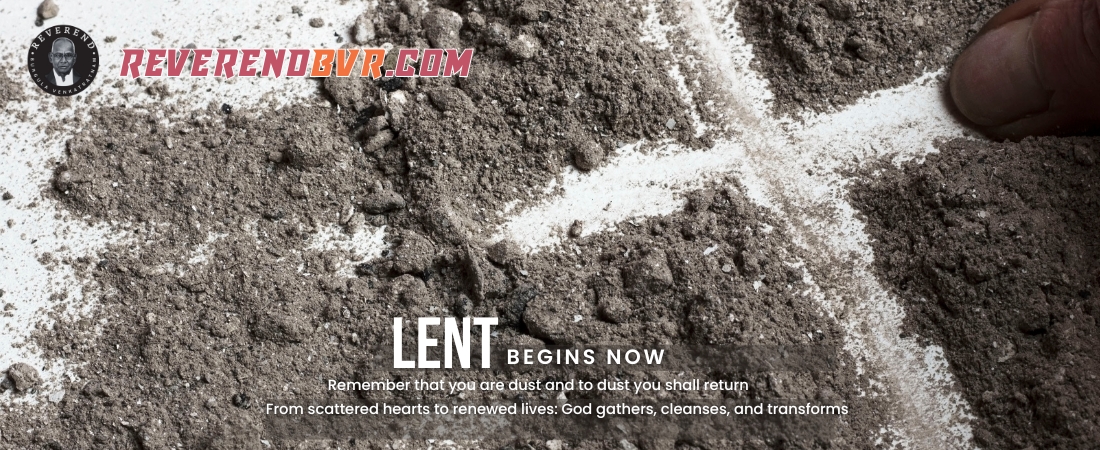
Sermon Title: Lent: A Call to Renewal | From scattered hearts to renewed lives: God gathers, cleanses, and transforms
Occasion: Ash Wednesday, February 18, 2026.
Bible Readings: Eze. 36: 24-36 | Psalm 51 | Rom. 11:33 – 12:2 | Matt. 6: 5-18 and 2 Cor. 4: 7-18.
Original Language Reflections (For deeper study, refer to the Table of Hebrew and Greek Terms in Section VI. of the sermon).
Website: www.reverendbvr.com
I. Theological Thesis:
Ash Wednesday does not begin with human effort but with God’s renewing initiative. Across all the appointed readings, one truth resounds: renewal is not self-improvement but divine re-creation. God gathers what is scattered, cleanses what is defiled, and reshapes human life from the inside out. Lent, therefore, is not about appearing religious but about being reformed by mercy, transformed by the Spirit, and conformed to the will of God.
This is the heart of Jesus’ teaching style: which is clear, searching, invitational. God is not asking for display, performance, or empty speech, but for hearts turned toward Him, lives quietly offered, and hopes anchored beyond what is seen.
II. Ash Wednesday: Dust with a Promise
Ash Wednesday names the truth we resist: “You are dust.”
But Scripture never lets dust have the final word.
Ashes speak of mortality, repentance, and truthfulness. yet the God revealed in today’s readings is the God who breathes life into dust, who gathers exiles, cleanses hearts, and reshapes fragile lives into vessels of glory.
Lent is not a season of despair. It is a season of reorientation.
1. Renewal as Divine Action: (Ezekiel 36:24–36)
“I will take you from the nations… I will sprinkle clean water upon you… I will give you a new heart, and a new spirit I will put within you.” (Ezek. 36:24–26)
Exegetical Insight: Ezekiel speaks to a people shattered by exile, not merely displaced geographically, but theologically disoriented. Israel assumes their sin has ended God’s faithfulness. God responds with a shocking reversal: restoration will happen not for Israel’s merit, but for God’s own holy name (v. 22).
The verbs belong to God alone:
- I will gather
- I will cleanse
- I will give
- I will put my Spirit within you
This is grace before obedience, renewal before reform.
Lent begins here: not with what we promise God, but with what God promises to do in us.
2. True Repentance Is Interior: (Psalm 51)
“Create in me a clean heart, O God, and put a new and right spirit within me.” (Ps. 51:10)
David’s psalm rejects religious minimalism. Sacrifice without transformation is noise. What God desires is truth in the inward being (v. 6).
Ash Wednesday exposes the danger of external religion:
- Confession without conversion
- Fasting without humility
- Prayer without surrender
Psalm 51 teaches us that repentance is not self-loathing but hopeful honesty before mercy.
3. From Awe to Transformation (Romans 11:33–12:2)
“Present your bodies as a living sacrifice… Do not be conformed to this world, but be transformed by the renewing of your minds.” (Rom. 12:1–2)
Paul moves from doxology to discipleship. The mercy of God does not terminate in admiration; it reconfigures life.
The word “transformed” (metamorphousthe) signals deep change, which is like a caterpillar becoming a butterfly. Lent is not behavior management; it is mind-renewal, its the slow reshaping of desire, perception, and allegiance.
The Christian life is lived between mercy received and mercy embodied.
4. Hidden Faith, Honest Devotion (Matthew 6:5–18)
“Your Father who sees in secret will reward you.” (Matt. 6:6)
Jesus dismantles religious performance. Prayer, fasting, and almsgiving are not tools for recognition but pathways to intimacy.
The danger is not devotion. it is when devotion turned into display.
Jesus’ teaching is deeply pastoral:
God is not impressed by volume, visibility, or vocabulary. God seeks sincerity.
Lent, then, is a return to secret faithfulness, where God does His deepest work.
5. Fragile Vessels, Eternal Glory (2 Corinthians 4:7–18)
“We have this treasure in jars of clay… For this slight momentary affliction is preparing us for an eternal weight of glory.”
Ash Wednesday names us as jars of clay, that are breakable, finite, honest. But Paul insists: fragility is not failure. It is the very place where divine power is revealed.
Lent does not deny suffering; it reframes it. What is wasting away outwardly is being renewed inwardly.
III. The Collect as Theological Summary
The Collect weaves the readings together with precision:
- God gathers
- God restores
- God renews hearts
- God teaches us to pray rightly
- God conforms us to His will
This prayer does not ask for religious success, but asks for spiritual truthfulness.
IV. Contemporary Human Challenges:
In a world obsessed with: Visibility over integrity, Productivity over faithfulness and Performance over presence. Ash Wednesday calls us back to depth.
Lent resists: Performative spirituality, Shallow optimism and Moral exhaustion
Instead, it invites patient transformation, quiet obedience, and hope anchored beyond what is seen.
V. Life Applications:
- Let fasting become attention, not punishment
- Let prayer become presence, not verbosity
- Let repentance become hopeful turning, not shame
- Let worship become offering, not performance
Do not strive to appear holy. Allow God to make you new.
VI. Let us Pray:
Merciful God,
You gather what is scattered and breathe life into dust.
Where our hearts are hardened, soften them.
Where our faith has become performative, make it truthful.
Where we are weary, renew us inwardly by your Spirit.
Teach us to pray with sincerity,
to fast with humility,
and to live as offerings shaped by mercy.
As we walk this Lenten road,
turn our eyes from what is seen to what is eternal,
until your renewing work is complete in us,
through Jesus Christ, our life and hope.
Amen.
VII. Key Original-Language Terms:
| S.No | Passage | Verse | Original Word | Language | Meaning | Theological Significance |
| 1 | Ezek. 36 | v.26 | לֵב חָדָשׁ (lev chadash) | Hebrew | New heart | Renewal as inner re-creation |
| 2 | Ezek. 36 | v.27 | רוּחִי (ruchi) | Hebrew | My Spirit | Divine indwelling, not self-effort |
| 3 | Psalm 51 | v.10 | בָּרָא (bara’) | Hebrew | Create | Same verb as Genesis -creation, not repair |
| 4 | Rom. 12 | v.2 | μεταμορφοῦσθε (metamorphousthe) | Greek | Be transformed | Deep inner change |
| 5 | Matt. 6 | v.6 | ἐν τῷ κρυπτῷ (en tō kryptō) | Greek | In secret | God values hidden faithfulness |
| 6 | 2 Cor. 4 | v.7 | ὀστρακίνοις (ostrakinois) | Greek | Earthen vessels | Fragility as the site of grace |