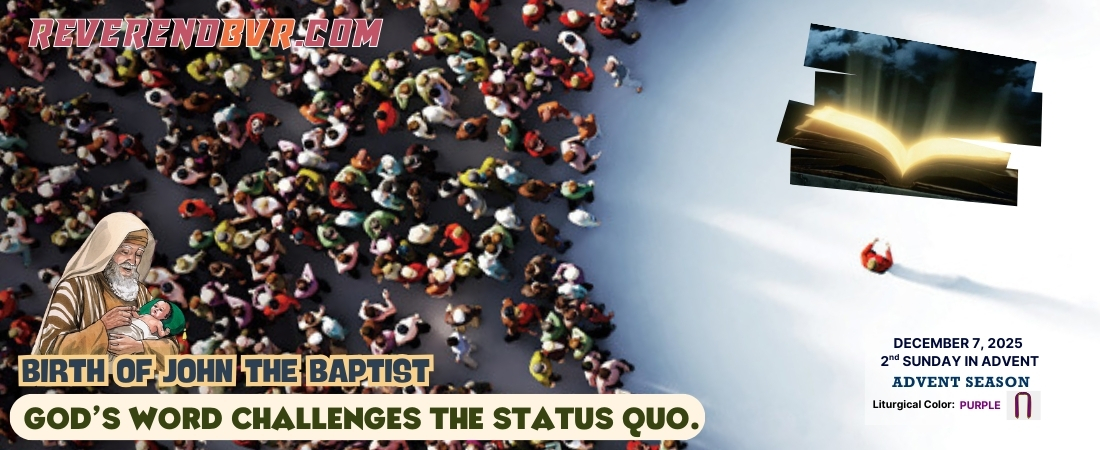
The birth of John the Baptist marks the arrival of a prophetic voice that shatters spiritual complacency and calls God’s people to radical reformation. God’s living Word pierces through inertia and injustice, inviting us to respond with courage, repentance, and faithfulness as we prepare the way for the kingdom of God.
Sermon Title: God’s Word Challenges the Status Quo.
Occasion: Birth of John the Baptist | 2nd Sunday in Advent | December 7, 2025, Sunday.
Textual Foundations: 2 Kings 22:1-3 | Psalm 119:33-40 | Hebrews 4:12-16 | Luke 1:67-80.
Original Language Reflections (For deeper study, refer to the Table of Hebrew and Greek Terms in Section 3 of the sermon).
Website: www.reverendbvr.com
Introduction: Disturbing the Comfortable
On this sacred occasion of celebrating the Birth of John the Baptist, we remember not only the man but the message—a call to repentance and a proclamation that God’s Word disrupts the status quo. The Scriptures for today draw us into the depths of divine truth, confronting our complacency and reorienting our lives. In an age that prizes convenience over conviction and stability over sanctity, the voice of God comes not as a lullaby but as a trumpet blast: “Prepare the way of the Lord.”
I. Historical Backdrop: Josiah’s Reform and the Lost Book of the Law (2 Kings 22:1–3)
When Josiah ascended the throne of Judah at the age of eight, the spiritual climate of his kingdom had long since deviated from covenantal fidelity. Amidst temple renovations in his eighteenth year, the Book of the Law (likely Deuteronomy or the Torah) was rediscovered—forgotten and hidden in the very house of God. This rediscovery catalyzed a sweeping reform that challenged the religious, political, and social norms entrenched in idolatry and injustice.
Josiah’s reaction was one of deep conviction. The King humbled himself before God (2 Kings 22:11), demonstrating that the Word of God does not merely inform leaders—it transforms them. In Josiah, we find a parallel to John the Baptist: a man raised for such a time to confront sin and reestablish covenantal faithfulness.
The rediscovery of the Law functioned as a prophetic disruption—a divine challenge to cultural and religious inertia. God’s Word, in its recovered form, did not confirm the nation’s trajectory; it condemned it, offering instead a radical alternative rooted in righteousness.
Theological Insight: The Hebrew word torah (תּוֹרָה) means “instruction” or “teaching.” Its rediscovery under Josiah signaled the reassertion of God’s authority over Israel’s life and governance. Like John the Baptist, the Law came crying in the wilderness of idolatry: “Return to the Lord!”
II. Psalm 119:33–40 – A Prayer for Illumination and Transformation
Psalm 119, the longest psalm, is a sustained meditation on the power and beauty of God’s Word. Verses 33–40 form an acrostic poem that illustrates a soul yearning for divine direction. The psalmist’s prayer—“Teach me, Lord… give me understanding… turn my heart…”—is a liturgical expression of repentance and surrender.
This psalm reminds us that God’s Word does not accommodate our selfish desires (v. 36), but calls us into conformity with divine righteousness (v. 40). This is no passive meditation; it is a vocational challenge.
Hebrew Note: The stanza begins with the letter ה (He), a breath-like consonant that often signals new beginnings. In rabbinic tradition, it represents the breath of God, the Spirit inspiring change. Thus, this passage becomes a prayer not merely to read the Word, but to be read by the Word.
In John the Baptist, we find one whose very being is aligned with this psalmic cry: a man set apart by the Word, shaped in the wilderness, filled with holy longing for the kingdom of God to come on earth as in heaven.
III. The Word as a Double-Edged Sword (Hebrews 4:12–16)
The author of Hebrews offers a theological lens into the power of God’s Word—living (ζῶν), active (ἐνεργής), and sharper than any sword (μάχαιρα δίστομος). Unlike static human speech, the divine logos penetrates to the very marrow of our being. It lays us bare—not to shame us, but to redeem us.
Hebrews goes further: the Word not only judges, it also intercedes. Through Christ, our great high priest, we are summoned not to hide but to approach the throne of grace with confidence (παρρησία). John the Baptist’s ministry embodied this dual dynamic: he confronted sin but also pointed to the Lamb of God who takes away the sin of the world (John 1:29).
Theological Reflection: The Word exposes and heals. It brings both crisis and consolation. In the language of Paul Ricoeur, it “disorients us to reorient us.” This is the hallmark of true prophetic speech—disruption with a redemptive goal.
IV. Luke 1:67–80 – Zechariah’s Prophetic Song and the Destiny of John
Zechariah, once rendered mute by unbelief, is filled with the Holy Spirit and proclaims a prophetic hymn known as the Benedictus. This canticle not only celebrates the birth of John but situates his life within the grand arc of salvation history.
“And you, my child, will be called a prophet of the Most High…” (Luke 1:76)
John is destined to be the forerunner—a voice in the wilderness (Isaiah 40:3), a bridge between covenant and Christ. His mission is to prepare the people by proclaiming salvation and forgiveness, rooted in divine mercy (Luke 1:77–78).
Zechariah’s song makes it clear: John’s ministry is not about preserving religious rituals but about preparing hearts. His birth is a divine disruption, announcing that the time of messianic fulfillment has arrived.
Greek Insight: The word for “prepare” (ἑτοιμάσαι) in verse 76 implies both logistical and spiritual readiness. John’s life is an affront to religious complacency and political compromise—a reminder that repentance is the only road to redemption.
V. God’s Word in Our Time: A Contemporary Challenge
In an age saturated with information but starved of transformation, the Word of God still challenges the status quo. Whether it be systemic injustice, ecclesial stagnation, or personal apathy, the divine Word confronts us with a holy demand:
- Rediscover the Law of the Lord in your daily life, like Josiah.
- Pray the psalmist’s cry for understanding and obedience.
- Allow the Word to pierce through your assumptions, prejudices, and fears.
- Hear the call of the wilderness: Repent. Prepare the way of the Lord.
Let us not trivialize the birth of John as a quaint historical footnote. Rather, let us see in it the continuing call of God to birth prophets in every generation—voices who will dare to speak truth to power, grace to sin, and hope to despair.
Conclusion: A Call to Reformation and Prophetic Boldness
God’s Word is never neutral. It challenges the status quo by confronting complacency, exposing hypocrisy, denouncing injustice, and unveiling sin. It summons both individuals and societies to repentance, renewal, and realignment with the holy will of God. Whether through the reforms of King Josiah, the voice crying in the wilderness through John the Baptist, or the incarnate Word in Jesus Christ, God’s Word disrupts comfort to catalyze redemptive change.
The Word of God is not a mirror for vanity/self-congratulation, but a sword for sanctification (cf. Hebrews 4:12). It does not soothe us in our rebellion; it summons us to transformation. The birth of John the Baptist is not merely a historical note but a divine disruption—a declaration that God breaks the silence of spiritual stagnation to reignite the prophetic fire.
As we commemorate this sacred moment, let us, like Zechariah, be filled with the Holy Spirit and proclaim: the time for silence has ended. The voice has cried in the wilderness. The axe is already laid at the root of the trees (cf. Luke 3:9). The kingdom of God has drawn near (cf. Mark 1:15).
Will we hear it?
Will we truly listen?
Will we respond with faith and courage?
Will we reform our lives, our churches, and our society in obedience to the living Word of God?
Closing Prayer
God of prophets and reformers,
We thank You for the gift of Your living Word that disturbs our slumber and calls us into Your truth.
As we remember the birth of John the Baptist, stir in us a holy courage to speak, to live, and to embody Your justice.
May we rediscover Your law as Josiah did, pray as the psalmist did, and proclaim Christ as John did.
In the name of Jesus, our Great High Priest, grant us boldness to challenge the status quo for the sake of Your kingdom.
Amen.
Original Language Terms in the Sermon
| S. No | Term / Word | Language | Transliteration | Meaning / Usage in Sermon Context |
| 1 | תּוֹרָה (Torah) | Hebrew | Torah | Law, teaching, instruction; rediscovered in 2 Kings 22, leads to reform under King Josiah |
| 2 | דֶּרֶךְ (Derek) | Hebrew | Derek | Way, path; used in Psalm 119 to seek God’s way of life |
| 3 | פִּקּוּדִים (Piqqudim) | Hebrew | Piqqudim | Statutes, precepts; divine rules to be followed with joy (Psalm 119:40) |
| 4 | מִשְׁפָּט (Mishpat) | Hebrew | Mishpat | Judgment, justice; central to Josiah’s reform and Zechariah’s vision of God’s justice |
| 5 | רַחֲמִים (Rachamim) | Hebrew | Rachamim | Mercy, compassion; foundational to Zechariah’s song and God’s covenantal character |
| 6 | χάρις (Charis) | Greek | Charis | Grace; referenced in Hebrews 4:16—approach God’s throne to receive grace and help |
| 7 | ἐλεος (Eleos) | Greek | Eleos | Mercy; God’s compassionate response, connected to the high priesthood of Christ (Hebrews) |
| 8 | ἀρχιερεύς (Archiereus) | Greek | Archiereus | High Priest; title used for Jesus, indicating His eternal intercessory role (Hebrews 4:14) |
| 9 | ῥῆμα (Rhema) | Greek | Rhema | Spoken word; God’s Word that is active, living, and penetrating (Hebrews 4:12) |
| 10 | σωτηρία (Soteria) | Greek | Soteria | Salvation; theme of Zechariah’s prophecy about God’s redeeming work through John the Baptist |
| 11 | λύτρωσις (Lutrosis) | Greek | Lutrosis | Redemption; connected to Luke 1:68, God “has come to His people and redeemed them” |
| 12 | διαθήκη (Diathēkē) | Greek | Diathēkē | Covenant; God’s holy covenant remembered in Zechariah’s song (Luke 1:72–73) |
| 13 | εἰρήνη (Eirēnē) | Greek | Eirēnē | Peace; the final goal of the Messiah’s guidance—“into the path of peace” (Luke 1:79) |
| 14 | μετανοία (Metanoia) | Greek | Metanoia | Repentance; central message of John the Baptist’s ministry |
Bibliography:
- Brown, Raymond E. The Birth of the Messiah: A Commentary on the Infancy Narratives in the Gospels of Matthew and Luke. Yale University Press, 1993.
- Childs, Brevard S. Introduction to the Old Testament as Scripture. Fortress Press, 1979.
- Wright, N.T. Luke for Everyone. SPCK, 2001.
- Koester, Craig R. Hebrews: A New Translation with Introduction and Commentary. Yale Anchor Bible, 2001.
- Motyer, Alec. The Prophecy of Isaiah: An Introduction and Commentary. Inter-Varsity Press, 1993.
- Alter, Robert. The Hebrew Bible: A Translation with Commentary. W. W. Norton & Company, 2018.
- Ricoeur, Paul. The Conflict of Interpretations: Essays in Hermeneutics. Northwestern University Press, 1974.
© 2025 ReverendBVR.com | High-Academic Sermon Series, 2025.
Content licensed under Creative Commons Attribution-NonCommercial-NoDerivatives 4.0 International (CC BY-NC-ND 4.0). You are free to share — copy and redistribute the material in any medium or format with proper attribution. No commercial use or modifications allowed without explicit permission.
For further sermons and biblical reflections, please visit 🌐 www.reverendbvr.com/sermons