“Non-violence is not merely the absence of physical aggression;
it is a way of being—cultivated within the family through empathy, respect, emotional safety, and shared responsibility...
What the world lacks, the family can restore.”— Inspired by Gandhi, rooted in Christ.
On this Family Sunday, we are reminded that the family is more than a social unit—it is a sacred sanctuary where non-violence and divine virtues are first nurtured. Rooted in Scripture, the family becomes the primary school of forgiveness, peace, and justice, shaping not only individual lives but the whole of society and the Church.
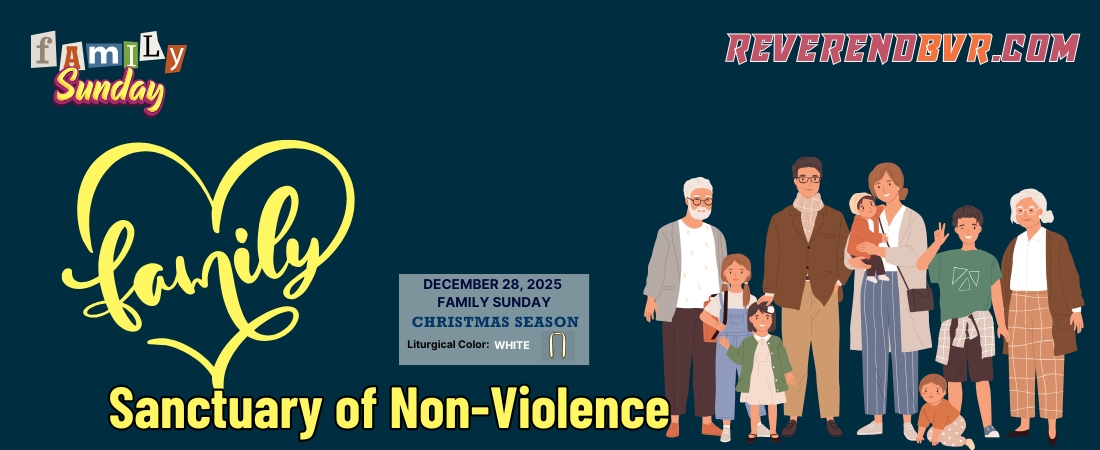
Sermon Title: Sanctuary of Non-Violence.
Occasion: 1st Sunday after Christmas | December 28 , 2025.
Bible Readings: Genesis 50:15-21 | Psalm 133, 103 | Colossians 3:12-17 | Luke 15:11-32.
Original Language Reflections (For deeper study, refer to the Table of Hebrew and Greek Terms in Section 3 of the sermon).
Website: www.reverendbvr.com
1. Introduction: The Family in Divine Perspective
On this Family Sunday, observed on the first Sunday after Christmas, we are invited to contemplate the family not merely as a sociological arrangement but as a sacred sanctuary of non-violence and divine formation. Scripture and tradition affirm that the family is more than a unit of kinship; it is the first school of virtue, the domestic Church (ecclesiola), and the nursery of peace and justice.
As St. John Chrysostom aptly said, “The family is a little Church.” It is in the home that the imago Dei—the image of God—is nurtured or neglected. What begins at home does not remain there; it shapes society, culture, and the Church. Hence, the theological task of family formation is not peripheral to Christian discipleship—it is foundational.
I. Joseph: Family as the Theatre of Forgiveness (Genesis 50:15–21)
The final chapters of Genesis provide a deeply moving portrait of forgiveness. Joseph’s brothers, burdened by guilt, fear revenge after their father’s death. But Joseph answers with stunning grace:
“You intended (ḥāshab, חָשַׁב) to harm me, but God intended it for good…” (Genesis 50:20)
The Hebrew verb ḥāshab connotes deliberate planning—yet what was devised for evil, God reweaves for salvation. Joseph refuses to exact vengeance, saying, “Am I in the place of God?” (v.19). His forgiveness flows from a theologically grounded trust in divine providence.
This is a critical corrective to modern family dynamics often marred by resentment, retaliation, and emotional isolation. The Spirit-saturated family becomes the first theater of peacemaking—a sanctified ground where wounds are not weaponized but healed in mercy.
II. Theological Foundations of Family Formation
Deuteronomy 6:6–7 offers a formative vision: “These commandments… Impress them on your children. Talk about them when you sit at home…”
Faith is not abstract theology but embodied practice—taught in the rhythms of daily life. The family is the original space for moral, spiritual, and social learning. St. Augustine in his Confessions recalls that he “learned to love” and to speak before he could read—through the loving witness of his family.
Within this crucible, we learn:
- Language and Manners: Through imitation and intimacy.
- Discipline and Responsibility: Through routine and shared labor (cf. Galatians 5:22–23).
- Moral Values: Honesty, kindness, and integrity modeled before verbalized.
As Aquinas develops from Aristotle, virtue is formed not by accident but by habit. Thus, Christian households become schools of virtue—forming not only good behavior but godly character.
III. Psalm 133: Dwelling in Unity as the Family of God
Psalm 133 celebrates the joy of familial and communal harmony: “How good and pleasant it is when God’s people live together in unity!”
The Hebrew term yaḥad (יַחְד) conveys more than mere coexistence—it speaks of covenantal harmony. Unity within the family is depicted through sacred imagery: oil upon the priest and dew upon the mountains. These metaphors evoke consecration and life-giving freshness.
Here, the family becomes a microcosm of the Church. In unity, the Lord commands blessing and life forevermore (v.3).
IV. Non-Violence Begins at Home: The Family as School of Peace
Mahatma Gandhi once said: “If we are to teach real peace in this world, we shall have to begin with the children.”
The biblical concept of shalom—peace, wholeness, and justice—must be rooted in the domestic sphere. Families are the first school of non-violence. This includes:
- Peaceful Communication (Ephesians 4:29): Speaking with grace, not harshness.
- Conflict Resolution (Matthew 18:15–17): Engaging disagreements with clarity and mercy.
- Equality and Inclusion (Galatians 3:28): Dismantling discrimination across gender, caste, or creed.
- Empathy and Forgiveness (Colossians 3:13): Cultivating a culture of understanding.
Non-violence is not just the absence of aggression—it is the active presence of agape, Christ-like love. It was in the household that early Christians first practiced the radical love that would later upend the Roman world.
V. Psalm 103: God’s Compassion as Parental Model
“As a father has compassion (raḥam, רַחֵם) on his children, so the LORD has compassion on those who fear him.” (v.13). This word raḥam—linked to the womb—expresses divine tenderness, both maternal and paternal. God, the ideal Parent, is slow to anger, rich in mercy, and abounding in steadfast love.
Families are called to reflect this character of God:
- Not as perfect managers of behavior,
- But as gracious caretakers of souls.
Dietrich Bonhoeffer described this as “life together”—marked by mutual patience, bearing with one another in love, and forgiving one another as Christ forgave.
VI. The Pauline Household Ethic (Colossians 3:12–17)
Paul exhorts families to clothe themselves with Christ-like virtues—compassion (splagchna, σπλάγχνα), kindness, humility, gentleness, patience.
“Above all, put on love (agapē) which binds everything together in perfect unity.”
The Christian home is not merely functional—it is liturgical. It becomes a place of:
- Teaching wisdom
- Singing praise
- Giving thanks
- Living Christ
Children are catechized by the daily practices and emotional environment of the home. The virtues of the kingdom take root in the smallest acts—shared meals, apologies, chores, and prayers.
VII. The Prodigal Son: Love Beyond Justice (Luke 15:11–32)
In the parable of the Prodigal Son, we find a father moved with compassion (splagchnizomai), running to embrace a wayward child. This term—used also of Jesus—implies deep, visceral mercy.
This is no mere pardon; it is restoration. Robe, ring, sandals, and feast all declare: You are still mine.
Justice gives what is due; grace gives what is divine. Families, too, are called not merely to judge but to heal—to run toward the broken and to rejoice over return.
VIII. Family and Social Transformation
What begins at home does not end there. Social evils—casteism, sexism, religious hatred—often take root in childhood attitudes formed within the home. But so does hope.
Families can:
- Model gender equality through mutual respect.
- Cultivate empathy for the marginalized.
- Teach hospitality across religions and cultures.
Proverbs 22:6 affirms this generational truth: “Train up a child in the way he should go, and when he is old he will not depart from it.”
The Church must therefore not only preach justice from the pulpit—but form just persons at the dinner table.
IX. Conclusion: The Kingdom of God Begins at the Kitchen Table
Jesus taught kingdom truths with household images: a lamp in a home (Matt. 5), yeast in dough (Matt. 13), a coin lost and found (Luke 15). Why? Because the divine transformation of the world begins in the family.
When a family becomes:
- A school of the Spirit
- A sanctuary of non-violence
- A nursery of virtue
- A workshop for justice
- A seedbed for saints
…then the world begins to change. The family is not only a private reality—it is public theology. It is the first place where the peace of Christ dwells richly.
Let us therefore recommit to honoring, restoring, and sanctifying the family as God’s chosen vessel for shaping history, healing wounds, and heralding the peace of Christ.
2. Closing Prayer
Gracious and Merciful God, You who dwell with the humble and abide with those who seek peace, We thank You for the sacred gift of family—the first dwelling place of Your love, the first altar of our becoming. As we have reflected on the call to make our homes sanctuaries of non-violence, clothe us, O Lord, with compassion, kindness, humility, gentleness, and patience. May Your Spirit dwell richly among us— guiding our speech, healing our wounds, and transforming our habits. Where there is resentment, sow forgiveness. Where there is silence, stir up wise words. Where there is weariness, bring rest and renewal. Help us remember that each table is a sacred space, each word a seed, each act of care a spark of Your kingdom. Empower every parent, grandparent, sibling, and child to embody Your grace— that our families may reflect the unity of the Trinity and the mercy of the Cross. Send us forth as peace-makers, not only in the public square, but in the hidden corners of our homes. We ask this through Jesus Christ our Lord, who with You and the Holy Spirit lives and reigns, One God, forever and ever. Amen.
3. Learn Words from the Original Scriptures (For deeper understanding and meditation on today’s theme)
| S. No | Term (Click on each Term to view its lexical details) | Language | Meaning | Verse Reference |
| 1 | ḥāshab (חָשַׁב) | Hebrew | To think, plan, devise, reckon | Genesis 50:20 |
| 2 | yaḥad (יַחַד) | Hebrew | Together, unity, alike | Psalm 133:1 |
| 3 | shalom (שָׁלוֹם) | Hebrew | Peace, wholeness, completeness | Multiple references |
| 4 | raḥam (רַחֵם) | Hebrew | To have compassion, show mercy | Psalm 103:13 |
| 5 | splagchna (σπλάγχνα) | Greek | Compassion, inward affection, tender mercy | Colossians 3:12 |
| 6 | agapē (ἀγάπη) | Greek | Divine love, selfless love | Colossians 3:14 |
| 7 | splagchnizomai (σπλαγχνίζομαι) | Greek | To be moved with compassion, feel pity | Luke 15:20 |
4. Bibliography
- Augustine. Confessions. Trans. Henry Chadwick. Oxford: Oxford University Press, 1991.
- Aquinas, Thomas. Summa Theologiae. Trans. Fathers of the English Dominican Province.
- Bonhoeffer, Dietrich. Life Together. Trans. John W. Doberstein. New York: Harper & Row, 1954.
- Chrysostom, John. Homilies on Ephesians. Nicene and Post-Nicene Fathers, Series I, Vol. 13.
- Gandhi, Mahatma. Collected Works of Mahatma Gandhi. New Delhi: Publications Division, Government of India.
- Wright, N.T. Paul and the Faithfulness of God. Minneapolis: Fortress Press, 2013.
- Vanier, Jean. Community and Growth. Mahwah, NJ: Paulist Press, 1989.
- Yoder, John Howard. The Politics of Jesus. Grand Rapids: Eerdmans, 1994.
© 2025 ReverendBVR.com | High-Academic Sermon Series, 2025.
Content licensed under Creative Commons Attribution-NonCommercial-NoDerivatives 4.0 International (CC BY-NC-ND 4.0). You are free to share — copy and redistribute the material in any medium or format with proper attribution. No commercial use or modifications allowed without explicit permission.
For further sermons and biblical reflections, please visit 🌐 www.reverendbvr.com/sermons