Sermon Title: Fall: Moving Away from God’s Purpose : Falling Away, and the God Who Still Calls Us Home
Occasion: 8th Sunday before Easter, February 8, 2026.
Bible Readings: Judges 2: 7-22 | Psalm 14 |1 Tim. 4: 1-10 | Luke 18: 18-27.
Original Language Reflections (For deeper study, refer to the Table of Hebrew and Greek Terms in Section V of the sermon).
Website: www.reverendbvr.com
The fall begins not in rebellion but in forgetting. when human lives drift from God’s purpose and harmony, it gives way to disorder. Yet the God who names our fall is the same God who restores what we cannot, calling us back to life through Christ.
I. Theological Thesis :
All the appointed readings speak with one voice: human life flourishes only when it remains ordered toward God’s purpose, and it collapses into confusion, anxiety, and bondage when it turns away from that purpose. Yet, and this is the gospel note that rings beneath every warning: God does not abandon a fallen people. Even in disorder, deception, and misplaced desire, God continues to call, correct, and redeem, drawing humanity back into harmony through Christ.
This is not merely a story about ancient Israel, Eden, or a rich ruler. It is the story of us: modern people living in a disordered world, pulled by competing voices, yet still addressed by the God of peace and order.
1. The Tragedy of Forgetting Purpose: Judges 2:7–22
The book of Judges describes not simply moral failure, but the erosion of memory.
“The people served the LORD all the days of Joshua… and all that generation also were gathered to their ancestors. Then another generation arose… who did not know the LORD or the work that he had done for Israel.” (Judg. 2:7,10).
The Hebrew text uses the language of covenant—בְּרִית (berît)—a relational bond. Israel does not forget information; they forget relationship. This is not intellectual ignorance, but relational amnesia. They forget who they are for.
Exegetical Insight : Judges presents a recurring cycle: 1. Forgetting –> 2. Idolatry –> 3. Oppression –> 4. Cry for help —-> 5. Deliverance ———–> Return & then repetition.
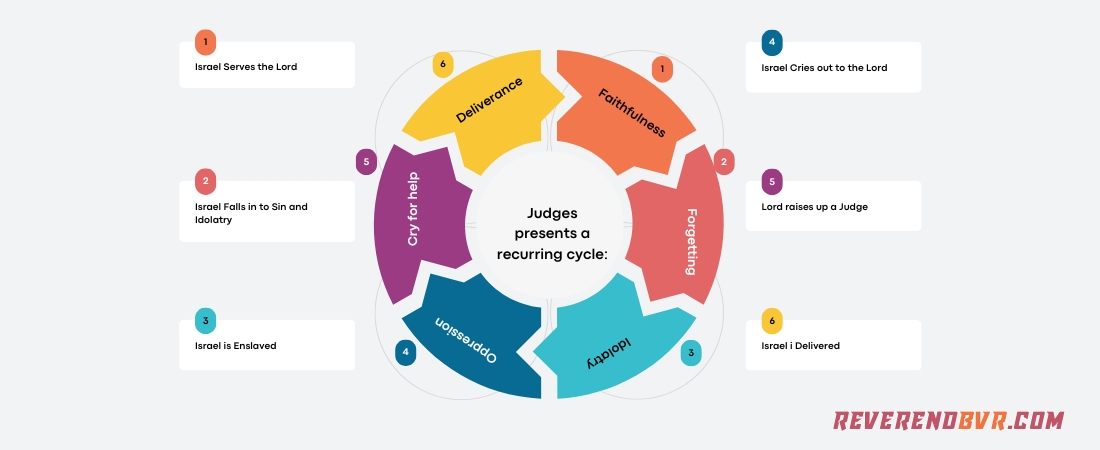
The problem is not that God changes; the people’s orientation changes. They exchange covenantal purpose for cultural convenience. The result is chaos: both social and spiritual.
Theological Meaning : God’s anger here is not arbitrary wrath. It is the grief of a Creator watching creation move against its own design. When God “hands them over,” it is not abandonment but discipline aimed at restoration.
2. The Inner Logic of Disorder (Psalm 14)
“The fool says in his heart, ‘There is no God.’”
The Hebrew word translated fool is נָבָל (nābāl). In biblical language, a “fool” is not unintelligent. The Hebrew term refers to someone who lives as though God were irrelevant.
Key Insight: Psalm 14 exposes the inner logic of a godless life:
- When God is excluded: Ethics collapse, Justice erodes and Community fractures.
This psalm is painfully contemporary. It mirrors societies that retain religious language but lose reverence, replacing God with power, success, or self. Yet the psalm does not end in despair. God remains the refuge of the poor. Divine purpose is not erased by human denial.
3. The Seduction of False Voices (1 Timothy 4:1–10)
Paul warns Timothy: “In later times some will depart from the faith, paying attention to deceitful spirits and teachings of demons.”
The Greek verb is ἀποστήσονται (apostēsontai), from which we get apostasy. It does not mean sudden rebellion, but gradual drifting. People do not always reject God angrily; they often wander sincerely. Notice the language: departure, not rebellion. People drift, often sincerely, often gradually.
What Makes These Teachings Dangerous?
They appear spiritual, but they distort God’s design:
- What God created as good is declared unclean.
- What God intended for gratitude is turned into anxiety and control.
False teaching always fractures creation from its Creator.
Paul responds not with fear but formation:
- Discipline yourself for godliness.
- Anchor your hope in the living God.
Christian faith is not escapism; it is reorientation toward life as God intended it.
4. When Goodness Becomes an Obstacle (Luke 18:18–27)
The rich ruler is not immoral. He is sincere, ethical, religious. And yet Jesus says: “One thing you still lack.”
The Problem Is Not Wealth, but Misaligned Trust. The man’s identity is anchored in what he possesses. His goodness has become self-contained. He wants eternal life without reordering his life.
Jesus’ shocking statement: “What is impossible for mortals is possible for God”
The Greek contrast is striking:
- ἀδύνατα (adynata) — impossible for humans
- δυνατά (dynata) — possible with God
The above statement is not condemnation but invitation. Salvation requires divine re-creation, not human achievement.
5. The Anatomy of the Fall (Genesis 3 & Romans 1)
Genesis 3:1–13
The fall begins not with rebellion, but with distrust: “Did God really say…?” The serpent is described as עָרוּם (ʿārûm)—crafty, subtly deceptive.Sin distorts perception before it breaks commandments. And The result is: Shame, Fear, Blame, Alienation from God, others, and creation
Romans 1:18–23
Paul universalizes Eden: Humanity suppresses truth. (ἀλήθειαν κατεχόντων). Truth is not absent; it is actively held down. Creation is worshiped instead of the Creator. Wisdom becomes folly. The fall is not merely ancient; it is ongoing whenever human beings exchange God’s glory for substitutes.
6. The Collect as Theological Center:
The Collect names the truth we often avoid: “By falling into various temptations, we have distorted the covenant of harmony…” This is a profound theological claim. Sin is not merely rule-breaking; it is disharmony; life out of tune with its Creator. Yet the prayer moves forward: Mercy, Restoration, Growth and Fixing our eyes on Christ. The goal is not nostalgia for Eden, but maturity in Christ.
II. Contemporary Application (Without Moralism)
We live in a world of: Competing truths, Spiritual noise, Productivity without purpose and Freedom without direction. This text does not call us to fear culture, but to recover orientation:
- To ask not “Is this allowed?” but “Does this align me with God’s purpose?”
- To measure success not by accumulation, but by faithfulness.
- To resist false voices not by withdrawal, but by deeper formation in Christ.
Faithful living is not perfection, it is direction.
III. Conclusion: Hope Beyond the Fall
The final word of these readings is not judgment but possibility. “What is impossible for mortals is possible for God.” God remains the One who restores order, heals distortion, and calls fallen people into fruitful lives—even in a disordered world.
IV. Concluding Prayer
God of holy order and patient mercy,
we confess that we have often mistaken freedom for independence
and abundance for blessing.
We have listened to voices that promised life
yet led us away from you, the source of life.
Re-order our desires,
re-tune our hearts to your truth,
and re-shape our lives according to the pattern of your Son.
Where we have fallen, lift us;
where we are confused, clarify us;
where we are burdened, free us.
Teach us to live not by fear or falsehood,
but by hope in the living God,
through Jesus Christ,
in whom all things hold together.
Amen.
V. Key Hebrew and Greek Terms from the Readings
| S.No | Passage | Original Word | Language | Meaning | Theological Significance |
| 1 | Judges 2:1, 2:20 | בְּרִית (berit) | Hebrew | Covenant | Relational bond, not contract |
| 2 | Psalm 14:1 | נָבָל (nabal) | Hebrew | Fool | Moral/spiritual insensitivity |
| 3 | Genesis 3:1 | עָרוּם (ʿārûm) | Hebrew | Crafty | Deceptive distortion of truth |
| 4 | Romans 1:18 | ἀλήθειαν κατεχόντων | Greek | Suppress the truth | Active resistance to God |
| 5 | 1 Timothy 4:1 | ἀποστήσονται (apostēsontai) | Greek | Will depart | Gradual drifting from faith |
| 6 | Luke 18:27 | ἀδύνατα (adynata) | Greek | Impossible | Human limitation |
| 7 | Luke 18:27 | δυνατά (dynata) | Greek | Possible | Divine power to save |
© 2025 ReverendBVR.com | High-Academic Sermon Series, 2026.
Content licensed under Creative Commons Attribution-NonCommercial-NoDerivatives 4.0 International (CC BY-NC-ND 4.0). You are free to share, copy and redistribute the material in any medium or format with proper attribution. No commercial use or modifications allowed without explicit permission.
For further sermons and biblical reflections, please visit 🌐 www.reverendbvr.com/sermons
Bibliography:
- Reinhold Niebuhr, The Doctrine of Sin (New York: Charles Scribner’s Sons, 1964).
- N. T. Wright, Surprised by Hope: Rethinking Heaven, the Resurrection, and the Mission of the Church (New York: HarperOne, 2008).
- Craig G. Bartholomew and Michael W. Goheen, The Drama of Scripture: Finding Our Place in the Biblical Story (Grand Rapids: Baker Academic, 2004).
- N. T. Wright, Paul and the Faithfulness of God (Minneapolis: Fortress Press, 2013).
- Thomas G. Long, The Witness of Preaching, 2nd ed. (Louisville: Westminster John Knox Press, 2005).
- Gerhard von Rad, Old Testament Theology, vol. 1 (New York: Harper & Row, 1962).
- Daniel I. Block, Judges, New American Commentary 6 (Nashville: B&H Publishing Group, 1999).
- Walter Brueggemann, Old Testament Theology: An Introduction (Minneapolis: Fortress Press, 2008).
- Walter Brueggemann, The Message of the Psalms: A Theological Commentary (Minneapolis: Augsburg Publishing House, 1984).
- Luke Timothy Johnson, The First and Second Letters to Timothy: A New Translation with Introduction and Commentary, Anchor Yale Bible 35A (New Haven: Yale University Press, 2001).
- Seward Hiltner, Pastoral Theology (Nashville: Abingdon Press, 1958).
- Joel B. Green, The Gospel of Luke, New International Commentary on the New Testament (Grand Rapids: Eerdmans, 1997).
- Claus Westermann, Genesis 1–11: A Continental Commentary (Minneapolis: Fortress Press, 1994).
- Paul Scott Wilson, Preaching Grace: Theological Foundations of Homiletics (Nashville: Abingdon Press, 1999).