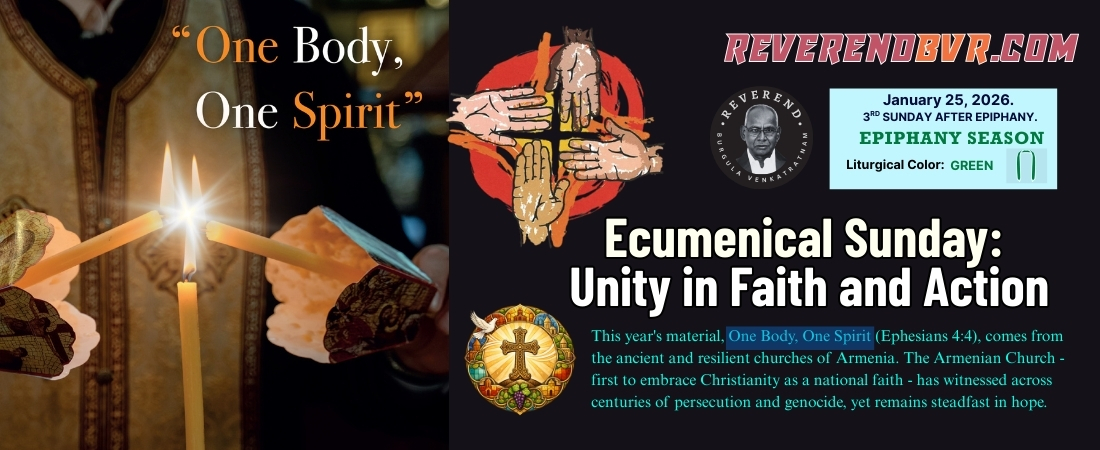
Sermon Title: Ecumenical Sunday: Unity in Faith and Action.
Occasion: 3rd Sunday after Epiphany, January 25, 2026.
Bible Readings: Joshua 4: 1-11 | Psalm 67 | Epistle Acts 4: 32-37 | Gospel Mark 6: 32-44.
Original Language Reflections (For deeper study, refer to the Table of Hebrew and Greek Terms in Section III of the sermon).
Website: www.reverendbvr.com
Resources for the Week of Prayer for Christian Unity 2026, the theme for the week: ““There is one body and one Spirit, just as you were called to the one hope of your calling” (Ephesians 4:4) can be downloaded here.
God’s Word reminds us that unity is not something we manufacture but something we receive and live out. From the stones lifted from the Jordan to the bread multiplied in Jesus’ hands, Scripture shows that God gathers diverse people into one story of grace, calling us to remember together, to bless beyond our boundaries, to share what we have, and to trust in God’s abundant provision. On this Ecumenical Sunday, we are invited to move from words about unity to lives shaped by it, becoming one heart and soul in Christ so that a divided world may glimpse God’s reconciling love.
I. Unifying Theological Thesis
The Scriptures appointed for this Ecumenical Sunday proclaim a single, Spirit-shaped vision: God forms one people from many by remembrance, blessing, shared life, and abundant provision. so that the world may know God’s saving love. Unity in the Bible is never mere agreement; it is embodied faith, remembered in stones, sung in blessing, practiced in shared life, and enacted in compassionate action.
1. Remembered Unity (Joshua 4:1–11).
When Israel crosses the Jordan, God commands an unusual act: twelve stones are lifted from the riverbed and set up as a memorial. This is not nostalgia; it is covenantal pedagogy. Each stone stands for a tribe i.e., distinct, named, remembered, yet together they form one testimony.
Biblical practice explained:
- Memorial stones were common in the ancient world, but here they function theologically: they catechize future generations (“When your children ask…”).
- Unity is rooted in shared memory of grace, not erased difference. Israel does not become one by losing tribal identity, but by remembering one saving act of God.
Ecumenical insight:
Christian unity begins not with institutional uniformity but with shared remembrance. the confession that we all stand on grace we did not create. The Church becomes fragmented when it forgets its river-crossings.
2. Blessed Unity (Psalm 67).
Psalm 67 is a missionary psalm sung as prayer: “May God be gracious to us and bless us… that your way may be known on earth.” Israel’s blessing is never private; it is centrifugal, moving outward to the nations.
Biblical practice explained:
- The psalm echoes the Aaronic blessing (Numbers 6), transforming priestly words into a global vocation.
- Worship here is missional: praise and justice belong together (“Let the nations be glad… for you judge the peoples with equity”).
Ecumenical insight:
The Church’s divisions undermine its witness. Psalm 67 insists that unity is evangelistic, the credibility of our faith is tied to whether our common life reflects God’s justice and joy.
3. Practiced Unity (Acts 4:32–37).
Luke describes the early Church with astonishing clarity: “one heart and soul.” This unity expresses itself economically, no one claims private ownership; needs are met through generous sharing.
Biblical practice explained:
- This is not coerced communism but voluntary koinōnia – a Spirit-generated fellowship where possessions serve persons.
- The apostles’ witness and the community’s generosity are inseparable; grace creates generosity.
Ecumenical insight:
Unity becomes visible when faith reshapes how we use power, property, and privilege. A divided Church cannot convincingly proclaim a reconciling gospel.
4. Enacted Unity (Mark 6:32–44).
The feeding of the five thousand reveals unity in action. Jesus does not bypass the disciples; he involves them: “You give them something to eat.” Scarcity is transformed when what little is shared in trust.
Biblical practice explained:
- The people are seated in groups: order without exclusion.
- The Eucharistic pattern is clear: take, bless, break, give – a foretaste of the Church’s ongoing ministry.
Ecumenical insight:
Christ’s unity is compassionate and practical. Where communities collaborate to feed the hungry and heal the broken, the Church becomes one loaf rather than competing crumbs.
5. The Collect as Theological Thread
The Collect gathers the Scriptures into prayerful coherence: remembrance (stones of faithfulness), mission (all nations), shared life (one heart and soul), and trust (abundant provision). It asks not for superficial harmony, but for bridge-building discipleship shaped by humility, listening, and generosity.
6. Contemporary Application: Faithful Living Without Moralism
In a polarized world, unity is often confused with compromise or control. Scripture offers another way:
- Remember together what God has done before debating what we should do next.
- Bless beyond boundaries, resisting fear-based faith.
- Share concretely, aligning resources with compassion.
- Act together, trusting Christ to multiply what we offer.
This is unity not enforced by rules, but formed by grace.
II. Conclusion Prayer
God of living memory and living bread,
gather your scattered people into one body shaped by your grace.
Where we forget, teach us to remember;
where we hoard, teach us to share;
where we divide, teach us to listen;
where we fear scarcity, teach us trust.
Make your Church a table wide enough for the world,
that fed by Christ, we may feed others, to the glory of your reconciling love, through Jesus Christ our Lord. Amen.
III. Key Biblical Words and Meanings
| S.No | Language | Word | Transliteration | Meaning | Theological Significance |
| 1 | Hebrew | זִכָּרוֹן | zikkārôn | memorial | Faith shaped by remembrance of God’s saving acts |
| 2 | Hebrew | בְּרָכָה | berākhāh | blessing | Blessing as vocation for the nations |
| 3 | Greek | καρδία μία | kardia mia | one heart | Spiritual unity beyond institutional sameness |
| 4 | Greek | κοινωνία | koinōnia | fellowship, sharing | Grace-expressed unity through shared life |
| 5 | Greek | εὐλογέω | eulogeō | to bless | Christ’s blessing that multiplies what is offered |
| 6 | Greek | περισσεύω | perisseuō | abound | God’s abundance overcoming human scarcity |
Ecumenical unity, the Epiphany Scriptures remind us, is not a strategy but a sacrament of God’s grace i.e., seen, shared, and lived for the life of the world.
© 2025 ReverendBVR.com | High-Academic Sermon Series, 2026.
Content licensed under Creative Commons Attribution-NonCommercial-NoDerivatives 4.0 International (CC BY-NC-ND 4.0). You are free to share, copy and redistribute the material in any medium or format with proper attribution. No commercial use or modifications allowed without explicit permission.
For further sermons and biblical reflections, please visit 🌐 www.reverendbvr.com/sermons