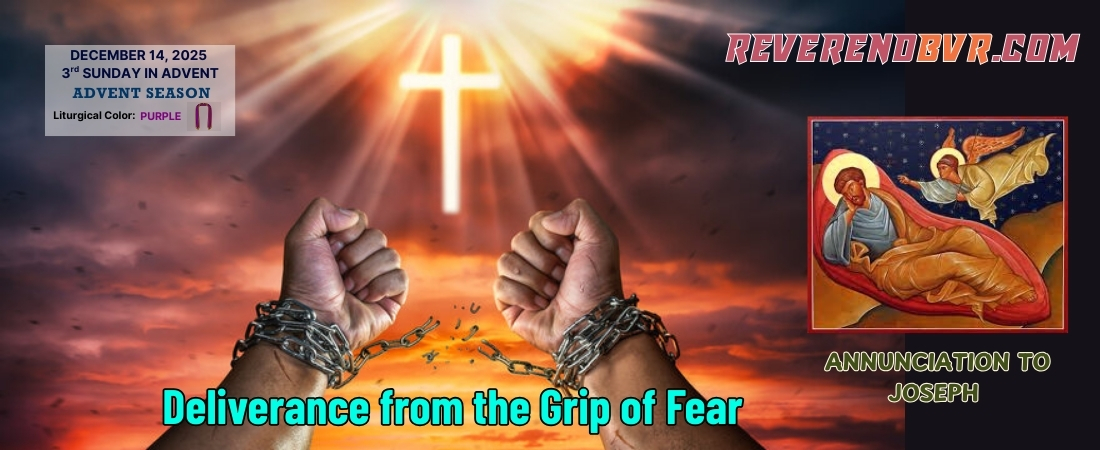
Rooted in the stories of Joseph, Joshua, David, and John, this Advent sermon explores how fear is not simply a psychological obstacle, but a spiritual battleground where God’s presence, promise, and perfect love bring deliverance. In the face of uncertainty and risk, courage is not self-generated but Spirit-given—an act of abiding in divine love.
Sermon Title: Deliverance from the Grip of Fear.
Occasion: Annunciation to Joseph | 3rd Sunday in Advent | December 14, 2025, Sunday.
Bible Readings: 1 John 4:13–21 | Matthew 1:18–25 | Joshua 1:1–9 | Psalm 27.
Original Language Reflections(For deeper study, refer to the Table of Hebrew and Greek Terms in Section 3 of the sermon).
Website: www.reverendbvr.com
Introduction: The Silent Revolution of Courage
Fear is as ancient as Eden. The first human reaction to sin was fear: “I was afraid, so I hid” (Genesis 3:10). From that primal moment, fear has continued to distort human perception, paralyze calling, and sever relationships. And yet, Scripture also reveals a counter-narrative: divine deliverance that begins in the trembling heart and blossoms into faithful action.
On this Advent Sunday, our theme is not merely psychological consolation—it is theological emancipation: Deliverance from the Grip of Fear. Through the stories of Joseph, Joshua, David, and the apostle John, we are invited to see that fear is not overcome by willpower, but by the presence, love, and promise of God.
I. Joseph’s Fear: The Crisis of Righteousness and Reputation (Matthew 1:18–25)
Joseph’s dilemma is often underappreciated. Described as a righteous man (Greek: dikaios, δίκαιος), he stands at the crossroads of legal obligation and divine mystery. When he learns of Mary’s pregnancy, fear grips his soul—not only personal shame but communal consequence. The Mosaic law permitted harsh action (Deut. 22:20–21), but Joseph’s heart leans toward mercy.
It is within this moral and emotional anguish that divine intervention arrives—“Do not be afraid to take Mary as your wife” (Matthew 1:20). The Greek phrase μὴ φοβηθῇς (mē phobēthēs) appears frequently in theophanic moments throughout Scripture. It is God’s archetypal way of initiating radical transformation.
Joseph’s deliverance from fear is vocational. He is not simply comforted; he is commissioned—to name the Messiah, to become adoptive father to the Incarnate Word. His obedience reframes fear not as an absence of danger, but as a context for divine action.
II. Joshua’s Fear: Leading into the Unknown (Joshua 1:1–9)
After Moses’ death, Joshua inherits not only leadership but the burden of expectation. The command “Be strong and courageous” (Hebrew: chazaq ve’ematz, חֲזַק וֶאֱמָץ) is repeated thrice, underscoring a deep-seated anxiety. But what is the foundation of this courage? It is not Joshua’s military skill or personal charisma. It is the covenantal assurance: “I will be with you; I will never leave you nor forsake you” (v. 5).
The transition from fear to faith here is liturgical and political. Israel’s journey into the Promised Land symbolizes more than geography—it points to God’s faithfulness across generations. Joshua becomes the prototype/Exemplar/Forerunner of faithful leadership rooted not in self-confidence, but in divine companionship.
As we face uncertain futures—be it climate catastrophe, geopolitical instability, or personal transitions—Joshua’s call echoes: courage is the fruit of God’s unfailing presence.
III. Psalm 27: The Spiritual Geometry of Fear and Faith
David’s psalm is not naïve1 bravado2 , It is a testimony forged in the crucible of danger. “The Lord is my light and my salvation—whom shall I fear?” (v. 1). The Hebrew word yare’ (יָרֵא), meaning both “to fear” and “to revere,” highlights a key spiritual principle: misplaced fear is corrected by rightly directed awe.
David’s spiritual geometry reorients dread into devotion. He prays not for escape but for divine presence: “One thing I ask… that I may dwell in the house of the Lord all the days of my life” (v. 4). This is not escapism but spiritual realism. Fear is not obliterated—it is recalibrated in the light of God’s beauty and faithfulness.
His final exhortation—“Wait for the Lord; be strong, and let your heart take courage” (v. 14)—uses the verb qavah (קָוָה), suggesting an active, tension-filled hope. Deliverance is not always immediate. It is gestated in trust.
↪ 1. Naïve means lacking experience, wisdom, or understanding; overly simple or trusting. ↪2. Bravado means a showy or boastful display of courage or confidence, often meant to impress or mask fear.
IV. Perfect Love Casts Out Fear (1 John 4:13–21)
The apex of this theological journey arrives in the Johannine epistle: “There is no fear in love. But perfect love drives out fear” (1 John 4:18). The verb ekballō (ἐκβάλλω)—“to drive out”—is exorcistic. John does not suggest that fear coexists with love; he insists that divine love violently ejects fear.
This is eschatological love—love that reorients how we stand before the judgment seat of God. It is also ecclesial love—“Whoever loves God must also love his brother” (v. 21). The absence of fear is not merely internal peace; it is communal integrity. Love is perfected in mutuality.
To abide in love is to abide in God (v. 16). And in that abiding, we find immunity to the terror of judgment. The Christian is not fearless because evil is absent, but because God is present.
V. Incarnational Courage: Joseph as the Advent Icon
Joseph’s fearless obedience is more than a moral lesson; it is a Christological paradigm. He receives the command to name the child Jesus (Yeshua, “The Lord saves”) and in doing so, enters the redemptive arc of history. He surrenders control, embraces scandal, and lives by divine assurance.
In our own lives, we may fear disgrace, uncertainty, supernatural calling, or failure. Joseph teaches us that deliverance is not escape—it is participation. God does not simply remove the object of fear; He invites us into a greater narrative where love and trust cast it out.
VI. Conclusion: Advent Hope in a Fearful World
Fear is not foreign to faith. The psalmist feared, the prophets trembled, the apostles panicked. But they all heard a recurring command: “Do not be afraid.”
This Advent, we are not called to eliminate fear by denial, distraction, or domination. We are called to respond as Joseph did:
- Like Joshua, to find courage not in ourselves, but in God’s presence.
- Like David, to worship through the trembling and seek God’s face.
- Like John, to abide in perfect love that casts out fear.
- Like Joseph, to obey even when the path is dark and the outcome unknown.
This is not sentiment. It is the logic of Incarnation. God with us. And that is enough.
2. Closing Prayer
O God of peace, who spoke to Joseph in the night and to Joshua on the brink of the Jordan, speak now to us who tremble in many ways. Cast out our fears with your perfect love. May your presence strengthen our hearts, your Word guide our paths, and your Spirit empower our obedience. In the name of Jesus, the Deliverer, we pray. Amen.
3.Learn Words from the Original Scriptures (For deeper understanding and meditation on today’s theme)
| S.No | Term (Transliteration) – Click on each term to view its lexical details | Language | Meaning/Context |
| 1 | δίκαιος (dikaios) | Greek | Righteous; used to describe Joseph as morally upright (Matthew 1:19) |
| 2 | μὴ φοβηθῇς (mē phobēthēs) | Greek | “Do not be afraid”; divine command in theophanic contexts (Matthew 1:20) |
| 3 | חֲזַק (chazaq) וֶאֱמָץ (ve’ematz) | Hebrew | “Be strong and courageous”; repeated encouragement to Joshua (Joshua 1:6,7,9) |
| 4 | יָרֵא (yare’) | Hebrew | “To fear” or “to revere”; used in Psalm 27:1 as a contrast between dread and awe |
| 5 | קָוָה (qavah) | Hebrew | “To wait for,” with tension and hope (Psalm 27:14) |
| 6 | ἐκβάλλω (ekballō) | Greek | “To drive out”; used to describe how perfect love casts out fear (1 John 4:18) |
| 7 | יֵשׁוּעַ (Yeshua) | Hebrew | “The Lord saves”; name of Jesus, given to Joseph to name the child (Matthew 1:21) |
Bibliography
- Brown, Raymond E. The Birth of the Messiah. New York: Doubleday, 1993.
- Brueggemann, Walter. The Message of the Psalms. Augsburg Fortress, 1984.
- Wright, N.T. Matthew for Everyone, Part 1. SPCK, 2004.
- Childs, Brevard S. Old Testament Theology in a Canonical Context. Fortress, 1985.
- Moloney, Francis J. The Gospel of John. Baker Academic, 2005.
- Bauckham, Richard. The Testimony of the Beloved Disciple. Baker Academic, 2007.
- Green, Joel B. The Theology of the Gospel of Luke. Cambridge University Press, 1995.
© 2025 ReverendBVR.com | High-Academic Sermon Series, 2025.
Content licensed under Creative Commons Attribution-NonCommercial-NoDerivatives 4.0 International (CC BY-NC-ND 4.0). You are free to share — copy and redistribute the material in any medium or format with proper attribution. No commercial use or modifications allowed without explicit permission.
For further sermons and biblical reflections, please visit 🌐 www.reverendbvr.com/sermons