
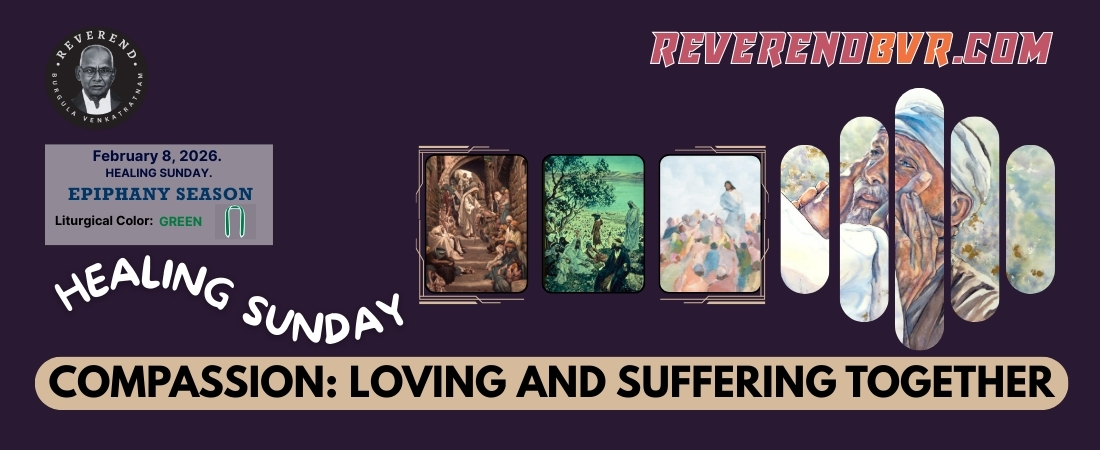
Sermon Title: Compassion: Loving and Suffering Together.
Occasion: Healing Ministry Sunday, February 8, 2026.
Bible Readings: Isa. 42: 1-9 | Psalm 103: 1-14 | James 5: 13-18 | Matt. 9: 35-38 and 2 Kings 5: 8-14, Acts 3: 1-10.
Original Language Reflections (For deeper study, refer to the Table of Hebrew and Greek Terms in Section VIII. of the sermon).
Website: www.reverendbvr.com
Theological Thesis: Biblical compassion is not mere sympathy or distant kindness. It is God’s deliberate choice to draw near, to bear suffering with the wounded, and to restore life through faithful presence and healing action. Across these readings, compassion is revealed as God’s way of being in the world: gentle yet powerful, patient yet urgent, personal yet communal. In Jesus Christ, this divine compassion takes flesh by touching bodies, forgiving sins, restoring dignity, and commissioning the church to become a living sign of God’s healing love.
One Story, Many Voices: How the Readings Cohere: Though drawn from different centuries and genres, the readings form a single narrative arc:
- Isaiah reveals God’s Servant whose compassion is quiet, faithful, and justice-bearing.
- The Psalmist names compassion as God’s enduring covenantal character.
- James insists that compassion must take embodied form in prayer, confession, and communal care.
- Matthew shows compassion incarnate in Jesus, whose heart breaks for the harassed and helpless.
- 2 Kings and Acts testify that God’s compassion heals not by magic or spectacle, but by obedience, faith, and restoration into community.
Together they proclaim: God heals by drawing near—and sends a healed people to draw near to others.
Exegesis and Theological Reflection:
1.Compassion Without Crushing (Isaiah 42:1–9)
“A bruised reed he will not break, and a dimly burning wick he will not quench.” (Isa. 42:3) – Written during Israel’s experience of exile, Isaiah’s Servant Song speaks to a people crushed by imperial violence and spiritual despair. God’s chosen Servant does not establish justice through domination or spectacle but through faithful tenderness.
The Hebrew word behind compassion here is tied to gentle restraint. God’s power does not overwhelm weakness. It protects it. This reframes healing ministry: true compassion does not rush suffering toward resolution but honors fragility as the very place where God works.
2. Compassion as God’s Memory (Psalm 103:1–14)
“The LORD is merciful and gracious, slow to anger and abounding in steadfast love.” (Ps. 103:8)
Psalm 103 is theology set to song. Compassion (raḥûm) is not an occasional divine mood but God’s enduring posture toward humanity. God remembers our dust even when we forget it.
This Psalm guards healing ministry from cruelty disguised as spirituality. God does not shame the wounded for being weak. Divine compassion flows precisely because God knows how fragile human life is.
3. Compassion That Takes Responsibility (James 5:13–18)
“Is anyone among you sick? Let them call for the elders of the church…” (James 5:14)
James refuses to spiritualize suffering. Prayer here is not private escape but communal solidarity. Healing involves oil, confession, presence, and persistence.
James anchors compassion in accountability: healing is not performed on people but practiced with them. The church becomes a healing body only when it learns to bear one another’s vulnerabilities without fear or pretense.
4. The Compassionate Heart of Christ (4. Matthew 9:35–38)
“When he saw the crowds, he had compassion for them, because they were harassed and helpless, like sheep without a shepherd.” (Matt. 9:36)
The Greek verb splagchnizomai refers to a visceral, gut-level movement. Jesus’ compassion is not strategic, it is physically felt.
Notice: Jesus does not first correct the crowds; he sees them. Compassion precedes instruction. Healing precedes mission. Only after compassion moves him does Jesus speak of laborers for the harvest. Mission flows from mercy, not ambition.
5. Healing Through Humble Obedience (2 Kings 5:8–14)
“Wash, and be clean.” (2 Kgs 5:13)
Naaman’s healing is scandalously simple. No ritual spectacle. No heroic act. Just obedience that humbles pride.
Compassion here crosses boundaries; ethnic, political, and religious. God’s healing mercy refuses to be monopolized. True compassion often offends our sense of entitlement before it restores our bodies and souls.
6. Healing That Restores Dignity (Acts 3:1–10)
“In the name of Jesus Christ of Nazareth, stand up and walk.” (Acts 3:6)
The man is healed, but more importantly, he is restored to worship and community. Compassion is not complete until the excluded are brought back into shared life.
Peter offers neither silver nor spectacle, but presence and proclamation. Healing is relational before it is miraculous.
II. The Collect as Theological Center
The Collect names God as “Our God of Compassion… the refuge of the penitent.” It binds together cross, Spirit, justice, healing, and proclamation.
This prayer teaches us that:
- Compassion flows from the Triune life of God
- Healing is inseparable from justice and solidarity
- The church is empowered not to replace Christ, but to reveal Christ through faithful acts.
- Contemporary Application:
- In a world obsessed with productivity, compassion affirms presence over performance.
- In polarized societies, compassion refuses to reduce people to labels.
- In churches tempted by spectacle, compassion chooses faithfulness over flash.
Healing ministry today may look like listening without fixing, praying without controlling outcomes, and standing with those whose suffering is unseen or inconvenient.
III. Conclusion: Compassion as Our Calling
To be compassionate is not to be emotionally soft, it is to be theologically faithful. We are invited not merely to admire Christ’s compassion, but to inhabit it. The church does not heal the world by having all the answers, but by loving and suffering together in hope.
IV. Closing Prayer
O God whose mercy moves before our words, teach us to see as Christ sees, to feel as Christ feels, and to love as Christ loves.
Where bodies ache, bring healing. Where hearts are weary, bring rest. Where communities fracture, bring justice with mercy.
Make us a people who do not pass by suffering, but kneel beside it, speaking life in the name of Jesus, until all creation learns again to walk, to praise,
and to hope in you. Amen.
V. Key Biblical Terms for Understanding the Sermon:
| Passage | Verse | Original Word | Language | Literal Meaning | Theological Significance |
| Isaiah 42 | 42:3 | רָחַם (raḥam) | Hebrew | To show tender mercy | God’s justice is gentle and restorative |
| Psalm 103 | 103:8 | רַחוּם (raḥûm) | Hebrew | Compassionate, womb-like mercy | God’s covenantal faithfulness |
| James 5 | 5:14 | εὐχή (euchē) | Greek | Prayer, vow | Healing is communal and faithful |
| Matthew 9 | 9:36 | σπλαγχνίζομαι (splagchnizomai) | Greek | Gut-wrenching compassion | Jesus’ embodied mercy |
| 2 Kings 5 | 5:14 | טָהֵר (ṭāhēr) | Hebrew | To cleanse, purify | Healing restores dignity |
| Acts 3 | 3:6 | ὄνομα (onoma) | Greek | Name, authority | Healing in Christ’s living presence |
© 2025 ReverendBVR.com | High-Academic Sermon Series, 2026.
Content licensed under Creative Commons Attribution-NonCommercial-NoDerivatives 4.0 International (CC BY-NC-ND 4.0). You are free to share, copy and redistribute the material in any medium or format with proper attribution. No commercial use or modifications allowed without explicit permission.
For further sermons and biblical reflections, please visit 🌐 www.reverendbvr.com/sermons
Bibliography:
- Walter Brueggemann, The Compassionate God (Minneapolis: Fortress Press, 2015).
- Henri J. M. Nouwen, The Wounded Healer (New York: Image Books, 1979).
- N. T. Wright, Jesus and the Victory of God (Minneapolis: Fortress Press, 1996).
- Walter Brueggemann, Old Testament Theology: An Introduction (Nashville: Abingdon Press, 2008).
- Luke Timothy Johnson, The Letter of James, Anchor Yale Bible (New Haven: Yale University Press, 1995).
- Dale C. Allison Jr., The Gospel according to Matthew, International Critical Commentary (London: T&T Clark, 2004).
- Christopher J. H. Wright, The Mission of God (Downers Grove, IL: IVP Academic, 2006).
- Willie James Jennings, Acts, Interpretation: A Bible Commentary for Teaching and Preaching (Louisville: Westminster John Knox Press, 2017).
- Jürgen Moltmann, The Crucified God (Minneapolis: Fortress Press, 1993).
- Emmanuel Y. Lartey, Pastoral Care in Context (Louisville: Westminster John Knox Press, 2003).