This sermon explores the theological richness of the Incarnation and Epiphany through key Hebrew and Greek terms, illuminating how Scripture reveals Jesus Christ as divine light, redeemer, and king for all nations.
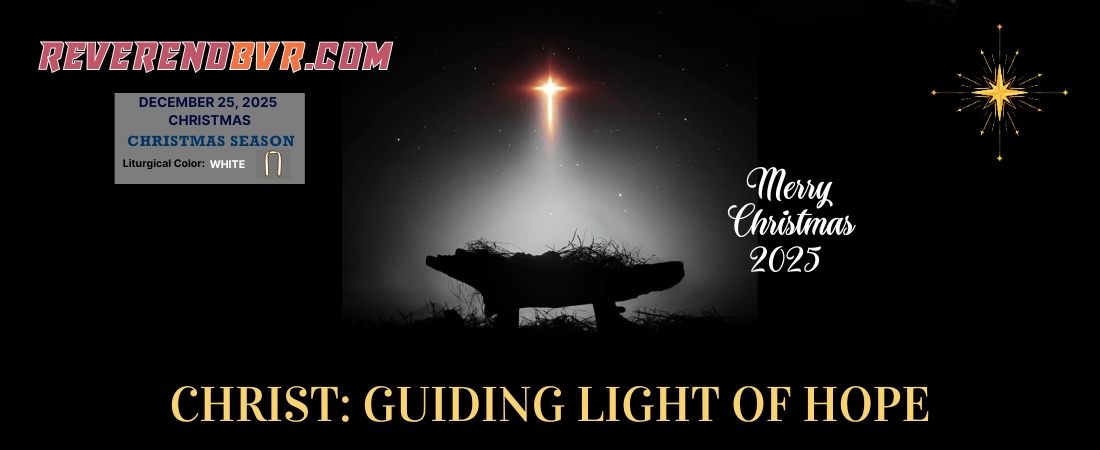
Sermon Topic: CHRIST: GUIDING LIGHT OF HOPE.
Occasion: Christmas Day | December 25, 2025.
Bible Readings: 1 John 4:13–21 | Matthew 1:18–25 | Joshua 1:1–9 | Psalm 27.
Original Language Reflections (For deeper study, refer to the Table of Hebrew and Greek Terms in Section 3 of the sermon).
Website: www.reverendbvr.com
1.Introduction: A World in Shadow, A Light Dawns
On this holy day, the Church universal proclaims anew the most luminous truth ever declared in history: “The Word became flesh and made his dwelling among us” (John 1:14). In a world fractured by division, wearied by despair, and disoriented by darkness, Christmas comes not as nostalgic sentiment but as a radical theological declaration—Christ is the light of hope that guides all nations (Isaiah 9:2).
This light did not emerge from worldly power, but from divine humility—a child born into obscurity, poverty, and threat, yet heralded by prophets, angels, and Eastern seekers. The Incarnation is no mere nativity tableau. It is the advent of the Divine Light breaking through the fog of human fallenness.
I. Isaiah’s Vision: A Light for the People in Darkness (Isaiah 9:1–7)
Isaiah’s oracle opens with a prophetic contrast: “The people walking in darkness have seen a great light” (Isaiah 9:2). Here, ḥōšek (חֹשֶׁךְ) — Hebrew for darkness — encapsulates the despair of Israel under Assyrian oppression, yet this gloom is not final.
This passage finds its New Testament fulfillment in the ministry of Jesus in Galilee, “by the Way of the Sea,” where the first rays of messianic hope dawned (cf. Matthew 4:12–17). Isaiah foresees the child born, the son given, who bears divine titles:
- Pele’ Yo’etz (פֶּלֶא יוֹעֵץ) – “Wonderful Counselor”
- El Gibbor (אֵל גִּבּוֹר) – “Mighty God”
- Avi ‘Ad (אֲבִי עַד) – “Everlasting Father”
- Sar Shalom (שַׂר שָׁלוֹם) – “Prince of Peace”
These titles are not poetic flourishes—they affirm both the divinity and eternal rule of the Messiah. The birth of Jesus is not merely the arrival of a human leader; it is the descent of Theos (Θεός)—God Himself—into history to shatter yokes, liberate the oppressed, and establish peace without end.
II. The Global Praise of the Incarnate King (Psalm 96)
Psalm 96 invites “all the earth” to sing a new song (v.1), a liturgical proclamation that God’s salvific work now encompasses every nation. This cosmic celebration anticipates the universal mission of Christ, fulfilled when Gentile Magi kneel before the infant King (Matthew 2:11).
The psalm declares, “The Lord reigns!” (v.10). The Hebrew verb mālak (מָלַךְ) implies enthronement and sovereign rule. Yet this reign is uniquely righteous and just—He judges with ’ĕměṯ (אֱמֶת, “faithfulness”) and ṣeḏeq (צֶדֶק, “righteousness”). The birth of Christ thus inaugurates a reign that is both global and just, spiritual and political, already and not yet.
III. The Magi: Seekers of Light, Worshipers of the King (Matthew 2:1–12)
Matthew’s account of the Magi—magoi (μάγοι)—is both theological and geopolitical. They came from the East (likely Persia, Babylon, or Arabia), regions associated with wisdom traditions and astronomy. Their question, “Where is the one born King of the Jews?” (v.2), is laced with irony: foreign sages seek the truth that Jerusalem’s leaders ignore.
Their journey, guided by a star (astēr, ἀστήρ), fulfills Numbers 24:17: “A star will come out of Jacob.” Theologically, this light anticipates Christ as the Morning Star (Revelation 22:16), whose rising outshines all cosmic powers.
Their gifts carry prophetic significance:
- Gold – acknowledging Jesus’ kingship.
- Frankincense – affirming his divinity (used in priestly offerings).
- Myrrh – foretelling his suffering and death (John 19:39–40).
The cradle already foreshadows the cross.
IV. The Mystery of Grace Revealed (Titus 3:4–7)
Paul’s letter to Titus encapsulates the meaning of the Nativity: “When the kindness and love of God our Savior appeared…” (v.4)
The Greek word for “appeared” is epiphaneō (ἐπιφαίνω), from which we derive Epiphany. This is a theophany—God made visible in the person of Jesus. Importantly, this manifestation is not earned: “Not because of righteous things we had done, but because of his mercy” (v.5).
Through the Holy Spirit’s palingenesia (παλιγγενεσία, “rebirth”) and anakainōsis (ἀνακαίνωσις, “renewal”), we become klēronomoi (κληρονόμοι), “heirs” of eternal life (v.7). The Incarnation is thus the dawn of divine mercy, not only to behold but to receive and live by.
V. The Cradle Points to the Cross
While modern Nativity scenes unite shepherds and Magi in serene harmony, the biblical account reveals deeper tensions. Jesus is born in a kataluma (κατάλυμα)—likely a crowded family guest room or animal shelter (Luke 2:7), not a wooden stable. The Holy Family’s status was humble.
Herod’s slaughter of infants (Matthew 2:16–18) underscores the perilous context of Christ’s birth. From the beginning, Jesus’ life is marked by opposition. Like Moses, he escapes death by fleeing to Egypt, only to return as a liberator—not from Pharaoh, but from sin and death.
The use of myrrh by the Magi is significant—it was an embalming spice. Even at his birth, Jesus is marked for burial. Christmas cannot be divorced from Good Friday. The light of Bethlehem casts its glow on Golgotha.
VI. Conclusion: Following the Guiding Light
In a world of confusion, Christ remains our phōs tou kosmou (φῶς τοῦ κόσμου) — “the light of the world” (John 8:12). Like the Magi, we are invited to follow the light of hope, even through wilderness and opposition. Christ does not promise a path of ease, but of meaning, renewal, and joy.
This Christmas, may we not only celebrate the birth of the Savior but commit anew to walk in his light, reflect his justice, and embody his mercy.
2. Closing Prayer
Lord Jesus Christ, Guiding Light of Hope,
You came into our world not with pomp, but in humility; not to rule over, but to dwell among us.
Shine in the darkness of our hearts, our homes, and our nations.
Lead us, like the Magi, to bow in wonder, to offer ourselves in worship, and to walk in your ways.
May the hope of your birth transform our fears, renew our faith, and kindle the fire of your love in us.
Until you return in glory, keep us steadfast in joy, mercy, and truth. Amen.
3.Learn Words from the Original Scriptures (For deeper understanding and meditation on today’s theme):
| S. No | Term (Language) | Language | Meaning | Biblical Usage |
| 1 | א֖וֹר (’ôr) | Hebrew | Light | Isaiah 9:2 – “The people walking in darkness have seen a great light.” Refers to divine illumination breaking into human despair. |
| 2 | φῶς (phōs) | Greek | Light | John 1:4-5 – “In him was life, and that life was the light of all mankind.” Refers to Christ’s role as the moral and spiritual light. |
| 3 | Ἐμμανουήλ (Emmanouēl) | Greek | God with us | Matthew 1:23 – Identifies Jesus as the divine presence dwelling among humanity. |
| 4 | σῴζω (sōzō) | Greek | To save, deliver | Titus 3:5 – “He saved us, not because of righteous things we had done…” Refers to Christ’s redemptive work. |
| 5 | χάρις (charis) | Greek | Grace | Titus 3:7 – “Justified by his grace…” Signifies God’s unmerited favor in salvation. |
| 6 | εἰρήνη (eirēnē) | Greek | Peace | Isaiah 9:6 (LXX); Luke 2:14 – Describes the messianic peace Christ brings to humanity. |
| 7 | מָשִׁיחַ (māšîaḥ) | Hebrew | Messiah, Anointed One | Isaiah 9:6 – Prophetic anticipation of the anointed king who embodies divine rule. |
| 8 | βασιλεύς (basileus) | Greek | King | Matthew 2:2 – “Where is he who has been born king of the Jews?” Refers to Jesus’ royal identity. |
| 9 | ἀστήρ (astēr) | Greek | Star | Matthew 2:2 – “We saw his star in the East…” Symbolizes divine guidance. |
| 10 | λύτρον (lytron) | Greek | Ransom, Redemption price | Implied in the gift of myrrh (Matthew 2:11) and Christ’s atoning mission. |
4. Bibliography
- Bauckham, Richard. Jesus and the Eyewitnesses. Eerdmans, 2006.
- Wright, N.T. Simply Jesus. HarperOne, 2011.
- Brown, Raymond E. The Birth of the Messiah. Yale University Press, 1999.
- Brueggemann, Walter. Isaiah 1–39. Westminster John Knox Press, 1998.
- Ferguson, Everett. Backgrounds of Early Christianity. Eerdmans, 2003.
- Schnabel, Eckhard J. Jesus in Jerusalem: The Last Days. Eerdmans, 2018.
- Moo, Douglas J. Titus: Tyndale New Testament Commentaries. IVP Academic, 1996.
- Liddell & Scott. Greek-English Lexicon. Oxford University Press.
© 2025 ReverendBVR.com | High-Academic Sermon Series, 2025.
Content licensed under Creative Commons Attribution-NonCommercial-NoDerivatives 4.0 International (CC BY-NC-ND 4.0). You are free to share — copy and redistribute the material in any medium or format with proper attribution. No commercial use or modifications allowed without explicit permission.
For further sermons and biblical reflections, please visit 🌐 www.reverendbvr.com/sermons