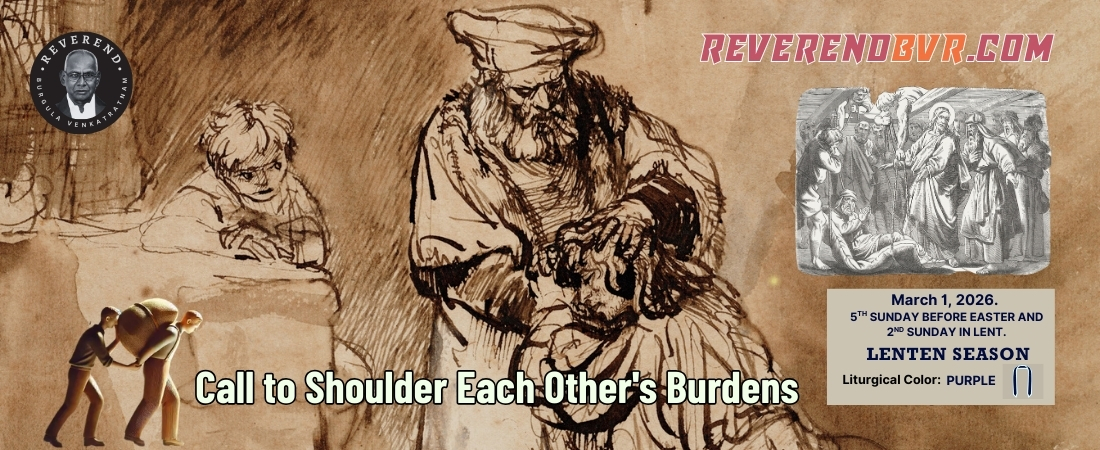
Sermon Title: Called to Shoulder One Another’s Burdens.
Occasion: 5th Sunday before Easter | 2nd Sunday in Lent, March 1, 2026.
Bible Readings: 2 Sam. 9: 1-13 | Psalm 41 | Gal. 6:1-10 | Mark 2: 1-12 | Zech. 7:4-10/Rom. 12: 9-21.
Original Language Reflections (For deeper study, refer to the Table of Hebrew and Greek Terms in Section VIII. of the sermon).
Website: www.reverendbvr.com
Theological Thesis: The God revealed in Scripture is not distant from human weakness but draws near through covenantal compassion, restoring dignity to the forgotten, healing the broken, and forming a community where burdens are not borne alone.
From David’s mercy to Mephibosheth, to Christ’s healing of the paralyzed man, to Paul’s call to burden sharing love, Scripture proclaims one unified truth: God’s saving work always moves through people who carry one another when strength fails.
Every one must note that, This is not charity from above but solidarity from within, a participation in the very compassion of God.
I. The Collect as the Heartbeat of the Sermon
The Collect rightly names God as “Compassionate”, a word that does not mean mere sympathy but suffering-with. The prayer confesses that God has always acted in history to shape a people who encourage one another, appoint leaders to guide them in love, and empower them by the Holy Spirit to bear burdens as Christ bore the cross.
What the prayer asks, the Scriptures show.
What the Scriptures reveal, the Church is called to embody.
1. Covenant Kindness That Restores the Forgotten (2 Samuel 9:1–13)
David asks a question that sets the theological tone: “Is there still anyone left of the house of Saul, that I may show him kindness for Jonathan’s sake?” (2 Sam. 9:1). The Hebrew word for “kindness” here is ḥesed, a covenantal love that is faithful, loyal, and restorative, not earned or deserved.
Mephibosheth is doubly vulnerable & politically dangerous as Saul’s descendant and physically disabled, “lame in both feet” (v.3).
In the ancient world, disability often meant exclusion and invisibility. Yet David does not merely spare him; he restores his land, status, and place at the king’s table.
“He ate at David’s table, like one of the king’s sons.” (v.11)
This is burden-bearing love in royal form. David shoulders the burden of another’s vulnerability, not as pity but as covenantal responsibility.
2. God Who Sustains the Weak (Psalm 41)
Psalm 41 moves from royal mercy to divine promise: “Blessed is the one who considers the poor; the LORD delivers him in the day of trouble.” (Ps. 41:1)
“To consider” (Hebrew: śākal) means more than noticing, It means attentive, thoughtful engagement.
God’s blessing rests not on power but on attentiveness to human frailty.
The psalm insists that God does not ignore suffering: “The LORD sustains him on his sickbed; in his illness you restore him to full health.” (v.3)
Here, burden-bearing becomes participation in God’s sustaining work. To lift another is to mirror God’s own action.
3. When Faith Is Carried by Others (Mark 2:1–12)
The heart of the Gospel reading is not only the miracle but the community around it.
“They came bringing to him a paralytic, carried by four of them.” (Mk. 2:3)
The man does not walk to Jesus; he is carried. His healing begins not with his faith but with the faith of others.
“When Jesus saw their faith, he said to the paralytic, ‘Son, your sins are forgiven.’” (v.5)
Here Jesus reveals something revolutionary: faith can be communal. Grace can arrive through another’s strength when our own fails.
Before healing the body, Jesus restores dignity and belonging by forgiving sin, an act that provokes controversy but reveals divine authority: “The Son of Man has authority on earth to forgive sins.” (v.10)
Burden-bearing love does not rush to fix symptoms; it restores the whole person.
4. The Shape of Spirit-Formed Community (Galatians 6:1–10)
Paul names explicitly what the Gospel embodies: “Bear one another’s burdens, and so fulfill the law of Christ.” (Gal. 6:2).
The Greek word for burden (barē) refers to overwhelming weight, not minor inconveniences, but loads that crush the soul.

In Engineering, large bridges like the Howrah Bridge in Kolkata are designed with distributed load systems. if weight concentrates on a single unsupported point, Collapse occurs. But when weight is distributed across multiple supports , even the massive loads can be carried safely. Similarly The Church functions as a spirit designed load bearing structure. The burden that crushes one believer becomes bearable when shared across many shoulders. This is the best example which we can apply to understand the Paul’s word for burden (barē) refers to overwhelming weight.
Paul insists this must be done:
- Gently : “in a spirit of meekness” (v.1)
- Humbly : “watching yourself”
- Persistently : “let us not grow weary in doing good” (v.9)
This is not moralism, It is Spirit shaped realism: we all stumble; therefore, we all carry.
5. From Ritual to Relational Faith (Zechariah 7:4-10 & Romans 12:9-21)
God speaks sharply through Zechariah: “Render true judgments, show kindness and mercy to one another; do not oppress the widow, the orphan, the foreigner, or the poor.” (Zech. 7:9–10)
Ritual without compassion is rejected. True faith expresses itself socially and ethically. Paul echoes this vision: “Love must be genuine… Rejoice with those who rejoice, weep with those who weep.” (Rom. 12:9,15)
This is emotional burden bearing, entering another’s joy and grief without dominance or distance.
II. One Coherent Narrative of God’s Action
Across all readings, one divine movement emerges:
- God restores dignity (Mephibosheth)
- God sustains the weak (Psalm 41)
- God heals through community (Mark 2)
- God commands mutual responsibility (Galatians 6)
- God rejects empty religion and forms a loving people (Zechariah & Romans)
The Gospel does not call us to be saviors, but to be carriers.
III. Contemporary Application:
Today’s burdens are often invisible:
- Mental exhaustion is masked as productivity
- Chronic illness carried in silence
- Economic anxiety hidden behind dignity
- Emotional wounds spiritualized away
The Church is not called to fix everything, but to refuse abandonment.
Sometimes burden-bearing looks like:
- Advocacy instead of advice
- Presence instead of answers
- Consistency instead of intensity
Grace often arrives on the shoulders of others.
IV. Let us Pray:
Compassionate God, You who never turn away from weakness, teach us the courage to draw near. When burdens bend our neighbors low, make our arms strong enough to lift and our hearts gentle enough to listen. Deliver us from faith that hides behind words and form in us a love that walks, waits, and carries. As Christ bore the weight of the cross, teach us to bear one another until no one is left alone and your kingdom of love and peace is made visible among us. Through Jesus Christ our Lord, who lives and reigns with you and the Holy Spirit, one God, now and forever. Amen.
V. Key Biblical Terms for Understanding the Sermon:
| S.No | Passage | Verse | English Term | Original Word | Language | Meaning / Theological Weight |
| 1 | 2 Sam 9:1 | v.1 | Kindness | ḥesed | Hebrew | Covenant loyalty, faithful love that restores dignity |
| 2 | 2 Sam 9:13 | v.13 | Lame | pissēaḥ | Hebrew | Vulnerability; social marginalization |
| 3 | Psalm 41:1 | v.1 | Considers | śākal | Hebrew | Thoughtful, attentive engagement with the weak |
| 4 | Psalm 41:3 | v.3 | Sustains | sāʿad | Hebrew | To support, uphold, strengthen |
| 5 | Mark 2:5 | v.5 | Faith | pistis | Greek | Trust expressed communally |
| 6 | Mark 2:5 | v.5 | Forgiven | aphiēmi | Greek | Released, sent away, liberated |
| 7 | Gal 6:2 | v.2 | Burdens | barē | Greek | Crushing weights, overwhelming loads |
| 8 | Gal 6:1 | v.1 | Gentleness | prautēs | Greek | Strength under control |
| 9 | Zech 7:9 | v.9 | Mercy | raḥamîm | Hebrew | Womb-like compassion, deep empathy |
| 10 | Rom 12:15 | v.15 | Weep with | synklaiō | Greek | To cry together; shared grief |
Bibliography:
- Boda, Mark J. The Book of Zechariah. New International Commentary on the Old Testament. Grand Rapids: Eerdmans, 2016.
- Brueggemann, Walter. First and Second Samuel. Interpretation. Louisville: John Knox Press, 1990.
- Brueggemann, Walter, and William H. Bellinger Jr. Psalms. New Cambridge Bible Commentary. New York: Cambridge University Press, 2014.
- Edwards, James R. The Gospel according to Mark. Pillar New Testament Commentary. Grand Rapids: Eerdmans, 2002.
- Gaventa, Beverly Roberts. Romans: A Commentary. New Testament Library. Louisville: Westminster John Knox, 2023.
- Gordon, R. P. 1 & 2 Samuel. Zondervan Illustrated Bible Backgrounds Commentary. Grand Rapids: Zondervan, 2009.
- Hays, Richard B. The Moral Vision of the New Testament. New York: HarperCollins, 1996.
- Kittel, Gerhard, and Gerhard Friedrich, eds. Theological Dictionary of the New Testament. Translated by Geoffrey W. Bromiley. 10 vols. Grand Rapids: Eerdmans, 1964-76.
- Koehler, Ludwig, and Walter Baumgartner. The Hebrew and Aramaic Lexicon of the Old Testament. Translated by M. E. J. Richardson. 5 vols. Leiden: Brill, 1994–2000.
- Kraus, Hans-Joachim. Psalms 1-59: A Commentary. Translated by Hilton C. Oswald. Minneapolis: Fortress Press, 1993.
- Marcus, Joel. Mark 1–8: A New Translation with Introduction and Commentary. Anchor Yale Bible 27. New Haven: Yale University Press, 2000.
- Martyn, J. Louis. Galatians: A New Translation with Introduction and Commentary. Anchor Yale Bible 33A. New Haven: Yale University Press, 1997.
© 2025 ReverendBVR.com | High-Academic Sermon Series, 2026.
Content licensed under Creative Commons Attribution-NonCommercial-NoDerivatives 4.0 International (CC BY-NC-ND 4.0). You are free to share, copy and redistribute the material in any medium or format with proper attribution. No commercial use or modifications allowed without explicit permission.
For further sermons and biblical reflections, please visit 🌐 www.reverendbvr.com/sermons