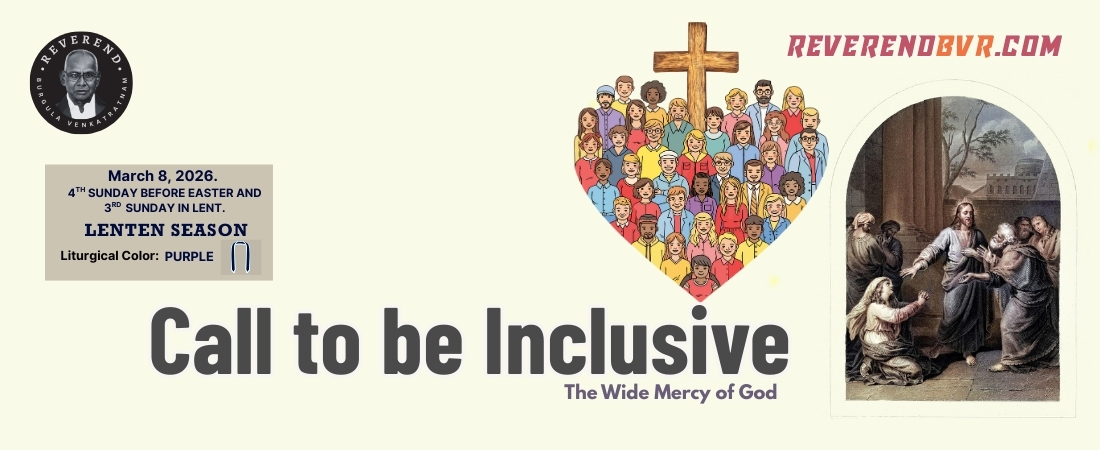
Sermon Title: Called to Be Inclusive: The Wide Mercy of God.
Occasion: 4th Sunday before Easter | 3rd Sunday in Lent, March 8, 2026.
Bible Readings: Isaiah 56:1–8 | Psalm 86 | Revelation 7:9–17 | Matthew 15:21–28 | Ruth 4:1–10 & Galatians 3:23–29.
Original Language Reflections (For deeper study, refer to the Table of Hebrew and Greek Terms in Section VI. of the sermon).
Website: www.reverendbvr.com
Theological Thesis : God’s holiness is not threatened by inclusion; it is revealed through it.
Across law, psalm, prophecy, gospel, and epistle, Scripture testifies that the God of Israel is the God who draws near to the outsider, gathers the excluded, and forms a people not by bloodline or boundary but by steadfast love. Inclusion, in the biblical sense, is not vague tolerance; it is covenantal hospitality rooted in God’s own character.
A Coherent Biblical Narrative of Inclusion:
The readings for today do not merely agree; they converge. Isaiah proclaims a future where foreigners are welcomed at God’s altar. The psalmist confesses that the Lord is good and forgiving to all who call. John’s vision in Revelation shows the promise fulfilled: a countless, multi-ethnic multitude standing before God. In Matthew’s Gospel, Jesus enacts this inclusion in a tense, real encounter with a woman who should have been invisible. Ruth and Galatians, read alongside, show how inclusion reshapes community, inheritance, and identity itself.
This is not sentiment. It is salvation history.
1. Holiness That Makes Room (Isaiah 56:1–8)
Isaiah speaks to a post-exilic community anxious about purity, boundaries, and identity. Into that anxiety, God says something astonishing: “My house shall be called a house of prayer for all peoples.” (Isa. 56:7)
Foreigners (נֵכָרִים – nēkārîm) and eunuchs; those excluded by Deuteronomic law are explicitly named as welcome. God’s concern is not ethnicity or status but covenant faithfulness: “Everyone who keeps the sabbath… and holds fast my covenant.” (v. 6)
Here holiness is not separation from others but devotion to justice (מִשְׁפָּט – mishpāṭ) and righteousness (צְדָקָה – tsĕdāqāh). God’s saving work breaks open narrow definitions of belonging.
Theological insight: God’s future does not erase Israel’s identity; it fulfills it by expanding it.
2. Mercy That Refuses to Be Small (Psalm 86)
The psalmist prays from vulnerability, not privilege. The central confession rings out: “You, O Lord, are good and forgiving, abounding in steadfast love to all who call on you.” (Ps. 86:5)
The Hebrew word חֶסֶד (ḥesed) signals covenantal mercy, loyal love that does not depend on worthiness. This psalm quietly undermines every attempt to monopolize God.
Pastoral truth: Those who know their need most clearly are often the first to recognize the wideness of God’s mercy.
3. A Faith That Refuses Exclusion (Matthew 15:21–28)
Jesus enters Gentile territory. A Canaanite woman; ethnically, religiously, and socially excluded, cries out: “Have mercy on me, Lord, Son of David.”
The silence of Jesus and the sharpness of his words disturb us. They should. This is not cruelty but revelation through encounter. The woman persists, not demanding rights but trusting mercy: “Even the dogs eat the crumbs that fall from their masters’ table.”
Jesus responds: “Woman, great is your faith!”
The Greek μεγάλη ἡ πίστις – megalē hē pistis signals a faith that recognizes who Jesus truly is… before insiders do.
Christological depth: Jesus does not abandon Israel’s mission; he fulfills it by letting mercy overflow its initial boundaries.
4. The End Toward Which God Is Moving (Revelation 7:9–17)
John sees what Isaiah promised: “A great multitude that no one could count, from every nation, from all tribes and peoples and languages.”
The Greek ἔθνος (ethnos) here signals not homogenization but redeemed diversity. The Lamb does not erase difference; he heals it.
“For the Lamb… will guide them to springs of the water of life.”
Eschatological hope: Inclusion is not a modern idea imposed on Scripture; it is the goal of redemption itself.
5. Belonging Reimagined (Ruth 4:1–10 & Galatians 3:23–29)
Ruth, a Moabite woman, is woven into Israel’s story and becomes an ancestor of David, and of Christ. Galatians interprets this theologically: “There is no longer Jew or Greek… for all of you are one in Christ Jesus.”
Paul does not deny difference; he denies hierarchy as a basis for worth before God.
II. The Collect as Theology in Prayer
The Collect names God rightly: “God of Inclusivity and Interconnectedness.” It does not ask us to invent inclusion but to recognize and embody what God is already doing. The prayer grounds mission not in guilt but in grace, not in ideology but in the Spirit’s power.
III. Contemporary Witness:
In a world fractured by fear of the “other” i.e., migrants, minorities, the wounded, the doubting; Scripture calls the Church not to slogans but to practiced hospitality. Biblical inclusion is costly. It demands listening, humility, and faith that God’s mercy is not diminished by sharing.
Faithful living looks like:
- Welcoming without requiring sameness
- Speaking truth without denying dignity
- Practicing justice as an expression of worship
- Trusting that God’s table is large enough
IV. Conclusion: The Call
To be inclusive is not to lower the bar of holiness. It is to recognize that holiness looks like love stretched wide.
The fear many faithful believers carry is this: “If we speak of inclusion, are we compromising Scripture?”
The readings today answer with clarity: NO.
Inclusion in Scripture is not rebellion against holiness. It is the unfolding of holiness.
V. Let us Pray:
God of the wide horizon, whose mercy runs ahead of our fears and whose grace outpaces our boundaries,
teach us to see your image in those we have learned to overlook. Loosen our tight certainties, soften our guarded hearts, and enlarge our love to mirror your own. Gather us, with all peoples, at your table of life, until your house truly becomes a house of prayer for all.
Through Jesus Christ, the Lamb who gathers and the Shepherd who leads us home. Amen.
VI. Key Biblical Terms for Understanding the Sermon:
| S. No | Passage | Verse | Original Word | Language | Transliteration | Meaning / Significance |
| 1 | Isaiah 56 | v.3,7 | נֵכָר / בֵּית תְּפִלָּה | Hebrew | nēkār / bêt tefillāh | Foreigner / House of Prayer |
| 2 | Isaiah 56 | v.1 | מִשְׁפָּט / צְדָקָה | Hebrew | mishpāṭ / tsĕdāqāh | Justice / Righteousness |
| 3 | Psalm 86 | v.5 | חֶסֶד | Hebrew | ḥesed | Steadfast covenant love |
| 4 | Matthew 15 | v.28 | πίστις μεγάλη | Greek | pistis megalē | Great, resilient faith |
| 5 | Revelation 7 | v.9 | ἔθνος | Greek | ethnos | Nation / people-group |
| 6 | Galatians 3 | v.28 | εἷς ἐν Χριστῷ | Greek | heis en Christō | One in Christ |
Bibliography:
- Joseph Blenkinsopp, Isaiah 56–66: A New Translation with Introduction and Commentary, Anchor Yale Bible 19B (New Haven: Yale University Press, 2003).
- John Goldingay, Psalms, Volume 2: Psalms 42–89, Baker Commentary on the Old Testament Wisdom and Psalms (Grand Rapids: Baker Academic, 2007).
- Daniel I. Block, Ruth, Zondervan Exegetical Commentary on the Old Testament (Grand Rapids: Zondervan, 2015).
- R. T. France, The Gospel of Matthew, New International Commentary on the New Testament (Grand Rapids: Eerdmans, 2007).
- Craig S. Keener, The Gospel of Matthew: A Socio-Rhetorical Commentary (Grand Rapids: Eerdmans, 2009).
- J. Louis Martyn, Galatians, Anchor Yale Bible 33A (New Haven: Yale University Press, 1997).
- G. K. Beale, The Book of Revelation, New International Greek Testament Commentary (Grand Rapids: Eerdmans, 1999).
- Richard Bauckham, The Theology of the Book of Revelation (Cambridge: Cambridge University Press, 1993).
- N. T. Wright, Paul and the Faithfulness of God (Minneapolis: Fortress Press, 2013).
- Richard B. Hays, The Moral Vision of the New Testament (San Francisco: HarperCollins, 1996).
© 2025 ReverendBVR.com | High-Academic Sermon Series, 2026.
Content licensed under Creative Commons Attribution-NonCommercial-NoDerivatives 4.0 International (CC BY-NC-ND 4.0). You are free to share, copy and redistribute the material in any medium or format with proper attribution. No commercial use or modifications allowed without explicit permission.
For further sermons and biblical reflections, please visit 🌐 www.reverendbvr.com/sermons