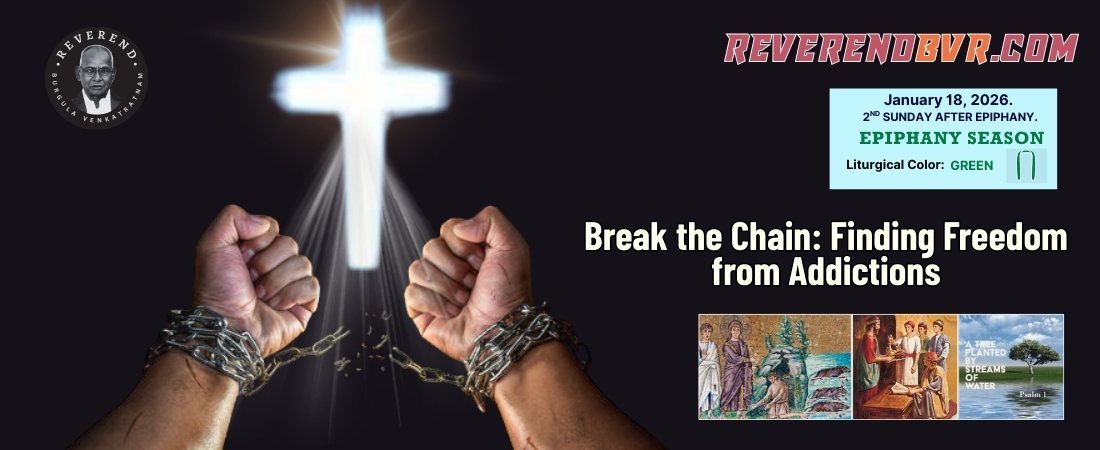
Sermon Title: Break the Chain: Finding Freedom from Addictions.
Occasion: 2nd Sunday after Epiphany, January 18, 2026.
Bible Readings: Daniel 1:8–21 | Psalm 1 | Colossians 3:1–11 | Mark 5:1–21.
Original Language Reflections (For deeper study, refer to the Table of Hebrew and Greek Terms in Section III of the sermon).
Website: www.reverendbvr.com
God’s grace does not merely restrain destructive habits, It breaks the chains that bind the human heart and restores us to freedom, dignity, and purpose. From Daniel’s quiet resolve to Christ’s liberating command, Scripture reveals a God who frees us not only from bondage, but for a renewed life rooted in love, wisdom, and fruitfulness.
Theological Thesis:
The Scriptures appointed for this Sunday proclaim a single, liberating truth: God’s saving work in Christ breaks the chains that bind human life, whether those chains are habits, powers, identities, or fears and restores us to freedom, dignity, and vocation. From Daniel’s disciplined refusal, to the psalmist’s vision of rooted freedom, to Paul’s call to a renewed mind, and finally to Jesus’ dramatic liberation of a man bound among the tombs, we witness a coherent movement of grace: God frees us not merely from something, but for someone and for a new way of life.
This is the freedom named in the Collect: liberation from all that binds us, renewal of the mind, and transformation into the likeness of Christ, so that we may live fruitfully in God’s love.
Introduction: Chains which We Cannot Break Alone
Addiction is not merely a moral failure; it is a bondage of the will, a captivity of desire, and often a refuge sought in pain. Whether chemical, digital, relational, or emotional, addiction promises relief but delivers captivity. The gospel does not begin by shaming the bound; it begins by revealing a God who enters the places of chains and calls people back to life.
Temperance Sunday, therefore, is not about willpower alone. It is about grace-enabled freedom.
1. Freedom Begins with a Resolved Heart (Daniel 1:8–21)
Daniel’s story unfolds in exile, A context of dislocation, pressure, and subtle assimilation. The royal food is not merely dietary; it symbolizes identity formation under imperial power.
“Daniel resolved that he would not defile himself…” (Dan 1:8). The Hebrew verb behind “resolved” (śîm ʿal-lēbô) literally means to set upon the heart. Freedom here begins internally, before it becomes visible externally. Daniel does not rebel noisily; he resists faithfully. His discipline is not self-righteous withdrawal but faithful discernment.
Addiction often thrives where identity is blurred. Daniel teaches us that temperance is not repression but clarity of belonging: I know who I am, and therefore I know what I cannot consume.
God honors this freedom, not by isolation but by flourishing within hostile systems.
2. Two Ways, Two Freedoms (Psalm 1)
Psalm 1 contrasts two paths, not merely in behavior but in orientation of desire.
The blessed person does not “walk… stand… sit” in patterns that entrench captivity. Instead, they delight in the Torah, i.e., God’s life-giving instruction.
“They are like a tree planted by streams of water.”
Addiction promises rootedness but uproots us. The psalmist redefines freedom not as limitless choice, but as deep rootedness in God’s life. True liberty is not drifting without restraint; it is being anchored where life flows.
3. Breaking the Inner Chains (Colossians 3:1–11)
Paul addresses not external exile but interior captivity. Having been raised with Christ, believers are summoned to a new imagination:
“Set your minds on things that are above…”
The Greek verb phroneite implies an ongoing orientation, a disciplined attentiveness. Paul does not deny desire; he re-educates it. Addiction disintegrates the self; resurrection re-integrates it.
The “old self” (palaios anthrōpos) is not merely bad habits. it is a whole identity shaped by disordered loves. The “new self” is being renewed (anakainoumenon) and is a continuous healing process.
Freedom here is not instant perfection but daily participation in resurrection life.
4. Christ Breaks the Chains We Cannot (Mark 5:1–21)
The climax of the readings is stark and unsettling. The Gerasene man is isolated, naked, violent, and bound. living among the tombs, the realm of death.
“No one could restrain him anymore, even with a chain.”
This is addiction in its most truthful portrait: loss of control, loss of community, loss of self.
Jesus crosses boundaries: geographical, ritual, social, to reach him. He does not negotiate with the chains; he commands them. The man is restored to his right mind (sōphronounta), clothed, and seated, signs of full human dignity.
But notice the ending: the freed man is sent back home.
Freedom is never merely personal. Deliverance becomes vocation.
5. The Collect as the Gospel Thread
The Collect prays for:
- Wise and faithful choices → Daniel’s resolve
- Resistance to temptation → Psalm 1’s rooted life
- Renewed minds → Colossians’ resurrection ethic
- Freedom from all that binds us → Mark’s liberated man
The prayer assumes what Scripture proclaims: God is both the Source of life and the Breaker of chains.
- Pastoral Application: Living Free Without Moralism
- Name the chains honestly: Freedom begins with truth, not denial.
- Choose rooted practices: Scripture, prayer, community, and accountability re-form desire.
- Trust Christ’s authority: Some chains yield only to grace, not effort.
- Turn freedom outward: The healed are sent, not hidden.
This is not moralism; it is participation in grace.
6. Conclusion: Freedom That Bears Fruit
The gospel does not say, “Try harder.” It says, “Come out of the tombs.” Christ does not merely loosen chains, He restores persons, renews minds, and reclaims futures.
II. Let us Pray
O Christ,
Breaker of chains and Restorer of souls,
You enter the places we fear to name
and speak freedom where we have learned captivity.
Set our hearts firmly upon You,
root us by the streams of Your Spirit,
renew our minds with resurrection light,
and clothe us again with dignity and hope.
Free us not only from what binds us,
but for lives that love, serve, and bear fruit.
Send us home, changed by grace,
to tell what You have done for us.
For You live and reign with the Father and the Spirit,
one God, now and forever.
Amen.
III. Key Hebrew and Greek Terms in the Readings
| S.No | Passage | Original Word | Language | Transliteration | Meaning |
| 1 | Daniel 1:8 | שִׂים עַל־לֵב | Hebrew | śîm ʿal-lēb | To set upon the heart, resolve |
| 2 | Psalm 1:2 | תּוֹרָה | Hebrew | Torah | Instruction, life-giving law |
| 3 | Psalm 1:3 | פָּלַג | Hebrew | palag | Stream, channel of water |
| 4 | Col. 3:2 | φρονεῖτε | Greek | phroneite | Set the mind, orient desire |
| 5 | Col. 3:9 | παλαιὸς ἄνθρωπος | Greek | palaios anthrōpos | Old self, former identity |
| 6 | Col. 3:10 | ἀνακαινούμενον | Greek | anakainoumenon | Being renewed |
| 7 | Mark 5:15 | σωφρονοῦντα | Greek | sōphronounta | Of sound mind, restored reason |
| 8 | Mark 5:4 | ἁλύσεις | Greek | halyseis | Chains, restraints |
© 2025 ReverendBVR.com | High-Academic Sermon Series, 2026.
Content licensed under Creative Commons Attribution-NonCommercial-NoDerivatives 4.0 International (CC BY-NC-ND 4.0). You are free to share, copy and redistribute the material in any medium or format with proper attribution. No commercial use or modifications allowed without explicit permission.
For further sermons and biblical reflections, please visit 🌐 www.reverendbvr.com/sermons