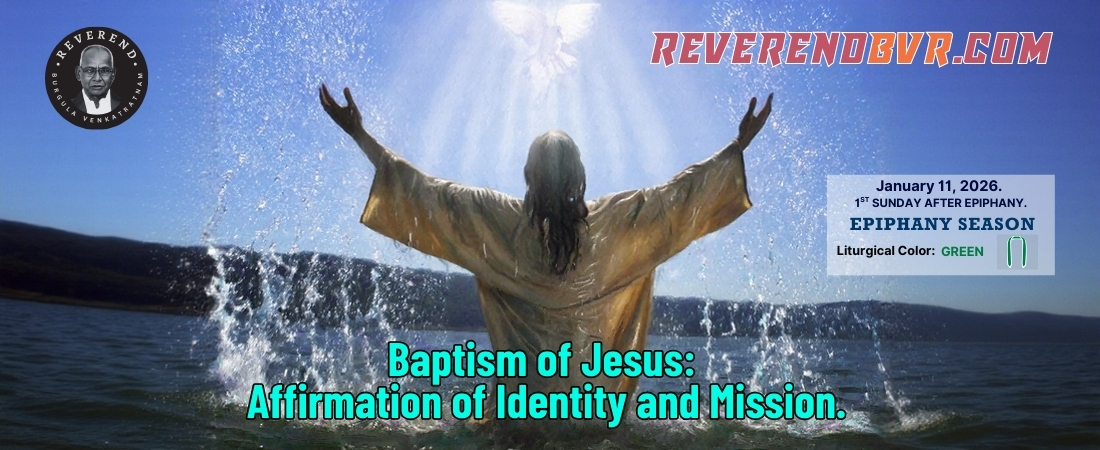
Sermon Title: Baptism of Jesus: Affirmation of Identity and Mission.
Occasion: 1st Sunday after Epiphany, January 11, 2026.
Bible Readings: Exo. 3: 1-15 | Psalm 98 | Epistle: Gal. 4: 1-7 | Gospel: Matt. 3: 11-17.
Original Language Reflections (For deeper study, refer to the Table of Hebrew and Greek Terms in Section III of the sermon).
Website: www.reverendbvr.com
collect: Our Gracious God, who are our Creator and Sustainer, and who in Baptism have claimed us as your own and given us the sign and seal of the covenant of grace, assuring us that you are our God and we are your people, grant that we who have been received into your covenant may always remain in your love, grow in faith, be protected from all dangers and temptations, and by your guiding Spirit be brought to confess Jesus Christ as our Saviour; through the same Jesus Christ our Lord, who lives and reigns with you and the Holy Spirit, one God, world without end. Amen.
At the Jordan, Jesus is baptized not to prove himself, but to be named Beloved. Baptism, then, is not our performance but God’s promise that’s given once, trusted for a lifetime, and lived out through repentance, faith, and mission in the power of the Spirit.
Theological Thesis : The Baptism of Jesus stands at the crossroads of revelation and vocation: the God who names himself to Moses, liberates Israel with joy, adopts humanity in Christ, and descends upon Jesus at the Jordan is the same God who claims, names, and sends. In Jesus’ baptism, divine identity and mission are inseparably joined, and in our baptism, that same grace draws us into God’s life, love, and purpose for the world.
1. The God Who Reveals His Name and Calls (Exodus 3:1–15)
At Horeb, Moses encounters a God who is both holy and near. The burning bush is aflame yet unconsumed, an image of divine presence that does not destroy but sustains. When Moses asks for God’s name, he receives not a label but a promise: “I AM WHO I AM.”
This self-disclosure reveals a God who is free, faithful, and present, not bound to idols or empires, not distant from suffering. God hears the cries of enslaved Israel and sends Moses into mission. Identity precedes action: Moses is called only after God reveals who God is.
So it is at Jesus’ baptism. Before Jesus teaches, heals, or suffers, heaven opens and God speaks. Divine mission flows from divine naming.
2. The God Who Saves with Joy (Psalm 98)
Psalm 98 is not quiet devotion; it is cosmic celebration. Seas roar, rivers clap, and hills sing, not because creation is naïve, but because God has acted decisively to save.
Salvation here is not merely private or spiritual. It is public, historical, and global. God’s righteousness is revealed “before the nations.” Joy erupts because justice is on the move.
At Jesus’ baptism, this psalm finds flesh and breath. The one standing in the Jordan is God’s saving action embodied. The joy of Psalm 98 anticipates the gospel joy that will flow from Jesus’ life, death, and resurrection.
3. The God Who Adopts and Sends the Spirit (Galatians 4:1–7)
Paul deepens the mystery: salvation is not only liberation from bondage but adoption into intimacy. In Christ, we are no longer slaves but children; no longer outsiders but heirs.
This passage echoes baptismal theology profoundly. The Spirit who descends on Jesus at the Jordan is the same Spirit sent into our hearts, crying “Abba, Father.” Faith is not merely assent, it is participation in Christ’s own relationship with the Father.
Here identity again precedes ethics. We do not act as God’s children in order to become heirs; we live faithfully because we already are.
4. The God Who Names the Beloved Son (Matthew 3:11–17)
At the Jordan River, Jesus aligns himself with sinners, not out of repentance for sin, but out of solidarity with humanity. John proclaims judgment and fire, yet what unfolds is grace and affirmation.
The heavens open. The Spirit descends. And the voice declares:
“This is my Son, the Beloved, with whom I am well pleased.”
This is not a reward for accomplishment but a declaration of identity. Before a single miracle, sermon, or cross, Jesus is named Beloved.
This moment gathers the whole biblical story:
- The God who said “I AM” now says “You are my Son.”
- The joy sung by creation now rests on a human life.
- The Spirit who liberates slaves now anoints the Messiah.
5. The Collect as Theological Lens
The Collect beautifully gathers these truths into prayer. It affirms that in baptism God claims us, seals us, protects us, and sustains us: not as an abstract doctrine, but as a lived covenant.
Baptism is not escape from danger but assurance within it. We are protected not from vocation, but for it, guided by the Spirit to confess Christ in a fearful and fractured world.
6. Contemporary Resonance: Identity Before Performance
Our age is anxious about identity. We are pressured to prove our worth through productivity, success, or visibility. Fear whispers: You are what you achieve.
The baptism of Jesus proclaims a different truth:
- You are named before you perform.
- You are loved before you succeed.
- You are sent because you belong.
This speaks to:
- Fear: God names us Beloved.
- Suffering: God enters the waters with us.
- Vocation: Mission flows from identity, not exhaustion.
- Doubt: Faith is grounded in God’s promise, not our certainty.
- Injustice: Baptism commits us to God’s redemptive work in the world.
7. Living the Baptismal Life
Faithful living is not moralism but response:
- Remember your baptism when you feel unworthy.
- Listen for God’s voice amid competing narratives.
- Live courageously, knowing you are God’s beloved.
- Participate in God’s mission of justice, reconciliation, and hope.
We do not strive to earn God’s pleasure; we live because we already rest in it.
II. Conclusion Prayer
O God of fire and water,
who spoke from the bush and from the heavens,
who named your Son Beloved and poured out your Spirit without measure:
Speak again over our fractured lives.
Silence the voices of fear and false worth.
Draw us into the deep waters of your grace,
that we may live as your children;
freed, forgiven, and sent.
Renew in us the joy of salvation,
the courage of vocation,
and the hope that your justice shall yet sing through all creation.
Through Jesus Christ,
the Beloved Son,
in the fellowship of the Holy Spirit,
one God, now and forever.
Amen.
III. Key Hebrew and Greek Terms in the Readings
| S.NO | Passage | Original Word | Language | Transliteration | Meaning / Theological Significance |
|---|---|---|---|---|---|
| 1 | Exod. 3:14 | אֶהְיֶה אֲשֶׁר אֶהְיֶה | Hebrew | Ehyeh Asher Ehyeh | “I AM WHO I AM” – God’s self-existent, faithful presence |
| 2 | Exod. 3:5 | קֹדֶשׁ | Hebrew | Qōdesh | Holiness; God’s otherness and moral purity |
| 3 | Psalm 98:1 | יְשׁוּעָה | Hebrew | Yeshu‘ah | Salvation; God’s victorious deliverance |
| 4 | Psalm 98:4 | רָנַן | Hebrew | Rānan | To shout/sing for joy; communal celebration |
| 5 | Gal. 4:5 | υἱοθεσία | Greek | Huiothesia | Adoption as children; relational salvation |
| 6 | Gal. 4:6 | Ἀββᾶ | Aramaic/Greek | Abba | Intimate address to God as Father |
| 7 | Matt. 3:11 | βαπτίζω | Greek | Baptizō | To immerse; cleansing and new identity |
| 8 | Matt. 3:16 | πνεῦμα | Greek | Pneuma | Spirit; God’s active presence |
| 9 | Matt. 3:17 | ἀγαπητός | Greek | Agapētos | Beloved; chosen and dearly loved Son |
IV. Baptism: Common Questions, Biblical Clarity
- Is baptism meant to happen more than once?
The New Testament speaks of “one baptism” (Eph. 4:5). Baptism is God’s once-for-all act of claiming us in Christ. When believers fall or return after wandering, Scripture calls for repentance and renewal, not repeated baptism. - Why do some people get baptized again today?
Often because they feel an earlier baptism “didn’t count,” differed in mode, or followed a return to faith. Biblically, only those who had not received Christian baptism (Acts 19) were baptized again, this was their first baptism into Christ, not a repeat. - Must baptism be by immersion only?
Immersion is clearly biblical and richly symbolic (Rom. 6:3–4). Scripture also uses sprinkling and pouring imagery for covenant cleansing and the gift of the Spirit (Ezek. 36; Heb. 10; Acts 2). The Bible never limits baptism to one physical mode. - Is infant/child baptism biblical?
The New Testament shows believer baptism clearly and does not command or forbid infant baptism. Those who baptize infants emphasize God’s grace first; those who practice believer baptism emphasize personal faith. Both seek to honor Scripture’s call to grace and discipleship. - What truly makes baptism Christian?
Baptism into the Triune name (Matt. 28:19), union with Christ (Rom. 6:3–4), and life in the Spirit and the church (1 Cor. 12:13). - What if someone desires another baptism?
Pastoral wisdom asks: Was the earlier baptism truly Christian?
If yes, Scripture encourages renewal, not repetition.
If no, baptism into Christ may be appropriate (Acts 19).
Baptism is not a reset button, it is God’s enduring promise: You belong to Christ.
© 2025 ReverendBVR.com | High-Academic Sermon Series, 2026.
Content licensed under Creative Commons Attribution-NonCommercial-NoDerivatives 4.0 International (CC BY-NC-ND 4.0). You are free to share, copy and redistribute the material in any medium or format with proper attribution. No commercial use or modifications allowed without explicit permission.
For further sermons and biblical reflections, please visit 🌐 www.reverendbvr.com/sermons