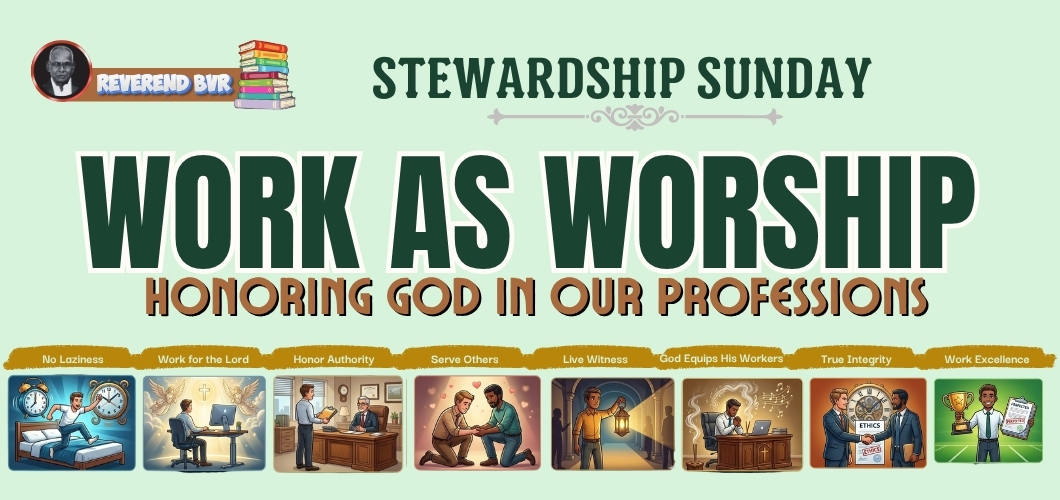
Sermon Title: Work as Worship : Honoring God in Our Professions.
Occasion: 5th Sunday after Pentecost | Sunday, 5 July 2026. | STEWARDSHIP SUNDAY
Scripture Readings: Exo. 31: 1-11 | Psalm 104: 1-24 | Epistle Colo. 3: 22-25 | Gospel Luke 17: 7-10 | Pro. 22: 16-29/1 Cor. 10: 31-33.
Original Language Reflections (For deeper study, refer to the Table of Hebrew and Greek Terms in Section VII. of the sermon).
Website: www.reverendbvr.com
Collect of the Day: Creator and Provider God, we thank you for filling us with your love, wisdom and the skills to fulfill your mission in this world. Grant us your grace that we may be faithful in our work and honour you in all that we do, following Jesus Christ our Saviour, who faithfully served His purpose. Grant us your spirit to discern, to work, serve one another, and honour your name through Jesus Christ our Lord, who lives and reigns with you and the Holy Spirit, one God, world without end. Amen.
I. Introduction: The Sacred Nature of Ordinary Work
There is a profound temptation, one as old as the Church itself, to divide life into two realms (the sacred and the secular). In this mistaken view, the priest at the altar is doing God’s work, while the carpenter at his bench, the nurse at her ward, the teacher in her classroom, or the farmer in his field are merely doing human work.
Today, on this Stewardship Sunday, the whole counsel of Scripture rises together to demolish that false boundary.
Work is not a curse. Work is not a distraction from worship. Work, when offered faithfully to God, is worship. It always has been.
Our theme today, “Work as Worship: Honoring God in Our Professions,” is not a modern management idea dressed in religious clothing. It is a deep biblical truth woven across centuries of Scripture, from the craftsmen of Sinai to the servants in Galilee, from the household in Colossae to the skilled workers in the book of Proverbs.
Let us open our hearts to what the Lord is saying to us this morning through His Word.
II. God Equips His Workers (Exodus 31:1–11)
We begin in the wilderness of Sinai. God has delivered His people from Egypt. He has given them the law. Now He is instructing them to build the Tabernacle, His dwelling place among them. And notice carefully: before one board is cut, before one curtain is woven, God does something remarkable. “He fills a man with His Spirit to do the work”.
Exodus 31:3-5: “I have filled him with the Spirit of God, with skill, ability and knowledge in all kinds of crafts: to make artistic designs for work in gold, silver and bronze, to cut and set stones, to work in wood, and to engage in all kinds of craftsmanship.”
Bezalel was not a prophet. He was not a priest. He was a craftsman (a skilled artisan in metal, stone, and wood). Yet the text could not be clearer: the same Spirit of God who anointed prophets and moved upon the waters of creation rested upon this man to do his work excellently.
What does this tell us? It tells us that God cares deeply about the quality of our work. It tells us that professional skill, creativity, and craftsmanship are not merely human achievements: they are gifts of the Spirit.
Every nurse who takes care in her diagnosis, every engineer who checks his calculations twice, every software developer who writes code with integrity, every software tester who diligently uncovers hidden defects, every teacher who prepares her lesson with love, every farmer who tends his land with wisdom: These are, in their own way, Bezalel’s. They are filled with gifts given by God, to be used for purposes larger than themselves.
Your profession is not outside of God’s reach. It is inside His design.
III. Creation Itself Is a Workplace (Psalm 104:1–24)
Our Psalm today is one of the grandest hymns in the entire Old Testament, a sweeping, awe-filled meditation on God as the master Worker of creation. From the waters above the heavens to the darkness of the deep, from the springs in the valleys to the cedars of Lebanon, everything exists because God worked to make it so.
Psalm 104:23-24: “Then people go out to their work, to their labor until evening. How many are your works, Lord! In wisdom you made them all; the earth is full of your creatures.”
Here is a stunning verse. The psalmist observes the animals at their daily rhythms (lions retreating at dawn, human beings going out to their labor) and sees it all as part of the same tapestry of God’s ordering of creation. Human daily work is presented not in contrast to God’s creative work, but as continuous with it.
You are made in the image of a God who works. When you go to your place of work each morning, you are in some small way imitating the Creator who looked at the chaos and brought order, beauty, and fruitfulness. The soil you cultivate, the students you teach, the accounts you manage, the patients you care for: these are your corner of creation, entrusted to you by a God who cares about how it is tended.
The earth is full of His creatures, and it is also full of His calling to steward them well.
IV. Work Done for the Lord (Colossians 3:22–25)
We come now to one of the most challenging passages in today’s readings , Paul’s words to slaves and workers in the household at Colossae. We must read these words carefully and in their full theological context.
Colossians 3:23-24: “Whatever you do, work at it with all your heart, as working for the Lord, not for human masters, since you know that you will receive an inheritance from the Lord as a reward. It is the Lord Christ you are serving.”
Paul is writing to people whose daily work situation was far from ideal. Many had no freedom to choose their occupation, their hours, or their masters. Yet into this reality, the apostle speaks a transforming word: the Lord for whom you ultimately work is Christ Himself.
This principle does not endorse unjust labor conditions. Rather, it speaks to something deeper: the transformation of motivation. When you work with the awareness that Christ sees your effort, your integrity, your faithfulness, and your quality, work is no longer merely transactional. It becomes an act of devotion.
Ask yourself today: If Jesus were standing at your workstation (at your desk, at your counter, at your field), how would that change how you work? That is exactly Paul’s point. He is there. Always. “It is the Lord Christ you are serving.”
This is the very heart of work as worship: not doing sacred tasks, but doing all tasks with a sacred orientation. The holiness is not in the task itself, but in the heart that performs it.
V. Faithful Service Without Expectation (Luke 17:7–10)
Jesus tells a parable about a servant who has been working in the fields all day. When he comes in at evening, his master does not say, “Sit down, you have earned your rest.” Rather, the servant prepares dinner and serves the household before attending to his own needs.
Luke 17:10: “So you also, when you have done everything you were told to do, should say, ‘We are unworthy servants; we have only done our duty.’”
This parable cuts against the grain of a culture (both ancient and modern) that measures worth by recognition, reward, and applause. Jesus is not here demean His followers, but to liberate them from the exhausting performance of work done for human approval.
The servant in the parable is not less dignified for having served faithfully without fanfare. He is honored precisely because his service is not calculated. He does not keep a ledger of what he is owed. He serves because it is right to serve.
For us today, this is a call to release the anxiety of seeking validation from employers, colleagues, clients, or crowds. When we work as unto the Lord, we are freed from the tyranny of human approval. Our worth is not determined by our performance review. It is settled in Christ.
Faithful, unglamorous, consistent service: this too is worship.
VI. Skill in the Hands, Honor in the Heart (Proverbs 22 & 1 Corinthians 10)
Our evening readings add two more dimensions to this rich picture. The book of Proverbs speaks of those who are skilled in their work:
Proverbs 22:29 “Do you see someone skilled in their work? They will serve before kings; they will not serve before officials of low rank.”
The wisdom tradition of Israel had a deep respect for professional excellence. To be skilled at what you do (truly skilled, not merely competent) was considered a form of honour. Excellence in craft is not worldly ambition. It is a form of integrity.
And Paul, writing to the Corinthians about far more than just work, nevertheless gives us the simplest and most complete summary:
1 Corinthians 10:31 “So whether you eat or drink or whatever you do, do it all for the glory of God.”
Whatever you do. These three words contain a whole theology of work. Not “whatever sacred thing you do.” Not “whatever ministry activity you perform.” Whatever. The meal cooked. The report written. The child taught. The crop planted. The wound dressed. The argument adjudicated. Whatever.
All of it (every ordinary, unglamorous, Monday-morning task) can be done for the glory of God.
VII. Key Biblical Words Table (For Teaching & Notes)
| S.NO | Reference | Original Word | Transliteration | Language | Meaning / Significance |
| 1 | Neh. 8:7–8 | מְפֹרָשׁ | m’phorash | Hebrew | “clearly, distinctly explained” ->reading combined with interpretation |
| 2 | Neh. 8:10 | מָעוֹז | ma’oz | Hebrew | stronghold, fortress -> “the joy of the LORD is your strength” |
| 3 | Ps. 1:1 | אַשְׁרֵי | ashrei | Hebrew | blessed, happy, fortunate (opening beatitude) |
| 4 | Ps. 1:2 | הָגָה | hagah | Hebrew | to meditate, murmur, growl -> low, continual rumination |
| 5 | Ps. 1:3 | שָׁתוּל | shatul | Hebrew | deliberately transplanted (not self-sown) |
| 6 | 1 Cor. 14:20 | τέλειοι | teleioi | Greek | mature, complete, full-grown (applied to thinking) |
| 7 | 1 Cor. 14:23 | μαίνεσθε | mainesthe | Greek | to rave, be out of one’s mind |
| 8 | Matt. 13:19 | συνιέντος | synientos | Greek | understanding (negated: “does not understand”) |
| 9 | Matt. 13:23 | συνιείς | synieis | Greek | understanding (the good soil “hears… and understands”) |
| 10 | Prov. 1:7 | יִרְאַת יְהוָה | yir’at YHWH | Hebrew | the fear of the LORD -> reverent beginning of knowledge |
VII. Practical Application: Bringing Work and Worship Together
How do we live this out? Here are three invitations for this week:
• Begin your workday with intention. Before you open your laptop, pick up your tools, or enter your classroom, take a moment to consciously offer your work to God. Say simply: “Lord, this day’s work is for You.” This changes the orientation of everything that follows.
• Work with excellence as a form of gratitude. Bezalel did not do mediocre work and call it good enough for God. He gave his best skill (the skill God had given him) back to God in full measure. Excellence in your profession is a way of honoring the Giver of your abilities.
• Treat those you serve at work as made in God’s image. Your customer, your patient, your student, your colleague: each one is a bearer of the divine image. How you treat them is how you treat the One in whose image they are made. Integrity, kindness, and fairness in the workplace are not soft virtues: they are expressions of theological conviction.
VIII. Conclusion: The Altar Is Everywhere
Brothers and sisters, the altar of worship is not confined to this sanctuary. It extends into every place where faithful people carry the spirit of God into their daily calling.
When Bezalel lifted his chisel, the Tabernacle grew more beautiful. When the psalmist watched humans go to their labor, he saw the fingerprints of the Creator. When Paul wrote to the workers of Colossae, he reminded them that the risen Lord Himself was their true Master. When Jesus told the parable of the servant, He called us to faithful, cheerful service without keeping score. And when Solomon observed the skilled craftsman, he called excellence its own form of honor.
All of these threads weave together into one magnificent truth: your work (done faithfully, skillfully, and humbly) is an act of worship. God is honored not only by the songs we sing in this building, but by the integrity with which we live and labor every day of the week.
You are a steward of the gifts, the time, and the calling God has given you. Use them, not to build your own kingdom, but to serve His.
Closing Prayer :
Lord of all creation and all labor, we offer you the work of our hands and the intentions of our hearts. Forgive us for the times we have worked for our own glory or from fear rather than faith. By the power of your Spirit (the same Spirit who equipped Bezalel, who inspired the psalmist, who spoke through Paul), renew our vision of what it means to work faithfully. May every day this week be lived as an act of worship, to the glory of Jesus Christ, in whose name we pray. Amen.
Suggested Readings:
- Every Good Endeavor: Connecting Your Work to God’s Work. Timothy Keller and Katherine Leary Alsdorf.
- The Theology of Work Bible Commentary. Theology of Work Project.
- The Call: Finding and Fulfilling the Central Purpose of Your Life. Os Guinness.
Soli Deo Gloria | Glory to God alone.
© 2025 ReverendBVR.com | High-Academic Sermon Series, 2026.
Content licensed under Creative Commons Attribution-NonCommercial-NoDerivatives 4.0 International (CC BY-NC-ND 4.0). You are free to share, copy and redistribute the material in any medium or format with proper attribution. No commercial use or modifications allowed without explicit permission.
For further sermons and biblical reflections, please visit 🌐 www.reverendbvr.com/sermons


Leave a Reply