
I. Introduction: Love That Creates a New Community:
Among the Seven Words spoken by Christ on the cross, the third saying reveals something extraordinary. While enduring unimaginable suffering, Jesus turns His attention not to Himself but to those standing near Him.
He sees His mother Mary and the beloved disciple.
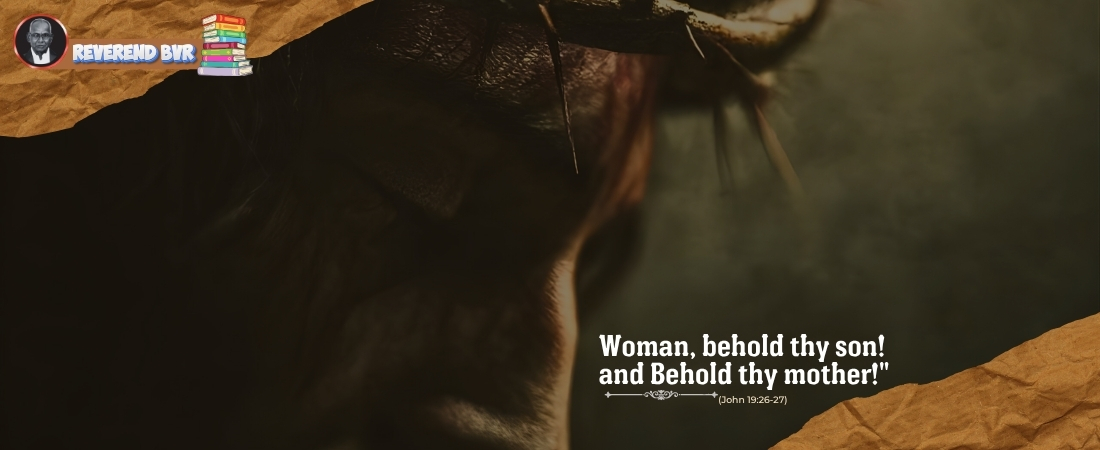
From the cross He speaks: “Woman, behold thy son!… Behold thy mother!” (John 19:26–27)
This is more than a moment of family concern. It is a theological act. At the moment of redemption, Jesus forms a new family: a community grounded not in blood, but in faith and love.
Theological Thesis:
At the cross, Jesus not only redeems humanity from sin but also creates a new spiritual family in which believers are bound together through sacrificial love. The cross therefore becomes both the place of salvation and the birthplace of Christian community.
II. The Biblical Scene: Standing Near the Cross
The Gospel writer describes the scene with careful detail: “Now there stood by the cross of Jesus his mother, and his mother’s sister, Mary the wife of Cleophas, and Mary Magdalene.” (John 19:25)
Four faithful figures remain near the cross when many others have fled. Among them are:
| Person | Significance |
| Mary (mother of Jesus) | Witness to the fulfillment of Simeon’s prophecy (Luke 2:35) |
| Mary Magdalene | Symbol of redeemed devotion |
| Mary of Clopas | Early disciple |
| The beloved disciple (traditionally John) | Representative disciple |
The presence of these individuals shows a contrast: While political powers condemn Jesus and crowds mock Him, true disciples remain near the suffering Messiah.
III. Exegetical Insight into John 19:26–27
1. Jesus Sees (Compassion in Suffering)
“When Jesus therefore saw his mother…” Even in agony, Jesus notices those who suffer around Him. The Greek word εἶδεν (eiden) indicates intentional perception. Christ is not merely glancing; He is attentively aware.
This reveals something profound about the character of God: Divine love remains attentive even in suffering.
2. “Woman, Behold Thy Son”
Jesus addresses Mary as “Woman” (γύναι – gynai).
At first glance this may seem distant, but in the culture of the time it was a respectful form of address, similar to “Madam.” Importantly, Jesus used the same word earlier: “Woman, what have I to do with thee?” — John 2:4
Thus, the Gospel creates a literary connection:
| Event | Address |
| Wedding at Cana (beginning of ministry) | “Woman” |
| Cross (end of ministry) | “Woman” |
The ministry of Jesus begins and ends with this address to Mary, framing His mission.
At Cana He began revealing His glory. At the cross He completes it.
3. “Behold Thy Mother”
Jesus then speaks to the beloved disciple: “Behold thy mother!”
Immediately the text records: “And from that hour that disciple took her unto his own home.”
This simple act represents something larger. The Church is born here. A new family emerges, not defined by genetics, but by discipleship.
IV. Historical and Theological Significance
1. Fulfillment of Simeon’s Prophecy
Earlier in Jesus’ life, Simeon told Mary: “A sword shall pierce through thy own soul also.” (Luke 2:35)
Standing at the cross, Mary experiences that prophecy.
Yet Christ’s words also comfort her grief. He ensures she will not be alone.
2. The Formation of the Christian Community
Jesus does not entrust Mary to His biological brothers. Instead, He entrusts her to a disciple. Why?
Because in the kingdom of God faith creates a deeper bond than blood.
Jesus already taught this truth: “Whoever does the will of my Father… is my brother, sister, and mother.” (Matthew 12:50) Thus the cross forms a spiritual household.
3. Love in Action
The command “Behold” appears twice. The Greek word ἴδε (ide) means look carefully, recognize, accept.
Jesus is effectively saying: “Receive one another as family.”
V. The Character of God Revealed at the Cross:
This brief exchange reveals three aspects of God’s nature:
- God Is Compassionate : Even in suffering, Christ cares for others.
- God Forms Community: Salvation is never individualistic. Faith creates relationships.
- God Rebuilds What Sin Broke: Sin fractured human relationships. The cross begins their restoration.
VI. Contemporary Reflection
- Modern society often experiences deep loneliness. People may have families yet still feel isolated.
- The cross speaks directly into this reality. Christ says: “You are not alone.”
- In the Christian community, believers become brothers and sisters in Christ. The Church is meant to embody this truth. Not merely an institution, but a family of sacrificial love.
VII. Life Applications
- Care for One Another: Jesus modeled responsibility even in suffering. Christians must practice practical care within their communities.
- See Others Through Christ’s Eyes: Jesus noticed those standing near Him. Compassion begins with seeing.
- Build Spiritual Families: Church life must move beyond attendance to genuine fellowship. The cross calls believers into relational discipleship.
VIII. Table of Original Words and Key Terms in John 19:26–27
| S.No | Verse | English Text | Greek Word | Transliteration | Meaning | Theological Insight |
| 1 | John 19:26 | Woman | γύναι | gynai | woman / respected lady | Respectful address to Mary |
| 2 | John 19:26 | behold | ἴδε | ide | look, observe | Command to recognize new relationship |
| 3 | John 19:26 | son | υἱός | huios | son | Spiritual sonship |
| 4 | John 19:27 | behold | ἴδε | ide | look carefully | Acceptance of responsibility |
| 5 | John 19:27 | mother | μήτηρ | mētēr | mother | Formation of new family |
| 6 | John 19:26 | saw | εἶδεν | eiden | perceived, noticed | Compassionate awareness |
Full Greek Text (John 19:26–27)
| Verse | Greek Text to English Text |
| John 19:26 | Ἰησοῦς οὖν ἰδὼν τὴν μητέρα καὶ τὸν μαθητὴν παρεστῶτα ὃν ἠγάπα λέγει τῇ μητρί· Γύναι, ἴδε ὁ υἱός σου. –> “When Jesus therefore saw his mother, and the disciple standing by, whom he loved, he saith unto his mother, Woman, behold thy son!” |
| John 19:27 | εἶτα λέγει τῷ μαθητῇ· Ἴδε ἡ μήτηρ σου. καὶ ἀπ’ ἐκείνης τῆς ὥρας ἔλαβεν ὁ μαθητὴς αὐτὴν εἰς τὰ ἴδια. –> “Then saith he to the disciple, Behold thy mother! And from that hour that disciple took her unto his own home.” |
IX. Integration with the Collect Prayer:
Many Good Friday liturgies include a prayer asking God to draw believers into the love revealed on the cross. This passage perfectly embodies that prayer. Christ not only forgives sinners (first word from the cross). He also forms a loving community among them. The Church therefore becomes the living answer to that prayer.
X. Conclusion:
At the foot of the cross, something remarkable happens. Jesus –> suffering, rejected, dying –>creates a new family.
Mary gains a son, John gains a mother, and believers gain a community.
The cross therefore reveals that redemption is relational. Christ saves us into a family of grace.
XI. Closing Prayer:
Gracious and merciful God, At the foot of the cross Your Son spoke words of love even in the midst of suffering. He saw His mother in sorrow and His disciple in faith, and He formed between them a new bond of care and belonging. Teach us to live as members of the family that Your Son created through His sacrifice. Give us eyes that see the lonely, hearts that carry the burdens of others, and hands that serve with compassion. May the love revealed on the cross shape our homes, our churches, and our communities. And may we always remember that through Christ we are no longer strangers, but brothers and sisters in the household of God. Through Jesus Christ our Lord, who loved us unto the cross and gathers us into one family. Amen.
© 2025 ReverendBVR.com | High-Academic Sermon Series, 2026.
Content licensed under Creative Commons Attribution-NonCommercial-NoDerivatives 4.0 International (CC BY-NC-ND 4.0). You are free to share — copy and redistribute the material in any medium or format with proper attribution. No commercial use or modifications allowed without explicit permission.
For further sermons and biblical reflections, please visit 🌐 www.reverendbvr.com/sermons
Leave a Reply