
Introduction: Grace at the Edge of Death:
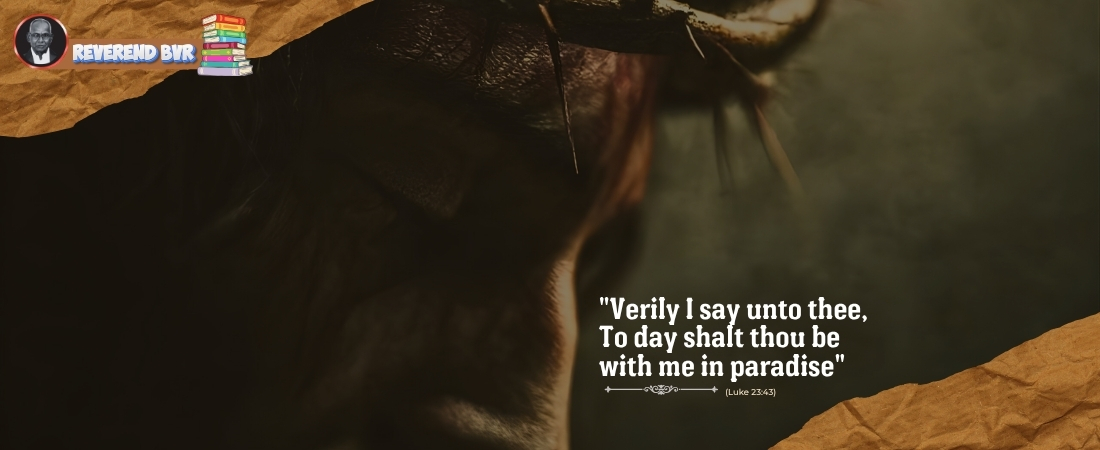
Among the Seven Words spoken by Christ on the Cross, the second saying is one of the most astonishing declarations of grace in the entire Bible: “Verily I say unto thee, To day shalt thou be with me in paradise.” (Luke 23:43, KJV)
These words are spoken not to a disciple, not to a righteous person, not to a religious leader, but to a criminal dying beside Jesus.
At the moment when the world sees only defeat, humiliation, and death, Jesus reveals the heart of the Gospel: God’s grace reaches even the most broken human life.
Theological Thesis:
The second word from the cross reveals that salvation is not earned by human merit but granted by divine grace, and that repentance joined with faith opens the immediate promise of life with Christ.
The thief on the cross becomes one of the clearest demonstrations of the theology of grace in Scripture. He had no time for religious works, no opportunity for restitution, no chance for moral reform. Yet he receives the promise of Paradise.
The Narrative Setting: A Cross Between Two Worlds
Luke describes the crucifixion scene in profound narrative contrast. Two criminals are crucified with Jesus (Luke 23:32–33). Both begin in the same condition: condemned, suffering, and dying.
Yet their responses to Christ diverge.–> One mocks Him, and the other believes in Him.
This moment reveals a profound biblical truth: The cross exposes the deepest orientation of the human heart.
Exegetical Reflection on Luke 23:39–43:
1.The Mocking Thief: Cynicism in the Face of Grace:
“If thou be Christ, save thyself and us.” (Luke 23:39); This criminal demands a miracle but shows no repentance. His request is self-centered: salvation without transformation. His words echo earlier mockery from the crowd and soldiers (Luke 23:35–36).
This represents a recurring human temptation: to seek God’s power without submitting to God’s authority.
2. The Repentant Thief: A Theology from the Cross
The second criminal rebukes his companion: “Dost not thou fear God… we indeed justly… but this man hath done nothing amiss.” (Luke 23:40–41)
In these few sentences, the thief articulates three profound theological truths:
- Fear of God: He recognizes divine judgment.
- Confession of guilt: He acknowledges his own sin.
- Recognition of Christ’s innocence: In a moment of suffering, this dying man becomes a theologian of grace.
3. The Prayer of Faith:
“Jesus, remember me when you come into your kingdom.” (Luke 23:42); This request is extraordinary. The thief sees a dying man, yet believes in a coming kingdom. This is faith in its purest form –> No miracles, No signs, No resurrection yet, Yet he believes.
Christ’s Astonishing Promise:
Jesus replies: “Truly I say to you, today you will be with me in Paradise.” Every phrase in this statement carries immense theological weight.
1. “Truly” (Amen)
Jesus begins with ἀμήν (Amen): a word of divine certainty. This promise is not speculation, It is guaranteed by Christ Himself.
2. “Today”
Not someday, Not after centuries. Today. This affirms the Christian hope that life with God begins immediately after death.
3. “With Me”
The greatest promise of heaven is not a place but a person. Salvation means being with Christ.
4. “Paradise”
The word Paradise recalls the Garden of Eden. Humanity lost paradise through sin. Christ restores paradise through the cross.
Biblical Theology: From Eden to Paradise: Scripture forms a beautiful narrative arc:
| Beginning | End |
| Humanity expelled from Eden (Genesis 3) | Humanity restored to Paradise (Luke 23) |
| Tree of knowledge brings death | Tree of the cross brings life |
| Sin separates humanity from God | Christ restores fellowship |
Thus, the thief becomes the first recipient of the redemption accomplished by the cross.
The Character of God Revealed: This moment reveals several dimensions of God’s character.
1. God’s Grace is Radical:
The thief had no religious credentials, yet he receives salvation. Grace is not wages, it is gift.
2. God’s Mercy Extends to the Last Moment:
The thief’s conversion occurs in his final hours of life. This reminds us that it is never too late to turn toward God. Yet it also warns us not to delay repentance.
3. Salvation is Personal:
Jesus addresses him individually: “I say to you.” Christian faith is not merely collective or institutional, It is personal relationship with Christ.
Integrating the Collect Prayer:
A traditional Good Friday Collect expresses this truth beautifully: “O God, who for our redemption gave your only-begotten Son to suffer death upon the cross… grant that we may glory in the cross of Christ.”
The thief gloried in the cross before anyone else understood it. While the crowd mocked and the disciples fled, this dying man recognized the King hidden in suffering.
Contemporary Reflection: Hope for Broken Humanity
The story of the thief speaks powerfully to modern life. Many people today feel trapped by guilt, shame, or past failures. Some believe their lives are beyond redemption. But the Gospel declares otherwise.
The thief had: a violent past, a criminal record and a life ending in public shame, Yet Christ offers him eternal life. This means no human life is beyond the reach of God’s grace.
Life Applications
- Salvation Comes Through Faith in Christ: The thief teaches us that salvation rests not in religious achievement but in trust in Jesus.
- Repentance Opens the Door to Grace: He does not excuse his wrongdoing. He confesses it. True repentance always precedes transformation.
- Hope Remains Even in the Darkest Moments: If grace could reach a criminal dying on a cross, it can reach anyone. No life is beyond redemption.
Table for Sermon Notes and Academic Study
| S.No | Verse | Original Greek / Hebrew Word | Transliteration | Literal Meaning | Passage Text |
| 1 | Luke 23:42 | Ἰησοῦ μνήσθητί μου | Iēsou mnēsthēti mou | Jesus, remember me | “Jesus, remember me when you come into your kingdom.” |
| 2 | Luke 23:43 | Ἀμήν | Amēn | Truly / certainly | “Verily I say unto thee…” |
| 3 | Luke 23:43 | σήμερον | sēmeron | today | “Today you will be…” |
| 4 | Luke 23:43 | μετ’ ἐμοῦ | met’ emou | with me | “you will be with me” |
| 5 | Luke 23:43 | παραδείσῳ | paradeisō | paradise / garden | “in paradise” |
| 6 | Genesis 2:8 | גַּן־עֵדֶן | Gan Eden | Garden of Eden | The original paradise of humanity |
| 7 | Revelation 2:7 | παράδεισος τοῦ θεοῦ | paradeisos tou theou | Paradise of God | Restored eternal life |
This table highlights the biblical language connecting Eden, Paradise, and redemption through Christ.
A Deeper Spiritual Insight:
The thief’s story reveals something extraordinary. He entered paradise before the apostles, before the martyrs, before the saints of the church.
The first person to enter heaven through the finished work of Christ was a repentant criminal. This demonstrates the radical truth of the Gospel: Grace always precedes merit.
Conclusion:
At the center of the Christian faith stands a crucified Savior who offers hope even at the edge of death. The second word from the cross reminds us that salvation is not reserved for the righteous but offered to the repentant. The thief came to Jesus with nothing: No good works, No reputation, No future. Yet Jesus gives him everything: “Today you will be with me in Paradise.”
Let us Pray:
Merciful God, who revealed your boundless grace through the cross of your Son, we thank you for the promise spoken to the dying thief: that even in our final moments, your mercy is greater than our sin. Teach us to come before you with humility and faith, confessing our failures and trusting in the saving power of Christ. Grant us hearts that recognize your kingdom even in suffering, and faith that clings to your promises when the world sees only despair. May the words spoken on the cross echo within our souls: that through Jesus Christ we too shall be with Him in Paradise. Through the crucified and risen Lord we pray. Amen.
© 2025 ReverendBVR.com | High-Academic Sermon Series, 2026.
Content licensed under Creative Commons Attribution-NonCommercial-NoDerivatives 4.0 International (CC BY-NC-ND 4.0). You are free to share — copy and redistribute the material in any medium or format with proper attribution. No commercial use or modifications allowed without explicit permission.
For further sermons and biblical reflections, please visit 🌐 www.reverendbvr.com/sermons
Leave a Reply