
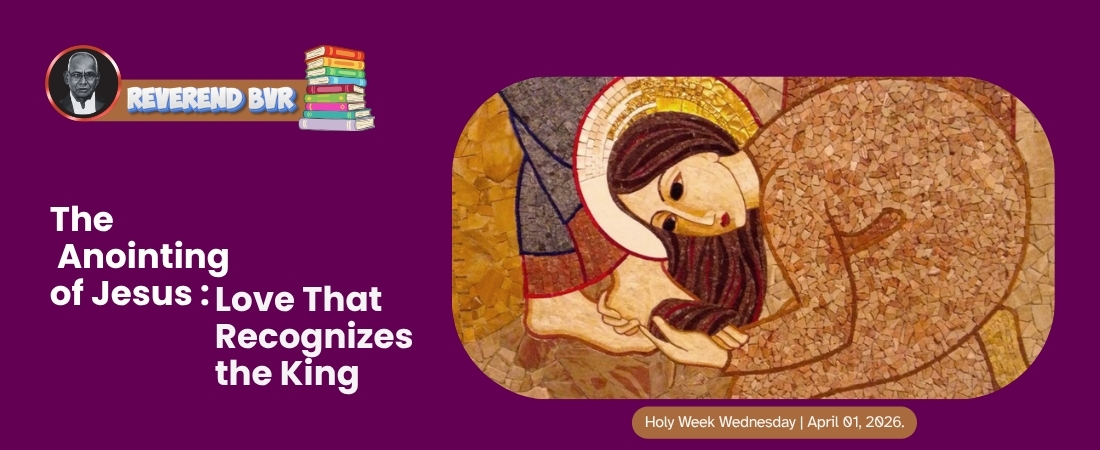
Holy Wednesday Sermon Title: “The Anointing of Jesus: Love That Recognizes the King”
Occasion: Holy Wednesday i.e., 3rd Day of Holy Week, April 01, 2026.
Bible Readings: Gospel of Matthew 26:6–13 | Gospel of Mark 14:3–9.
Original Language Reflections (For deeper study, refer to the Table of Hebrew and Greek Terms in Section IX. of the sermon).
Website: www.reverendbvr.com
I. Introduction: A Moment of Quiet Before the Storm
Holy Week moves with dramatic intensity. On Palm Sunday the crowds shout Hosanna. On Monday the temple is cleansed. On Tuesday Jesus debates religious leaders in Jerusalem. But on Holy Wednesday, the narrative pauses in a quiet house in Bethany. In this still moment, a woman performs one of the most profound acts of devotion recorded in Scripture: she anoints Jesus with costly perfume. This act appears simple. Yet in the Gospel narrative it becomes a window into the identity of Christ, the meaning of love, and the mystery of the cross.
Theological Thesis:
The anointing at Bethany reveals that true love recognizes the worth of Christ, responds with sacrificial devotion, and participates unknowingly in God’s redemptive plan. In a world that calculates value through utility and efficiency, the Gospel teaches that love poured out for Christ is never wasted.
II. Historical Setting: Bethany, the House of Simon the Leper
Both Matthew and Mark place the event in Bethany, a small village on the eastern slope of the Mount of Olives, about two miles from Jerusalem. The meal occurs in the house of Simon the leper. The name likely indicates a man once healed of leprosy, since someone actively suffering from leprosy would not host a public meal according to Jewish purity laws.
Bethany was a place of friendship for Jesus. It was also the home of Mary, Martha, and Lazarus (John 12 describes a similar event, possibly the same or a related one). Thus, the scene is deeply personal.
Jesus is not in the temple. He is not teaching crowds. He is reclining at table among friends, shortly before His betrayal and death.
III. Exegesis of the Event
1. A Woman’s Act of Extravagant Devotion:
“A woman came to him with an alabaster jar of very expensive perfume.” (Matt. 26:7)
The perfume was nard, imported from the Himalayan region of India. nard is extracted from the root and rhizome of the plant Nardostachys grandiflora belonging to the family Caprifoliaceae (formerly Valerianaceae).
Mark tells us its value: “More than three hundred denarii.” (Mark 14:5).
A denarius was roughly a day’s wage. Thus, the perfume cost about a year’s salary.
The woman breaks the alabaster jar and pours the perfume on Jesus’ head. In the ancient world, anointing the head with oil was a sign of honor reserved for kings and priests. Without fully understanding it, the woman performs a messianic act. She treats Jesus not merely as teacher but as King.
2. The Disciples’ Objection: Pragmatic Religion
The disciples react with criticism. “Why this waste?” (Matt. 26:8)
Their argument appears reasonable: The perfume could have been sold and the money given to the poor.
This objection introduces a recurring biblical tension: Devotion vs. utility
The disciples evaluate the act through economic logic. The woman acts through love. In human terms, the act seems wasteful. But in divine terms, love that honors Christ is never waste.
3. Jesus’ Interpretation: Preparation for Burial
Jesus defends the woman. “She has done a beautiful thing to me.” (Matt. 26:10)
The Greek word used for “beautiful” is kalon, meaning morally noble, fitting, and good. Then Jesus reveals the deeper meaning: “She did it to prepare me for burial.” (Matt. 26:12)
In Jewish burial customs, bodies were anointed with spices and perfumes. Ironically, because Jesus’ burial would be hurried after the crucifixion, this moment becomes His true anointing for death. Thus, the woman unknowingly participates in God’s redemptive preparation for the cross.
4. A Prophetic Promise
Jesus concludes with a remarkable declaration: “Wherever this gospel is preached throughout the world, what she has done will also be told.” (Mark 14:9)
In a society where women often lacked public recognition, Jesus promises that her act will be remembered forever. History confirms the prophecy. For two thousand years, her act of devotion has been proclaimed wherever the Gospel is preached.
IV. The Spiritual Meaning of the Anointing
This narrative reveals three profound theological truths.
1. Christ Is Worth More Than Our Calculations
The disciples measured value economically. But Jesus measured value relationally. Christian faith teaches that Christ deserves our best, not merely what is convenient.
Faith is not merely intellectual belief. It is devotion of the heart.
2. Love Often Appears Wasteful to the World
The world prizes efficiency. The Gospel prizes love.
From the world’s perspective: Prayer seems inefficient, Worship seems impractical and Generosity seems foolish
Yet the Gospel proclaims that love poured out for God transforms the world.
3. God Uses Small Acts in His Redemptive Plan
The woman did not know she was preparing Jesus for burial. Yet her action became part of salvation history.
Often believers serve Christ without knowing the full impact of their faithfulness. God weaves even our quiet acts of love into His eternal purposes.
V. The Collect Prayer and Its Meaning
Many traditions pray during Holy Week: “Almighty God, whose Son was anointed for our redemption, grant that we may follow Him in humility and sacrificial love.”
The Collect echoes the Gospel narrative. Christ was anointed not for worldly kingship but for the cross. Thus, the prayer asks that we may follow Christ in the same spirit of self-giving love.
VI. Contemporary Reflection: What Does This Mean Today?
Modern life is driven by productivity, metrics, and results. We ask questions such as:
What is the return on investment?
Is this efficient?
Does it produce measurable outcomes?
But the Gospel asks a deeper question: Do we love Christ enough to give Him our best?
Faithfulness today may mean: Taking time for prayer in a hurried world, Generosity in a culture of accumulation and Compassion in a society of indifference.
Such acts may seem small. But before God they are fragrant offerings.
VII. Application for Faithful Living
The story invites believers to reflect:
- Offer Christ Your Best: Not leftovers of time, attention, or resources. But the best of our devotion.
- Do Not Let Cynicism Destroy Devotion: The disciples’ criticism almost silenced the woman’s act. Faith requires courage to love Christ openly.
- Trust That God Uses Faithful Acts: Even unseen acts of kindness and worship participate in God’s kingdom. Nothing offered in love to Christ is ever wasted.
VIII. Closing Prayer
Lord Jesus Christ,
You who were anointed in Bethany
on the eve of Your suffering,
teach us the wisdom of sacrificial love.
When the world measures worth by profit and efficiency,
teach us to measure life by devotion to You.
Give us hearts that recognize Your worth
and courage to offer our best without fear of criticism.
May our prayers, our service, and our generosity
rise before You like fragrant perfume.
And when our small acts of faith seem unnoticed,
remind us that nothing offered in love is ever wasted.
Prepare our hearts during this Holy Week
to walk with You to the cross,
that we may also share in the joy of Your resurrection.
Amen.
IX. Word Study Table (Greek Terms for Sermon and Teaching)
| S.No | Passage | Greek Word | Transliteration | Meaning | Verse |
| 1 | Matt 26:7 | ἀλάβαστρον | alabastron | alabaster jar | Matt 26:7 |
| 2 | Matt 26:7 | μύρον | myron | perfumed ointment | Matt 26:7 |
| 3 | Matt 26:8 | ἀπώλεια | apōleia | waste, destruction | Matt 26:8 |
| 4 | Matt 26:10 | καλόν | kalon | beautiful, noble act | Matt 26:10 |
| 5 | Matt 26:12 | ἐνταφιασμός | entaphiasmos | burial preparation | Matt 26:12 |
| 6 | Mark 14:3 | νάρδος πιστική | nardos pistikē | pure nard perfume | Mark 14:3 |
| 7 | Mark 14:5 | δηναρίων | dēnariōn | denarii (wages) | Mark 14:5 |
| 8 | Mark 14:6 | καλὸν ἔργον | kalon ergon | good / beautiful deed | Mark 14:6 |
| 9 | Mark 14:8 | προέλαβεν μυρίσαι | proelaben myrisai | she anointed beforehand | Mark 14:8 |
© 2025 ReverendBVR.com | High-Academic Sermon Series, 2026.
Content licensed under Creative Commons Attribution-NonCommercial-NoDerivatives 4.0 International (CC BY-NC-ND 4.0). You are free to share — copy and redistribute the material in any medium or format with proper attribution. No commercial use or modifications allowed without explicit permission.
For further sermons and biblical reflections, please visit 🌐 www.reverendbvr.com/sermons
Leave a Reply