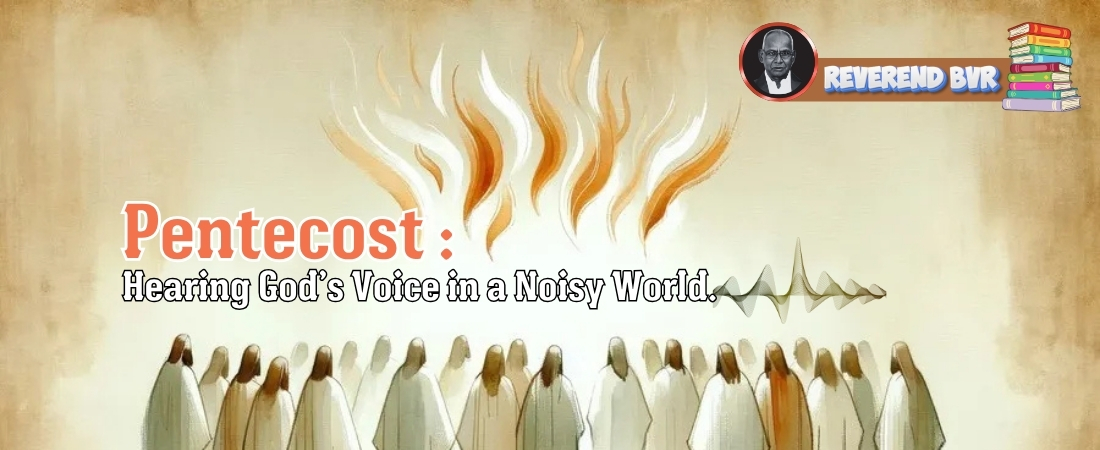
Sermon Title: Pentecost: Hearing God’s Voice in a Noisy World.
Occasion: Pentecost Sunday, May 24, 2026.
Bible Readings: 1 Kings 19: 11-18 | Psalm 29 | Acts 2: 1-13 | John 20: 19-23 | Gen. 1: 1-5 / Acts 13:1-12.
Original Language Reflections (For deeper study, refer to the Table of Hebrew and Greek Terms in Section VI. of the sermon).
Website: www.reverendbvr.com
Theological Thesis: Pentecost proclaims that God is not absent amid the noise of the world; rather, God speaks through it and beyond it: creating, calling, comforting, and commissioning. From the whisper heard by Elijah, to the thunderous voice of the Lord in Psalm 29, to the wind and fire of Pentecost, and finally to the quiet breath of the risen Christ saying, “Peace be with you”, Scripture testifies that God’s voice is both powerful and personal, thatnever coercive, always life-giving.
In a world saturated with competing voices: fear, outrage, distraction, anxiety. Pentecost invites the Church to relearn how to listen, how to discern, and how to speak with courage shaped by peace.
One Coherent Narrative of God’s Action
These readings are not isolated Pentecost fragments; they form a single theological arc:
God speaks → Creation responds → Fear is stilled → Mission begins
Exegesis and Theological Reflection
1. God’s Voice: Not Always in the Loud (1 Kings 19:11–18)
Elijah expects God in spectacle—wind, earthquake, fire. But God comes in qôl demāmāh daqqāh, means “a sound of sheer silence” (1 Kgs 19:12)
This is not weakness; it is divine intimacy.
God refuses to compete with chaos. God waits until the noise passes.
Theological insight: God’s voice is not diminished by gentleness. Silence is not absence; it is often the condition for revelation.
Pastoral word: Many believers fear that if God were truly present, life would feel clearer, louder, more decisive. Elijah teaches the opposite: God often speaks after the storm, not during it.
2. God’s Voice as Creative Power (Genesis 1:1–5)
Creation begins not with force, but with speech: “And God said, ‘Let there be light.’”
God’s word (אָמַר | ʾāmar) does not describe reality, It creates it.
Pentecost is not new theology; it is creation renewed. The Spirit who hovered over chaos now fills the Church.
Theological insight: Where God speaks, chaos yields to order, darkness to light, fear to vocation.
3. God’s Voice as Overwhelming Majesty (Psalm 29)
Psalm 29 names the qôl YHWH means the Voice of the LORD seven times, echoing the seven days of creation.
This voice:
- Breaks cedars
- Shakes wilderness
- Gives strength to God’s people
Yet the psalm ends not in thunder, but in blessing: “The LORD blesses his people with peace.” (Ps 29:11)
Theological insight: Divine power is never opposed to peace; peace is its final purpose.
4. God’s Voice as Missional Fire (Acts 2:1–13)
Pentecost is noisy: wind, fire, speech, confusion.
But notice: the Spirit does not erase difference.
Each hears “in their own language” (τῇ ἰδίᾳ διαλέκτῳ).
The miracle is not uniformity, but intelligibility.
Theological insight: The Spirit does not make everyone the same; the Spirit makes the gospel understandable.
Contemporary challenge: In an age of polarized shouting, Pentecost calls the Church not to be louder, but truer, not angrier, but clearer.
5. God’s Voice as Peace and Commission (John 20:19–23)
The risen Christ does not shout. He breathes: “He breathed on them and said, ‘Receive the Holy Spirit.’”
This echoes Genesis 2. Resurrection is new creation.
Before mission comes peace.
Before authority comes forgiveness.
Before speech comes breath.
Pastoral insight: Christian witness that does not begin in peace will never end in reconciliation.
6. God’s Voice That Redirects Power (Acts 13:1–12)
The Spirit speaks again this time in community.
The mission expands. Authority is re-defined.
God’s voice interrupts control and opens the future.
Integrating the Collect:
The Collect names our condition honestly:
noise, fear, confusion.
It also names God rightly:
- The whispering God
- The fiery God
- The peace-giving God
The prayer does not ask for louder signs, but for listening hearts, a profoundly Pentecostal request.
Life Applications:
- Practice holy listening: Silence is not empty; it is receptive.
- Discern God’s voice communally: The Spirit speaks through worship, Scripture, and shared prayer.
- Speak with Pentecostal courage shaped by peace: Truth spoken without peace is not yet Spirit-filled.
- Trust that God still speaks: Not always spectacularly, but always faithfully.
Prayer:
Come, Holy Spirit… Voice that hovered over chaos, Breath that raised dry bones, Fire that gave courage to trembling hearts. Still the noise within us that we may hear your truth. Quiet the fear around us that we may speak your peace. Where we are scattered, gather us. Where we are confused, illumine us. Where we are silent out of fear, set our tongues free with love. Breathe on your Church again, O God, that we may live as people who listen, people who discern, people who speak life in a world longing to hear your voice. Amen.
Key Biblical Words for Teaching & Sermon Notes:
| S.No | Passage | Original Word | Language | Meaning |
| 1 | 1 Kgs 19:12 | qôl demāmāh daqqāh | Hebrew | Sound of sheer silence |
| 2 | Gen 1:3 | ʾāmar | Hebrew | God speaks into being |
| 3 | Psalm 29 | qôl YHWH | Hebrew | Voice of the LORD |
| 4 | Acts 2:4 | glōssais heterais | Greek | Other languages |
| 5 | Acts 2:6 | idia dialektō | Greek | One’s own language |
| 6 | John 20:22 | enephysēsen | Greek | He breathed into |
| 7 | John 20:19 | eirēnē hymin | Greek | Peace be with you |
Selected Scripture Quotations Used:
- “A sound of sheer silence.” (1 Kgs 19:12)
- “The voice of the LORD is powerful.” (Ps 29:4)
- “Each one heard them speaking in the native language of each.” (Acts 2:6)
- “Peace be with you.” (John 20:19)
© 2025 ReverendBVR.com | High-Academic Sermon Series, 2026.
Content licensed under Creative Commons Attribution-NonCommercial-NoDerivatives 4.0 International (CC BY-NC-ND 4.0). You are free to share, copy and redistribute the material in any medium or format with proper attribution. No commercial use or modifications allowed without explicit permission.
For further sermons and biblical reflections, please visit 🌐 www.reverendbvr.com/sermons
Bibliography:
- Brueggemann, Walter. First and Second Kings.
- Brueggemann, Walter. Genesis.
- Mays, James L. Psalms.
- Dunn, James D. G. The Acts of the Apostles.
- Keener, Craig S. Acts: An Exegetical Commentary.
- Moltmann, Jürgen. The Spirit of Life.
- Wright, N. T. John for Everyone.
- Green, Joel B. The Gospel of John.
- Fee, Gordon D. God’s Empowering Presence.
- Barth, Karl. Church Dogmatics IV/1.
Leave a Reply