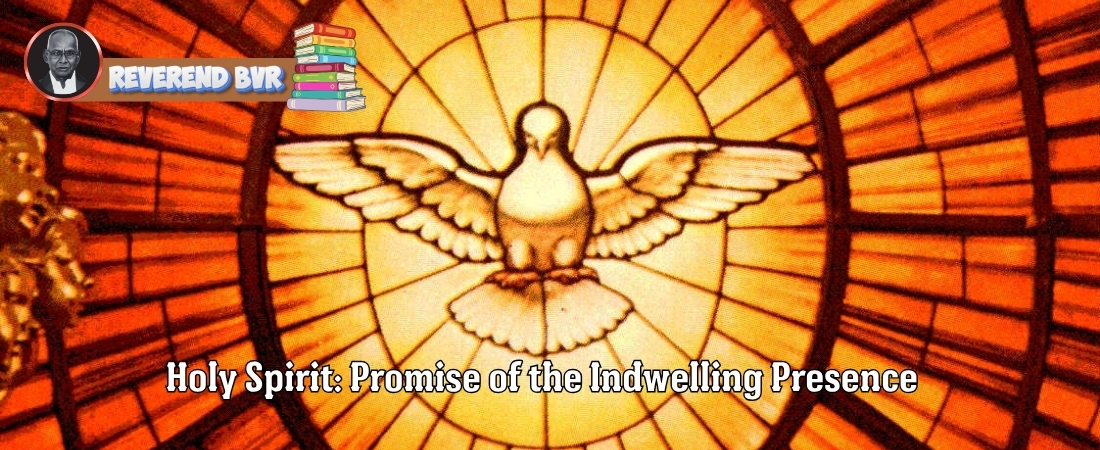
Sermon Title: Holy Spirit: Promise of the Indwelling Presence.
Occasion: 6th Sunday after Easter | May 17, 2026.
Bible Readings: Isa. 59: 14-21 | Psalm 143 | Heb. 10: 8-18 | John 14: 15-21 | Isa. 44: 1-5/1 Cor. 3: 10-17.
Original Language Reflections (For deeper study, refer to the Table of Hebrew and Greek Terms in Section VIII. of the sermon).
Website: www.reverendbvr.com
Theological Thesis: God’s promise in Isaiah (to send his Spirit and his Redeemer) reaches fulfilment in the new covenant of Hebrews and is inaugurated by the risen Christ in John 14. This indwelling presence transforms the entire community of faith into the living temple of the Holy Spirit (1 Cor. 3), pouring out on all God’s people the abundance of his blessing (Isa. 44). The Spirit is the Father’s gift, the Son’s promise, and the Church’s vocation.
I. Introduction: A World Without Presence
There is a particular kind of loneliness that has nothing to do with the number of people around you, the loneliness of feeling unseen, unknown, and utterly unaccompanied in the deepest places of the soul. Ancient Israel knew this intimately. Surrounded by the splendour of the temple, they felt the presence of God had withdrawn. The prophets thundered that justice had stumbled in the streets (Isa. 59:14). The psalmist cried from a crushed spirit: “My spirit faints within me” (Ps. 143:4, 7).
Yet into precisely this desolation, God makes an extraordinary promise: not to return to his temple built of stone, but to take up residence in human hearts. He promises to place his Spirit within his people (Isa. 59:21; 44:3); to send “another Advocate” who will be in you (John 14:17): not merely among you, not visiting, but indwelling.
We stand, this Sixth Sunday after Easter, in the pregnant pause between Ascension and Pentecost, the Church holding its breath. Today the Scriptures open that promise wide and ask: Do you grasp what God intends to do in you?
II. The Collect:
The Collect prays that God, who has exalted his Son and sent the Spirit upon the Church, would pour out that same Spirit upon all people. Crucially, it begins not with human need but with divine action already accomplished. The worshipping community is positioned not as petitioners begging for something yet to come, but as recipients asking to receive more fully what has already been given, precisely the logic of every reading today. The petition to “pour out” the Spirit echoes Isaiah 44:3’s promise of water on thirsty land, and the Joel-prophecy fulfilled at Pentecost (Acts 2:17).
III. Exposition of the Readings:
1. When God Himself Intervenes (Isaiah 59:14-21)
Isaiah 59 addresses a community in profound moral and spiritual collapse (6th–5th c. BCE). The city gate (the ancient courthouse) is the site of Isaiah’s diagnosis: “Justice is turned back, truth has stumbled in the public square” (v. 14). Whoever turns from evil makes himself prey; righteousness itself has become dangerous.
Then at verse 16, something dramatic occurs. God surveys the wreckage, sees there is no human intercessor, and acts himself. The imagery is martial theophany: righteousness as breastplate, salvation as helmet, garments of vengeance (vv. 17–18). God enters history as the Divine Warrior.
“He will come like a rushing stream, which the wind of the LORD drives.” (Isaiah 59:19b)
The Hebrew word for “wind” is ruach, the same word for breath and Spirit. The Spirit of God drives divine intervention like a river in flood. The passage culminates in verse 21 with a covenantal promise: “My Spirit that is upon you, and my words that I have put in your mouth, shall not depart… from this time forth and forevermore.” Spirit and Scripture are given together as a unified, perpetual, intergenerational gift. Isaiah 59 establishes the foundational problem (sin and divine absence) and the foundational solution (God’s own intervention through his Spirit).
2. The Soul’s Cry and God’s Spirit (Psalm 143)
This Penitential Psalm moves through lament (vv. 1–6), urgent appeal (vv. 7–10), and confident trust (vv. 11–12). The speaker is in extreme distress, pursued by enemies, living in darkness; the wilderness imagery of verse 6 (“like a parched land”) connects directly to Isaiah 44:3’s promise of water for the thirsty.
“Let your good Spirit lead me on level ground.” (Psalm 143:10b)
The Hebrew ruach tobah (“good Spirit”) is one of the clearest Old Testament anticipations of the New Testament’s theology of the Holy Spirit as guide and teacher, precisely what Jesus promises in John 14:26. The Psalm voices the human longing for what Christ will fulfil: not an external code but an interior guide.
3. The New Covenant Writes the Law Within (Hebrews 10:8-18)
This is Written to Jewish-Christians tempted to return to Mosaic practice, Hebrews argues that Christ’s single perfect sacrifice supersedes the entire Levitical system. The very repetition of animal sacrifices proved their incompleteness. Verses 15–17 cite Jeremiah’s New Covenant oracle and attribute it to the Holy Spirit as witness:
“By a single offering he has perfected for all time those who are being sanctified.” (Hebrews 10:14)
The promised law is now written on the kardia (heart, the seat of will and desire) and dianoia (deep mind, the centre of moral cognition). This is not an upgraded version of the old system: it is a new creation from within. Where God’s forgiveness through Christ is complete, “there is no longer any offering for sin” (v. 18). What remains is the indwelling Spirit, transforming rather than demanding.
4. The Spirit of Truth Comes to Dwell (John 14:15-21)
The Farewell Discourse finds Jesus speaking on the night of his betrayal to bewildered, frightened disciples. He is leaving; they are panicking. Into this fragile moment Jesus speaks with extraordinary calm: “I will ask the Father, and he will give you another Advocate, to be with you forever” (v. 16).
The Greek Parakletos (from para, alongside + kaleo, to call) means advocate, counsellor, intercessor. Jesus calls the Spirit allos Parakletos, “another of the same kind.” The Spirit does not replace Jesus; in the Spirit, Jesus himself comes to indwell the believer.
“You know him, for he dwells with you and will be in you. I will not leave you as orphans.” (John 14:17b–18)
The preposition shift is the theological hinge: from meta (with, alongside) to en (in, within). This is the transition from external association to interior habitation, the very transformation Isaiah promised and Hebrews explains. The Greek orphanos evokes deep vulnerability and lostness. Christ’s answer is: the Spirit gives the security of divine sonship, not orphan anxiety.
5. Water on Dry Ground, Spirit on Dry Souls (Isaiah 44:1-5)
The divine address “But now hear, O Jacob my servant” (v. 1) signals reversal: from judgment to grace. In a land of seasonal rains and chronic drought, water poured on thirsty ground was an image of resurrection. The Spirit-promise runs in exact structural parallel:
“I will pour my Spirit upon your offspring and my blessing on your descendants.” (Isaiah 44:3b)
The verb yatsaq (to pour out) is used for pouring oil or water, suggesting abundance, not rationing. The result is a flourishing community that publicly claims its identity: “This one will say, ‘I am the LORD’s’” (v. 5). The Spirit’s outpouring is not merely inward: it produces witnesses. This directly anticipates Pentecost and the Church’s mission.
6. You (We) Are God’s Temple (1 Corinthians 3:10-17)
Paul addresses a fractured Corinthian church divided along lines of personality and leadership. He uses the construction metaphor: he is the architekton (master builder) who laid the foundation, Jesus Christ himself (v. 11). Every subsequent builder must exercise care. Then the theological climax:
“Do you not know that you are God’s temple and that God’s Spirit dwells in you?” (1 Corinthians 3:16)
The Greek word is naos, not hieron (the broader temple complex) but the inner sanctuary, the Holy of Holies itself. Paul’s claim is staggering: the community of believers, with all its divisions and failures, is that sacred space. Crucially, the “you” is plural in Greek (hymeis): this is a communal reality. Divisions are not merely social problems: they are acts of desecration. Every reconciliation is a restoration of the sanctuary.
IV. The Unified Message of All Six Readings:
- Isaiah 59 establishes the crisis (moral darkness, absent justice, divine withdrawal), but ends with God’s promise to intervene through his Spirit and Word, which will never depart.
- Psalm 143 gives the human voice within that crisis: the crushed spirit, the parched soul, the urgent prayer for the ruach tobah to lead.
- Isaiah 44 fills the positive promise: the Spirit poured lavishly like water on dry ground, producing a community that flourishes and owns its identity publicly.
- Hebrews 10 reveals the mechanism: through Christ’s perfect sacrifice, external law gives way to interior transformation. The Spirit writes God’s law on living hearts.
- John 14 gives Christ’s own voice: the Paraclete will dwell within (not alongside), so disciples are not orphans.
- 1 Corinthians 3 shows the communal dimension: the indwelling Spirit constitutes the community as the living naos of the new age.
The arc moves from promise to fulfilment, from external to internal, from temporary to permanent, from individual to communal. God is building a temple: not of stone, but of Spirit-filled human beings gathered in Christ.
V. Practical Life Applications:
- Cultivate awareness of the indwelling Spirit. Begin each day: “Lord, your Spirit dwells within me. Lead me today.” This is theological attentiveness, training the mind to live in the reality Scripture proclaims.
- Use seasons of dryness as invitations. When prayer feels dry, take Psalm 143 in hand and pray it honestly. The psalmist’s cry becomes the channel through which the Spirit flows.
- Take Christian community with ultimate seriousness. If the community of believers is God’s naos, every act of service, reconciliation, and hospitality is a liturgical act.
- Allow the Spirit to speak through you. Ask the Spirit daily to give you words for the people around you. Isaiah 59:21’s promise of words in your mouth is a call to availability, not eloquence.
- Live from covenant identity, not performance. Hebrews 10:14 declares you have been “perfected for all time.” You are not on probation with God. You are forgiven, accepted, and sealed by the Spirit, so live from that secure identity, not toward it.
VII. Conclusion:
“Do you not know that you are God’s temple?” Not: do you know that God is out there somewhere? But: do you know that you (you, in all your complexity and failure and longing) are the place where God has chosen to live? The Sixth Sunday after Easter places us at the threshold: the Son ascended, the Spirit promised, the Church waiting. We live in the reality the first disciples only hoped for. The Advocate has come. The Spirit dwells within. The temple is not a building; it is a people, poured out like water on dry ground, speaking words that will not depart, built on the foundation that cannot be shaken.
“The Spirit does not replace Jesus; in the Spirit, Jesus himself comes to indwell the believer, moving from meta (alongside) to en (within). This is the theological revolution of the new covenant.”
VII. Closing Prayer
Holy and ever-present God, we come before you as dry and thirsty ground, longing for the water of your Spirit. You who spoke to Isaiah of a Redeemer coming to Zion, of words placed in mouths that would never fall silent, of your ruach poured out on all your offspring, fulfil that promise afresh in us this day. Lord Jesus, who promised your disciples would not be orphaned, who spoke of an Advocate (another of your own kind) who would dwell not merely among us but within us: we receive that promise now. Spirit of truth, Spirit of adoption, who writes God’s law not on stone but on the soft tissue of the heart, who makes of this broken assembly a naos, a Holy of Holies: pour yourself upon us like water on thirsty land. Make our speech your speech. Make our community your temple. Bind us together across every line that divides, that the world may know in us a people indwelt, transformed, and sent. Through Jesus Christ, our foundation and our great High Priest, in whom all the fullness of the Godhead dwells bodily. Amen.
VIII. Original-Language Word Study
| S.No | Passage | Word | Transliteration | Lit. Meaning | Theological Significance & Sermon Connection |
| 1 | Isa. 59:19 | רוּחַ (Heb.) | ruach | Wind / Breath / Spirit | Tri-semantic: the Spirit is as essential as breath and as unstoppable as storm-wind; same Spirit promised to indwell believers is the very power of God. |
| 2 | Isa. 59:21 | בְּרִיתִי (Heb.) | beriti | My covenant | God’s unconditional pledge binding himself to his people, not contingent on human performance, and the Spirit’s indwelling is permanent and irrevocable. |
| 3 | Ps. 143:10 | רוּחֲךָ טוֹבָה (Heb.) | ruach tobah | Your good Spirit | Clearest OT prayer for the Spirit as guide and teacher, directly anticipating Christ’s Paraclete promise in John 14:26. |
| 4 | Heb. 10:16 | καρδία (Gk.) | kardia | Heart / innermost self | Seat of will and desire, where the Spirit’s work goes to the very core of personhood, not merely the surface of behaviour. |
| 5 | Heb. 10:16 | διάνοια (Gk.) | dianoia | Mind / deep intellect | Centre of moral cognition, where the new covenant is not external code but interior transformation: the Spirit rewrites the human mind. |
| 6 | John 14:16 | Παράκλητος (Gk.) | Parakletos | One called alongside | Advocate, Counsellor, Intercessor: the Spirit is “another of the same kind” (allos) as Christ; not a lesser replacement but a continuation of Christ’s own presence. |
| 7 | John 14:17 | ἐν ὑμῖν (Gk.) | en hymin | In you (plural) | Decisive shift from meta (with) to en (in): external presence becomes interior habitation, the theological revolution of the new covenant. |
| 8 | John 14:18 | ὀρφανός (Gk.) | orphanos | Orphan / bereft | Deep vulnerability and lostness, answered by the Spirit of adoption answers the deepest human fear of divine abandonment with the security of divine sonship. |
| 9 | Isa. 44:3 | יָצַק (Heb.) | yatsaq | To pour out / lavish | Verb for pouring oil or water, suggesting unrestrained generosity: the Spirit is not rationed but poured out abundantly on all God’s offspring. |
| 10 | 1 Cor. 3:16 | ναός (Gk.) | naos | Inner sanctuary / Holy of Holies | The most sacred space in Jewish theology now applied to the community of believers, where the Spirit’s indwelling makes the Church itself the sacred space of divine presence. |
IX. Bibliography
- John Goldingay, Isaiah 40–55: A Critical and Exegetical Commentary (London: T&T Clark, 2014); Joseph Blenkinsopp, Isaiah 56–66, AB 19B (New York: Doubleday, 2003).
- John R. Levison, Filled with the Spirit (Grand Rapids: Eerdmans, 2009), a comprehensive study of ruach across wind, breath, and Spirit.
- Leslie C. Allen, Psalms 101–150, WBC 21 (Waco: Word, 1983), on the Penitential Psalms and Ps. 143.
- William L. Lane, Hebrews 9–13, WBC 47B (Dallas: Word, 1991); Peter T. O’Brien, The Letter to the Hebrews, PNTC (Grand Rapids: Eerdmans, 2010).
- Gordon D. Fee, The First Epistle to the Corinthians, NICNT (Grand Rapids: Eerdmans, 1987), on the naos/hieron distinction, 146–148.
- Raymond E. Brown, The Gospel according to John XIII–XXI, AB 29A (New York: Doubleday, 1970); Gary M. Burge, The Anointed Community (Grand Rapids: Eerdmans, 1987), on the Paraclete in Johannine tradition.
- George R. Beasley-Murray, John, WBC 36 (Waco: Word, 1987), on the meta/en preposition shift in John 14:17.
- Gordon D. Fee, God’s Empowering Presence: The Holy Spirit in the Letters of Paul (Peabody: Hendrickson, 1994), a comprehensive treatment of Pauline pneumatology.
© 2025 ReverendBVR.com | High-Academic Sermon Series, 2026.
Content licensed under Creative Commons Attribution-NonCommercial-NoDerivatives 4.0 International (CC BY-NC-ND 4.0). You are free to share, copy and redistribute the material in any medium or format with proper attribution. No commercial use or modifications allowed without explicit permission.
For further sermons and biblical reflections, please visit 🌐 www.reverendbvr.com/sermons
Leave a Reply