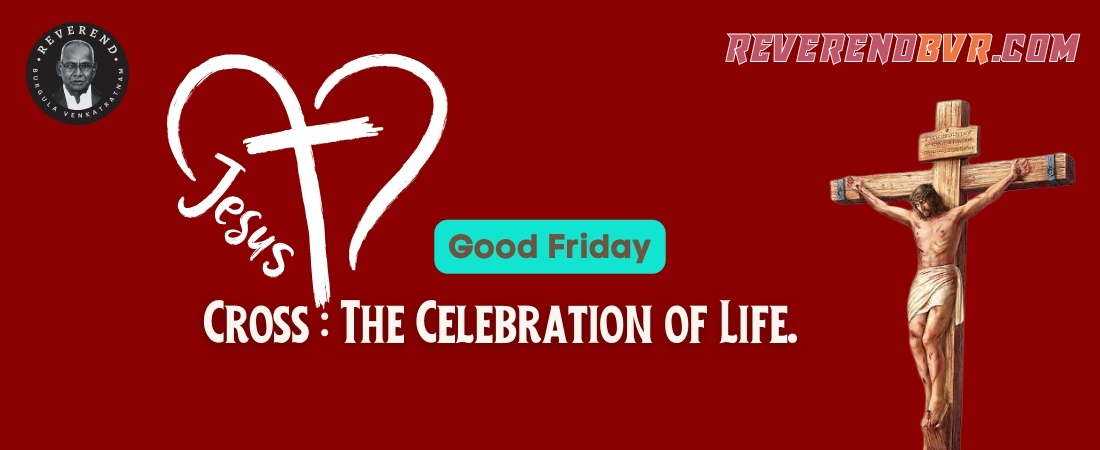
Sermon Title: The Cross: The Celebration of Life.
Occasion: 4th Sunday before Easter |Good Friday, April 3, 2026.
Bible Readings: Exo. 12: 1-17 | Psalm 22/ Psalm 88 | 1 Cor. 1: 18-25 | Mark 15: 21-41 / John 12: 22-33.
Original Language Reflections (For deeper study, refer to the Table of Hebrew and Greek Terms in Section V. of the sermon).
Website: www.reverendbvr.com
Theological Thesis: Good Friday proclaims a paradox at the heart of the Christian faith: the cross, an instrument of death, becomes God’s decisive act of life-giving love. What appears as defeat is revealed as victory; what looks like weakness becomes the power of God; what seems like the end becomes the beginning of new creation. Across Exodus, Psalms, Epistle, and Gospel, Scripture speaks with one voice: God chooses to save not by domination, but by self-giving love, A love that liberates, restores dignity, and births life precisely where death seems to reign.
1. The Cross and the God Who Liberates: From Slavery to Life (Exodus 12:1–17)
The Exodus is the grammar of salvation. Israel’s liberation begins not with weapons but with the blood of a lamb and a meal shared in hope.
“It is the LORD’s Passover” (Exod. 12:11).
The Hebrew term פֶּסַח (pesach) means to pass over or to spare. Life is preserved not by Israel’s strength but by God’s merciful intervention. The people are freed so they may live as God’s covenant community.
On Good Friday, the Church hears Exodus anew. Christ becomes the Paschal Lamb, not sacrificed to appease a violent God, but given by a God who enters human suffering to break the cycle of death from within. Liberation here is not abstract; it is embodied, costly, and real.
2. The Cross and the Cry of the Human Heart: God in God-Forsakenness (Psalms 22 / 88)
Psalm 22 opens with words Jesus himself speaks from the cross: “My God, my God, why have you forsaken me?” (Ps. 22:1)
This is not unbelief, it is faith daring to speak honestly. In Hebrew, the cry carries covenant intimacy even in abandonment. Psalm 88 goes further, refusing easy resolution. It ends in darkness.
Good Friday honors this unresolved pain. Scripture does not rush grief. God does not silence lament. Instead, God meets humanity at the deepest point of despair. The cross declares that no human cry is foreign to God. not the cry of refugees, the silenced, the depressed, or the oppressed.
3. The Cross and the Wisdom That Shatters Power: Foolishness That Saves (First Epistle to the Corinthians 1:18–25)
“The message of the cross is foolishness to those who are perishing, but to us who are being saved it is the power of God.” (1 Cor. 1:18)
Paul confronts every system that equates power with domination. The Greek word μωρία (mōria) means foolishness, describes how the cross looks to a world obsessed with control.
Yet this “foolish” love dismantles violence at its root. God does not defeat evil by becoming more violent than violence itself. God defeats it by absorbing it and transforming it. The cross reveals a God whose power is restorative, not coercive.
4. The Cross and the God Who Suffers With Us: Love That Endures to the End (Mark 15:21–41)
Mark’s crucifixion account is stark and unadorned. Jesus dies abandoned, mocked, and misunderstood. Yet at the moment of death: “The curtain of the temple was torn in two, from top to bottom.” (Mark 15:38)
Access to God is no longer mediated by hierarchy or exclusion. The cross tears down every barrier, i.e., between sacred and secular, insider and outsider.
A Roman centurion, an agent of empire, becomes the first to confess: “Truly this man was God’s Son!” (15:39)
Life breaks forth precisely where the world expects only death.
5. The Cross as the Lifting Up of Life: Glory Revealed in Giving (Gospel of John 12:22–33)
John reframes crucifixion as exaltation: “When I am lifted up from the earth, I will draw all people to myself.” (John 12:32)
The Greek verb ὑψωθῆναι (hypsōthēnai) means to be lifted up refers to both crucifixion and glorification. For John, the cross is not a detour from glory; it is glory itself.
Jesus compares his death to a grain of wheat: “Unless a grain of wheat falls into the earth and dies, it remains just a single grain; but if it dies, it bears much fruit.” (12:24)
Here lies the heart of Good Friday: life multiplied through self-giving love.
II. The Collect as Theology in Prayer
The Collect names God as Compassionate Parent, Refuge of the Penitent, and Source of Life. It refuses a distant deity. Instead, it proclaims a Triune God who suffers, forgives, and empowers.
The prayer does not end at the cross but it moves outward:
- to justice
- to liberation
- to voicing the voiceless
Thus, Good Friday is not passive remembrance but active participation in God’s mission.
II. Contemporary Word: Where the Cross Speaks Today
In a world marked by: systemic injustice, spiritual exhaustion, performative religion, and cheap hope,
But the cross calls us to a different way:
- to stand with the crucified of our time,
- to resist violence without becoming violent,
- to love without calculating return.
Good Friday asks not merely, Do you believe this?
It asks, Will you live this way?
III. Life Applications (Faith That Walks the Cross-Shaped Way)
- Practice costly compassion, choose presence over convenience.
- Speak truth from within suffering, lament is holy speech.
- Resist domination in homes, churches, workplaces.
- Become instruments of peace, not neutrality, but reconciling courage.
- Trust God in unfinished stories, resurrection begins in the dark.
IV. Prayer:
God of the cross and God of life, when the world teaches us to win, you teach us to give; when fear urges us to protect ourselves, you open your arms wide. Meet us in our Good Fridays; in grief without answers, in faith without applause, in love that costs more than we planned to give. Lift us up with Christ, that we may be drawn not to power, but to people; not to safety, but to solidarity; not to silence, but to liberating truth. Make our lives living crosses, where love is poured out, where justice takes root, and where hope, against all reason, rises. Through Jesus Christ, the Crucified and the Living One. Amen.
V. Key Biblical Terms & Original Languages:
| S.No | Passage | Verse | Original Word | Language | Literal Meaning | Theological Significance |
| 1 | Exodus 12 | v.11 | פֶּסַח (pesach) | Hebrew | Pass over / spare | God’s liberating mercy |
| 2 | Psalm 22 | v.1 | עָזַב (azav) | Hebrew | Forsake | Honest lament before God |
| 3 | Psalm 88 | v.18 | חֹשֶׁךְ (choshek) | Hebrew | Darkness | Faith without resolution |
| 4 | 1 Cor 1 | v.18 | μωρία (mōria) | Greek | Foolishness | Cross overturns worldly power |
| 5 | Mark 15 | v.38 | καταπέτασμα (katapetasma) | Greek | Curtain / veil | Access to God opened |
| 6 | John 12 | v.32 | ὑψωθῆναι (hypsōthēnai) | Greek | Lifted up / exalted | Cross as glory |
| 7 | John 12 | v.24 | κόκκος (kokkos) | Greek | Grain | Life through self-giving |
© 2025 ReverendBVR.com | High-Academic Sermon Series, 2026.
Content licensed under Creative Commons Attribution-NonCommercial-NoDerivatives 4.0 International (CC BY-NC-ND 4.0). You are free to share — copy and redistribute the material in any medium or format with proper attribution. No commercial use or modifications allowed without explicit permission.
For further sermons and biblical reflections, please visit 🌐 www.reverendbvr.com/sermons
Leave a Reply