
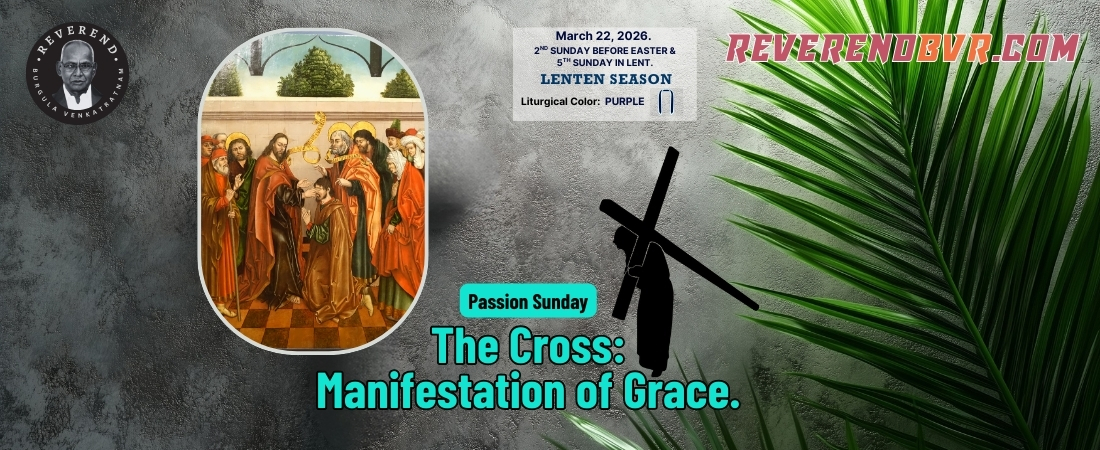
Sermon Title: The Cross: Manifestation of Grace.
Occasion: 2nd Sunday before Easter | 5th Sunday in Lent, March 22, 2026. | Passion Sunday.
Bible Readings: Micah 7: 15-20 | Psalm 31 | Acts 1 Peter 2: 17-24 | Mark 10: 46-52 | Jer. 31: 31-34 | Rom. 5:8-21.
Original Language Reflections (For deeper study, refer to the Table of Hebrew and Greek Terms in Section VIII. of the sermon).
Website: www.reverendbvr.com
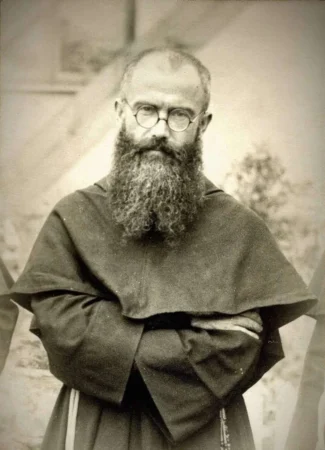
In 1941, in the Nazi concentration camp of Auschwitz, a prisoner escaped. As punishment, ten men were chosen to die by starvation.
One of them cried out, “My wife… my children.”
At that moment a quiet priest named Maximilian Kolbe stepped forward and said to the guards,
“I will take his place.”
Kolbe died so that another man could live.
Years later the man who survived said that every day of his life reminded him that someone else had died for him.
That moment helps us understand the Cross: we live because someone else chose to suffer in our place.
Theological Thesis : On Passion Sunday, the Church stands before the Cross not as a symbol of divine anger but as the clearest manifestation of God’s grace. Across the readings, the one truth that resounds is: God’s saving power is revealed not through domination but through mercy that bears suffering, forgives sin, and creates new sight and new hearts. The Cross gathers Israel’s hope, Christ’s obedience, and the believer’s discipleship into one coherent story of grace that heals, restores, and calls us to follow. Grace here is not sentimental kindness; it is costly mercy: God entering human brokenness, absorbing sin’s weight, and transforming it into life.
1. Grace Remembered: God’s Character Revealed (Micah 7:15–20)
Micah ends not with judgment but with wonder. Israel’s future rests on who God is, not on who Israel has been.
“Who is a God like you, pardoning iniquity…? He does not retain his anger forever, because he delights in steadfast love.” (Mic 7:18)
The Hebrew word ḥesed (חֶסֶד) means steadfast, covenantal love, anchors the passage. God’s power is shown in forgiveness, not vengeance. Sin is not merely overlooked; it is cast into the depths of the sea (v.19). This is grace that removes guilt decisively.
Micah’s vision prepares us for the Cross: a God whose justice is fulfilled through mercy, not cancelled by it.
2. Grace Entrusted: Suffering Without Retaliation (1 Peter 2:17–24)
Peter addresses communities suffering unjustly. He does not glorify pain; he redefines it through Christ.
“When he was abused, he did not return abuse… but entrusted himself to the one who judges justly.” (1 Pet 2:23)
The Greek verb paradidōmi (παραδίδωμι) means to hand over, entrust, is crucial. Jesus hands Himself over to God, not to violence. The Cross becomes the place where sin is borne (anēnegken, ἀνήνεγκεν) and healing flows: “By his wounds you have been healed.” (v.24)
Grace here is transformative: forgiveness that frees us from sin’s power so that we might “live to righteousness.”
3. Grace Seen: From Blindness to Discipleship (Mark 10:46–52)
Bartimaeus is not healed quietly. He cries out publicly: “Jesus, Son of David, have mercy on me!” (v.47)
The cry for mercy eleēson (ἐλέησόν), is a plea for restoring grace. Though blind, Bartimaeus sees who Jesus truly is. When healed, Mark tells us:
“Immediately he regained his sight and followed him on the way.” (v.52)
The Greek hodos (ὁδός), the way, is not just a road, it is the path to Jerusalem, to the Cross. Grace opens our eyes not only to receive healing but to walk the costly way of discipleship.
4. Grace Written on the Heart (Jeremiah 31:31–34)
Jeremiah speaks of a new covenant, not etched in stone but inscribed within: “I will put my law within them, and I will write it on their hearts.” (Jer 31:33)
Forgiveness here is relational and interior: “I will forgive their iniquity, and remember their sin no more.” (v.34)
This promise finds fulfillment at the Cross, where grace does not merely pardon—it re-creates.
5. Grace Accomplished: Love Proven at the Cross (Romans 5:8–21)
Paul names the scandal of grace: “God proves his love for us in that while we still were sinners Christ died for us.” (Rom 5:8)
Grace (charis, χάρις) is not a reward for repentance; it is the cause of repentance. Where sin increases, grace superabounds (hyperperisseuō, ὑπερεπερίσσευσεν).
The Cross is not Plan B. It is the eternal intention of divine love.
6. Grace Prayed: The Collect as Theology in Motion
The Collect gathers the readings into a lived confession:
- Christ bears sin without retaliation (1 Peter),
- God shows steadfast love and forgiveness (Micah, Jeremiah),
- We are invited to forgive others and follow in faith, like Bartimaeus.
Prayer becomes formation: grace received becomes grace embodied.
Contemporary Resonance:
In a world addicted to retaliation, the Cross announces a different power.
In cultures driven by visibility and success, Bartimaeus teaches us that faith often begins in unimpressive cries for mercy.
In societies shaped by shame and performance, Jeremiah’s promise reminds us: God’s grace works from the inside out.
The Cross does not deny suffering; it redeems it. Grace does not excuse injustice; it heals and transforms those who bear it without surrendering to hate.
Life Applications (Without Moralism)
- Practice courageous mercy: Forgiveness is not weakness; it is participation in God’s own power.
- Entrust rather than retaliate: Like Christ, hand your wounds to God’s just judgment.
- Follow after healing: Grace restores us not to comfort, but to discipleship.
- Live from the heart: Let God’s law be written inwardly, shaping daily decisions quietly and faithfully.
Let us Pray:
O Crucified and Risen Christ,
You are the grace we did not earn and the mercy we could not imagine.
When our eyes are blind with fear, give us the courage of Bartimaeus to cry out.
When our wounds tempt us to bitterness, teach us to entrust ourselves to the Father, as you did upon the Cross.
Write your covenant upon our hearts, not in fear but in love, that forgiven and healed, we may walk your way – bearing grace into a wounded world, until your mercy makes all things new. Amen.
Key Biblical Terms & Texts (For Sermon Notes / Teaching Handout)
| S.No | Passage | Verse | Original Term | Language | Text (Original) | Meaning / Theological Weight |
| 1 | Micah | 7:18 | ḥesed | Hebrew | חֶסֶד | Steadfast, covenantal love |
| 2 | Micah | 7:19 | kābaš | Hebrew | כָּבַשׁ | To subdue, bring under control |
| 3 | Psalm 31 | 5 | rûaḥ | Hebrew | רוּחַ | Breath, life entrusted to God |
| 4 | 1 Peter | 2:23 | paradidōmi | Greek | παραδίδωμι | To hand over, entrust |
| 5 | 1 Peter | 2:24 | anapherō | Greek | ἀναφέρω | To bear up, carry sacrificially |
| 6 | Mark | 10:47 | eleēson | Greek | ἐλέησόν | Have mercy |
| 7 | Mark | 10:52 | hodos | Greek | ὁδός | The way, path of discipleship |
| 8 | Jeremiah | 31:33 | lēb | Hebrew | לֵב | Heart, inner self |
| 9 | Romans | 5:8 | agapē | Greek | ἀγάπη | Self-giving, covenantal love |
| 10 | Romans | 5:20 | charis | Greek | χάρις | Grace, unmerited favor |
© 2025 ReverendBVR.com | High-Academic Sermon Series, 2026.
Content licensed under Creative Commons Attribution-NonCommercial-NoDerivatives 4.0 International (CC BY-NC-ND 4.0). You are free to share, copy and redistribute the material in any medium or format with proper attribution. No commercial use or modifications allowed without explicit permission.
For further sermons and biblical reflections, please visit 🌐 www.reverendbvr.com/sermons
Bibliography:
- The Holy Bible.
- Walter Brueggemann, Theology of the Old Testament: Testimony, Dispute, Advocacy (Minneapolis: Fortress Press, 1997).
- Bruce C. Birch, Walter Brueggemann, Terence E. Fretheim, and David L. Petersen, A Theological Introduction to the Old Testament, 2nd ed. (Nashville: Abingdon Press, 2005).
- James Limburg, Hosea–Micah (Louisville: Westminster John Knox Press, 2011).
- R. W. L. Moberly, The Old Testament of the Old Testament: Patriarchal Narratives and Mosaic Yahwism (Minneapolis: Fortress Press, 1992).
- Joel B. Green, 1 Peter (Grand Rapids: Eerdmans, 2007).
- Karen H. Jobes, 1 Peter (Grand Rapids: Baker Academic, 2005).
- Joel Marcus, Mark 8–16: A New Translation with Introduction and Commentary (New Haven: Yale University Press, 2009).
- Ched Myers, Binding the Strong Man: A Political Reading of Mark’s Story of Jesus, 20th anniversary ed. (Maryknoll, NY: Orbis Books, 2008).
- Walter Brueggemann, A Commentary on Jeremiah: Exile and Homecoming (Grand Rapids: Eerdmans, 1998).
- Terence E. Fretheim, Jeremiah (Macon, GA: Smyth & Helwys, 2002).
- Douglas J. Moo, The Epistle to the Romans, 2nd ed. (Grand Rapids: Eerdmans, 2018).
- N. T. Wright, Romans (Nashville: Abingdon Press, 2002).
- James D. G. Dunn, The Theology of Paul the Apostle (Grand Rapids: Eerdmans, 1998).
- Fleming Rutledge, The Crucifixion: Understanding the Death of Jesus Christ (Grand Rapids: Eerdmans, 2015).
- Jürgen Moltmann, The Crucified God (Minneapolis: Fortress Press, 1993).
- Dietrich Bonhoeffer, Discipleship (Minneapolis: Fortress Press, 2001).
- Rowan Williams, Tokens of Trust: An Introduction to Christian Belief (Louisville: Westminster John Knox Press, 2007).
- Thomas G. Long, The Witness of Preaching, 3rd ed. (Louisville: Westminster John Knox Press, 2016).
- Ellen F. Davis, Scripture, Culture, and Agriculture: An Agrarian Reading of the Bible (Cambridge: Cambridge University Press, 2009).
Leave a Reply