From the fragile basket on the Nile to the meeting of two unlikely mothers, grace rises where the world sees weakness. Advent whispers that God’s hope dwells not in thrones but in the lowly hearts who dare to believe.
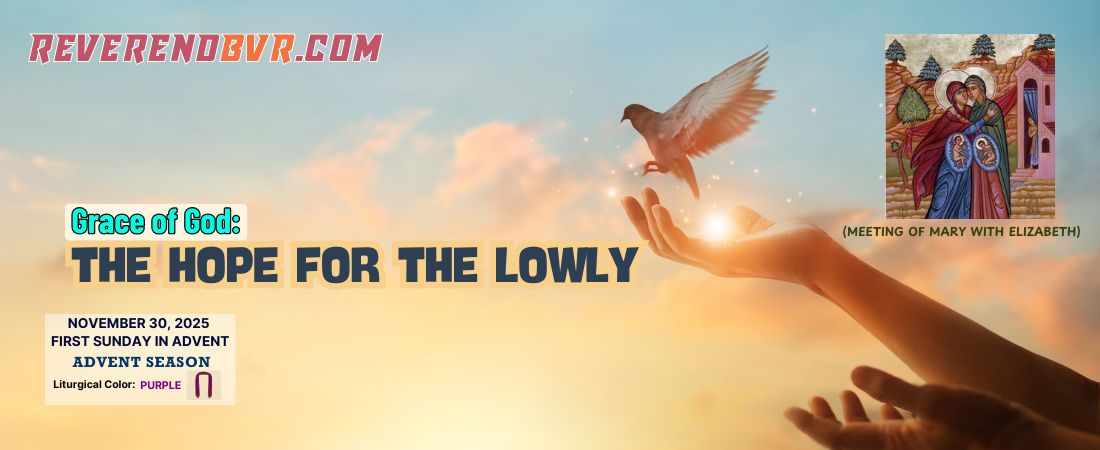
Sermon Title: Grace of God: The Hope for the Lowly | Grace Rising from the Margins: Hope for the Lowly at Advent
Occasion: Meeting of Mary with Elizabeth | 1st Sunday in Advent | November 30, 2025, Sunday.
Textual Foundations: Exodus 2:1–10; Psalm 30; 1 Thessalonians 3:6–13; Luke 1:39–45
Original Language Reflections (For deeper study, refer to the Table of Hebrew and Greek Terms in Section 3 of the sermon).
Website: www.reverendbvr.com
1.Introduction: Disruptive Grace
Grace is not only amazing; it is disruptive—it overturns the expected order of power and privilege. It interrupts our assumptions, dismantles our hierarchies, and rewrites destinies with divine mercy. Advent, that sacred season of waiting and watching, centers on this kind of grace: grace that lifts the lowly and levels the proud (Luke 1:52). It is not a distant ideal; it is hope made flesh for the humble, the unseen, the powerless.
Advent, from adventus (“coming”), marks a season of divine grace breaking into history. Its Greek counterpart, parousia (παρουσία), adds the sense of royal presence. Beginning in late November, the four Sundays of Advent guide us through Hope, Faith, Joy, and Peace—symbolized by candles lit in many CSI churches. These culminate in the Christ Candle, celebrating God’s grace fully revealed in Jesus Christ.
The Four Advent Sundays of 2025:
| Advent Sunday | Date | Candle Name | Theme |
| 1st Sunday of Advent | November 30 | Candle of Hope | Grace of God: The Hope for the Lowly (Meeting of Mary with Elizabeth) |
| 2nd Sunday of Advent | December 7 | Candle of Faith (Bethlehem Candle) | God’s Word Challenges the Status Quo (The birth of John the Baptist) |
| 3rd Sunday of Advent | December 14 | Candle of Joy | Deliverance from the Grip of Fear (Annunciation to Joseph) |
| 4th Sunday of Advent | December 21 | Candle of Peace (Angel’s Candle) | Maranatha: Life in Waiting (The Second Coming of Christ) |
Through these weeks, we prepare not just to celebrate a birth but to embrace a transformative grace—one that disrupts, renews, and empowers us to live faithfully in anticipation of Christ’s coming.
In this sermon, we consider how grace rises from the margins through the stories of hidden figures—a Levite mother, a psalmist saved from despair, a teenage girl in Nazareth, and a persecuted community—each bearing witness to a God who acts from the edges, not the center.
I. Exodus 2:1–10 – A Tevah of Grace
In Hebrew, the word tevah (תְּבָה) is used only twice in the Old Testament: for Noah’s ark and for the basket in which baby Moses is placed. Both float upon chaos waters. Just as God hovered over the deep in Genesis 1, so divine grace hovers over the Nile in Exodus 2, carrying Israel’s future liberator in a fragile vessel of faith.
Jochebed, Moses’ mother, enacts a profound trust—placing her child into the very waters that symbolize danger and destruction. Yet in doing so, she becomes a partner in divine redemption. Pharaoh’s daughter, a member of the oppressor class, becomes an unwitting instrument of God’s salvation.
Grace infiltrates systems of power to rescue the powerless. Advent grace is born not in security but in surrender, not in palaces but among reeds. It reveals that God’s deliverance often arrives through maternal courage and liminal acts of faith.
II. Psalm 30 – Grace Turns Mourning into Dancing
“You have turned my mourning into dancing” (Psalm 30:11). The Hebrew verb hāpakh (פַּכתָּ) denotes a complete inversion. This is not improvement; it is transformation. Psalm 30 is not about the absence of suffering but the power of grace to reverse its trajectory.
In Advent, as we sit in the shadows of longing, this psalm assures us: grace meets us within our mourning. Lament is not a prelude to grace; it is the soil in which grace blooms. The psalmist teaches that joy is not delayed until sorrow ends; joy is already breaking in, because God is at work transforming the night.
Advent hope declares that darkness is not permanent and despair is not destiny.
III. Luke 1:39–45 – Meeting Grace in the Womb
Two women meet in the Judean hill country: Mary, young and unwed; Elizabeth, old and long barren. Society marginalizes both. Yet God chooses them to bear grace. Mary is called kecharitōmenē (κεχαριτωμένη)—the “graced one”—a perfect passive participle in Greek indicating an act of grace completed and continuing. This is not about Mary’s merit, but about God’s sovereign favor.
This is the grace we echo in every “Ave Maria”—not a veneration of perfection, but an astonishment at divine election. Grace here is maternal, incarnate, and radical. The Magnificat is a revolution: “He has brought down rulers from their thrones but has lifted up the humble” (Luke 1:52).
In a world under Herod and Rome—marked by violence, surveillance, and fear—Mary’s song is dangerous. It is not a lullaby but a battle cry of hope. Elizabeth’s prophetic affirmation confirms that this meeting is more than personal; it is ecclesial. Two women carry not only children but the very kingdom of God.
IV. 1 Thessalonians 3:6–13 – Grace Sustains in Affliction
Paul writes from affliction to a persecuted church. He calls their perseverance his joy. He prays that God would “strengthen your hearts in holiness… at the coming (parousia) of our Lord Jesus” (v.13).
The Greek parousia (παρουσία) suggests not just an arrival, but a royal visit. In Advent, we live between grace received and glory anticipated. Like Thessalonica, the Church today waits with endurance, grounded in grace.
Advent ecclesiology calls us to communal hope—sustained by shared memory and mutual encouragement. Grace is not only personal salvation; it is the glue that binds exiles into a resilient communion.
V. Advent Grace: For the Lowly
Advent proclaims that God acts from the periphery. He chooses an endangered baby, a barren elder, an unwed girl, a persecuted congregation. Grace comes not to the esteemed but to the excluded.
Christ is born not in Herod’s court but in a manger among animals. The first evangelists are not priests or elites, but shepherds—unclean, uncredentialed, unseen. Grace stoops low to raise the lowly.
This is divine protest against human pride. It is theological upheaval. It is God’s revolution of love.
VI. Conclusion: Not Just Their Story—Ours
This is not just the history of salvation; it is our story too. We are the lowly whom God regards. We are called to:
- Trust sovereignty like Jochebed.
- Celebrate the small like Mary and Elizabeth.
- Stand firm like Thessalonica.
- Sing like the psalmist.
Grace is not an abstraction. It is a power that finds us in the womb, in the flood, in the prison, in the borderland, in the margins. You are seen. You are chosen. You are loved.
VII. How Shall We Then Live?
- Trust Sovereignty – Like Jochebed, entrust your future to God, even amid chaos.
- Celebrate the Small – Like Mary and Elizabeth, see glory in what the world dismisses.
- Stand in Grace – Like the Thessalonians, endure by the power of grace.
- Sing Your Magnificat – Let your life echo God’s reversal of the world.
Grace rises from the margins. Let it rise in you.
2.Closing Prayer:
Gracious and Sovereign God, You who hover over the waters of chaos and bring forth life from the fragile ark of hope, We thank You for Your disruptive grace— A grace that overturns the proud and lifts the lowly, A grace that meets us in our mourning and transforms our sorrow into dancing. As we await the fullness of Your kingdom, Strengthen our hearts to trust like Jochebed, To celebrate the small and seemingly insignificant like Mary and Elizabeth, And to stand firm in faith like the early Church of Thessalonica. May Your Spirit move within us, That we might carry Your hope to the margins, Embody Your love in hidden places, And sing Your Magnificat with lives marked by mercy and justice. In this Advent season, teach us to see that Your grace is not just a story of old, But our story—written into every humble heart, every oppressed voice, every waiting soul. Come, Lord Jesus, come. Make us vessels of Your hope, courage, and peace, That we might live boldly in the light of Your saving grace. In Your holy and gracious name, we pray, Amen.
3. Learn Words from the Original Scriptures (For deeper understanding and meditation on today’s theme)
| S. No | Term | Language | Meaning / Context |
| 1 | תֵּבָה (tevah) | Hebrew | “Ark” or “basket”; used in Exodus 2:3, also for Noah’s ark, symbolizing divine shelter and salvation. |
| 2 | הֲפַכְתָּ (hapakhta) | Hebrew | “You have turned”; from hāphak, meaning to overturn, reverse—used in Psalm 30:11. |
| 3 | κεχαριτωμένη (kecharitōménē) | Greek | Perfect passive participle from charitóō; “highly favored” or “graced” (Luke 1:28), referring to Mary. |
| 4 | παρουσία (parousia) | Greek | “Coming” or “presence”; theological term for Christ’s second coming, used in 1 Thess. 3:13. |
4. Bibliography
- Ambrose of Milan, Exposition of the Psalms, PL 14.
- Irenaeus, Against Heresies, Book 3.
- Thomas Aquinas, Summa Theologiae, I-II, q. 110–114.
- Walter Brueggemann, Exodus. New Interpreter’s Bible, Vol. 1. Nashville: Abingdon, 1994.
- Joel B. Green, The Gospel of Luke. NICNT. Grand Rapids: Eerdmans, 1997.
- Beverly Roberts Gaventa, Mary: Glimpses of the Mother of Jesus. Columbia: University of South Carolina Press, 1995.
- Abraham J. Malherbe, The Letters to the Thessalonians: A New Translation with Introduction and Commentary. Anchor Bible 32B. New Haven: Yale University Press, 2000.
- Francis Brown, S. R. Driver, and Charles A. Briggs, The Brown-Driver-Briggs Hebrew and English Lexicon. Peabody: Hendrickson, 2006.
- Jürgen Moltmann, The Coming of God: Christian Eschatology. Minneapolis: Fortress Press, 1996.
- Fleming Rutledge, Advent: The Once and Future Coming of Jesus Christ. Grand Rapids: Eerdmans, 2018.
May this Advent be a season where the grace of God becomes your hope, your strength, and your joy.
© 2025 ReverendBVR.com | High-Academic Sermon Series, 2025.
Content licensed under Creative Commons Attribution-NonCommercial-NoDerivatives 4.0 International (CC BY-NC-ND 4.0). You are free to share — copy and redistribute the material in any medium or format with proper attribution. No commercial use or modifications allowed without explicit permission.
For further sermons and biblical reflections, please visit 🌐 www.reverendbvr.com/sermons
Leave a Reply