
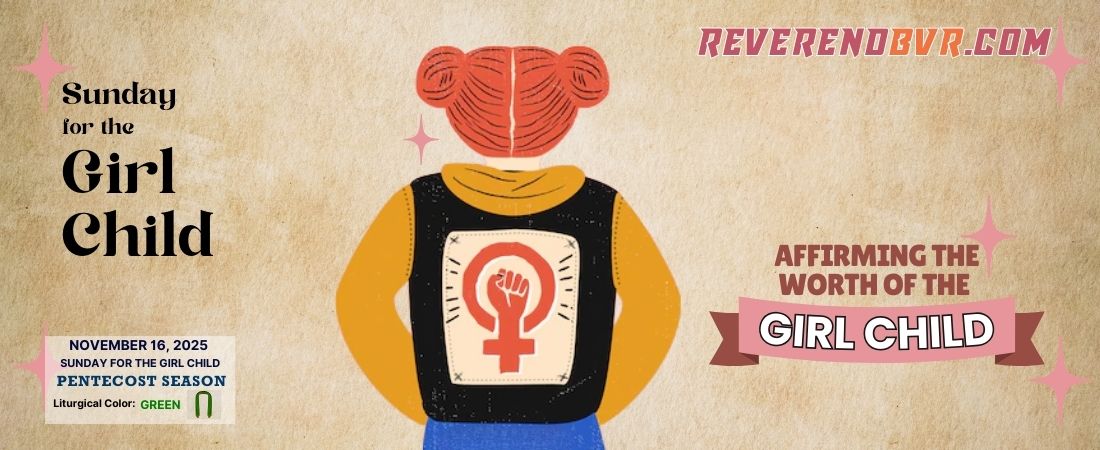
In a world that often overlooks the girl child, Scripture speaks with bold clarity—from the legal courage of Zelophehad’s daughters to Jesus’ tender call, “Talitha koum.” This sermon affirms the divine dignity, prophetic calling, and resurrection worth of every girl, urging the Church to echo heaven’s justice and compassion.
Sermon Title: Affirming the Worth of the Girl Child
Occasion: For the Occasion of the Sunday for the Girl Child – November 16, 2025.
Textual Foundations: Num. 27:1-11 | Ps. 71:1-12 | Acts 21:7-14 | Mk. 5:35-43.
Original Language Reflections (For deeper study, refer to the Table of Hebrew and Greek Terms in Section 3 of the sermon).
By Reverend B.V.R. Memorial Ministry | www.reverendbvr.com
1.Introduction
In a world that has too often devalued or dismissed the girl child, the Word of God speaks with timeless clarity, affirming her dignity, destiny, and divine calling. The Scriptures—from Torah to Gospel—are not silent on this matter. Rather, they testify, through law, poetry, prophecy, and history, to God’s justice, compassion, and revolutionary affirmation of every human being made in the imago Dei (image of God).
Today’s readings draw us into a sacred narrative arc—from Zelophehad’s daughters in the wilderness to Jairus’s daughter restored to life by the Messiah—revealing a biblical theology that boldly affirms the worth of girls in the eyes of the Creator. Let us now delve into this theme with academic rigor and pastoral warmth, seeking both theological clarity and practical wisdom.
I. The Courage of Zelophehad’s Daughters: A Legal Revolution (Numbers 27:1–11)
The story of Mahlah, Noah, Hoglah, Milkah, and Tirzah stands as one of the most pivotal legal precedents in the Hebrew Scriptures. At a time when inheritance laws (nahalah, נַחֲלָה) favored only sons, these five sisters stood courageously before Moses, Eleazar the priest, the leaders, and the whole assembly, demanding justice.
Their argument was not just emotional; it was theologically grounded: “Why should our father’s name disappear from his clan because he had no son?” (Num. 27:4)
Moses, rather than dismissing them, brought their plea before the Lord (YHWH, יְהוָ֗ה), who declared: “What Zelophehad’s daughters are saying is right.” (v. 7)
Theological Insight:
God’s affirmation of the daughters is a divine endorsement of justice, gender equality, and human dignity. It marks a shift in Israelite law, initiating the principle that women too could be bearers of legacy and covenant responsibility. This is not merely civil law; it is covenantal theology in action.
Application:
In every culture where the girl child is denied education, rights, or voice, the daughters of Zelophehad rise to remind us that the Kingdom of God upholds the cries of the marginalized and adjusts even established norms to reflect divine justice.
II. God’s Refuge and Confidence from Youth: A Liturgical Meditation (Psalm 71)
Psalm 71 is a poignant reflection by one who has known God’s faithfulness “from birth” (v. 6). Though not written specifically for or by a girl, the psalm echoes the voice of the vulnerable, pleading:
“In you, LORD, I have taken refuge; let me never be put to shame.” (v. 1)
Verses 5–6 are particularly important: “For you have been my hope, Sovereign LORD, my confidence since my youth. From birth I have relied on you; you brought me forth from my mother’s womb.”
Theological Insight:
The psalmist declares that divine relationship precedes societal identity. God relates to children—even girl children—before the world imposes worth or unworth upon them. This pre-natal intimacy demolishes patriarchal assumptions that value girls only after proving utility.
Application:
In a society where girls are often unwanted or devalued before birth, Psalm 71 declares a theology of divine preeminence and protection. The Church must become the place where every girl hears: “You are God’s child, loved and purposed from the womb.”
III. Four Daughters Who Prophesied: Spirit-Filled Witness (Acts 21:7–14)
Among the early church’s hidden heroines are the four unnamed daughters of Philip the evangelist. Luke tells us they were “unmarried” and that they “prophesied” (v. 9). This inclusion is deliberate and rare.
The Greek term prophēteuō (προφητεύω) implies active declaration of divine revelation. These daughters are not passive recipients but agents of the Holy Spirit (Pneuma Hagion, Πνεῦμα Ἅγιον).
Historical Context:
In a Greco-Roman world where women’s speech was often restricted, especially in religious contexts, these four daughters break cultural norms through Spirit-led proclamation.
Theological Insight:
Pentecost did not just empower apostles—it empowered daughters. This fulfillment of Joel 2:28 (“Your sons and daughters shall prophesy”) proves that the Holy Spirit is not a respecter of gender hierarchies.
Application:
Every girl child is potentially a prophetess in God’s Kingdom. The Church must not hinder but equip and encourage girls to listen, speak, and lead as Philip’s daughters once did.
IV. Jesus and the Girl: Resurrection and Worth (Mark 5:35–43)
The climax of our theme is found in Mark 5:35–43. Jairus, a synagogue leader, pleads for his dying daughter. When news arrives of her death, Jesus responds not with despair but faith:
“Don’t be afraid; just believe.” (v. 36)
He enters the house, silences mockery, and speaks two Aramaic words:
“Talitha koum!” (Ταλιθα κουμ)
“Little girl, I say to you, arise.”
Theological Insight:
This is not just a resurrection miracle; it is a public proclamation of the worth of a girl in the Kingdom of God. Jesus takes her hand—a tender, defiant act—and restores her to life, voice, and community.
Application:
“Talitha koum” is the Gospel’s call to every oppressed, trafficked, aborted, or abandoned girl: “Rise, beloved child of God.” May the Church echo Christ’s call, lifting girl children from death into dignity, from silence into speech.
V. Conclusion: A Call to Action
Affirming the worth of the girl child is not a social agenda—it is biblical justice. From the wilderness of Numbers to the household of Jairus, God’s Word affirms the dignity, voice, and calling of every girl. The Church, informed by Scripture and inspired by the Spirit, must become the loudest voice affirming:
- The legal rights of girls (Numbers 27),
- Their spiritual intimacy with God (Psalm 71),
- Their prophetic potential (Acts 21), and
- Their divine worth and resurrection power (Mark 5).
2. Closing Prayer
Gracious and Sovereign God, You formed each child in the secret place and called them by name. We thank You for the daughters of Zelophehad who stood for justice, for the psalmist who trusted You from the womb, for Philip’s daughters who prophesied, and for the little girl to whom Jesus said, “Talitha koum.” Empower us to be a Church that speaks life over every girl child— to fight for her rights, nurture her faith, affirm her calling, and raise her in the truth that she is fearfully and wonderfully made. May we proclaim with boldness: Every girl is a beloved image-bearer, a vessel of the Spirit, and a living testimony of Your redeeming love. In the name of Jesus Christ, who called daughters and sons alike, Amen.
3. Learn Words from the Original Scriptures (For deeper understanding and meditation on today’s theme)
| S.No | Word/Term | Language | Meaning/Usage in Context |
| 1 | נַחֲלָה (Nachalah) | Hebrew | Inheritance |
| 2 | צֶדֶק (Tzedek) | Hebrew | Righteousness |
| 3 | προφητεύω (propheteuō) | Greek | To prophesy. |
| 4 | παιδίον (paidion) | Greek | Little child |
| 5 | ταλιθα κουμ (Talitha koum) | Aramaic | “Little girl, arise |
| 6 | δικαιοσύνη (dikaiosynē) | Greek | Justice or righteousness |
| 7 | ἐλπίς (elpis) | Greek | Hope |
| 8 | κοράσιον (korasion) | Greek | Girl or maiden |
4. Bibliography
- Alter, Robert. The Five Books of Moses: A Translation with Commentary. W. W. Norton & Company, 2004.
- Bauckham, Richard. Gospel Women: Studies of the Named Women in the Gospels. Eerdmans, 2002.
- Berman, Joshua. Created Equal: How the Bible Broke with Ancient Political Thought. Oxford University Press, 2008.
- Keener, Craig S. Acts: An Exegetical Commentary. Baker Academic, 2012.
- Wright, N.T. Mark for Everyone. SPCK, 2001.
- Berlin, Adele, and Marc Zvi Brettler, eds. The Jewish Study Bible. Oxford University Press, 2004.
- Stendahl, Krister. The Bible and the Role of Women. Fortress Press, 1966.
© 2025 ReverendBVR.com | High-Academic Sermon Series, 2025.
Content licensed under Creative Commons Attribution-NonCommercial-NoDerivatives 4.0 International (CC BY-NC-ND 4.0). You are free to share — copy and redistribute the material in any medium or format with proper attribution. No commercial use or modifications allowed without explicit permission.
For further sermons and biblical reflections, please visit 🌐 www.reverendbvr.com/sermons
Leave a Reply